- Animals
- ›Chordates
- ›Vertebrates
- ›Mammals
- ›Therians
- ›Placental Mammals
- ›Primates, Rodents, and Allies
- ›Rodents
- ›Mice, Rats, and Hamsters
- ›Muroids
- ›Old World Mice and Rats
- ›Murines
- ›Australasian Mice and Rats
- ›Chrotomys
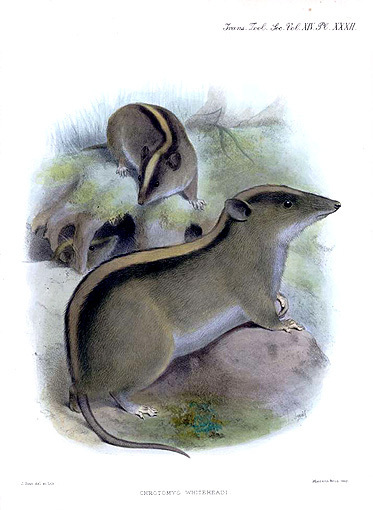
Montane Chrotomys
Chrotomys whiteheadi
The Luzon striped rat (Chrotomys whiteheadi) is a species of rodent in the family Muridae. It is found only in the Philippines. Its natural habitat is subtropical or tropical dry forests.
From the article Luzon striped rat on Wikipedia (CC BY-SA), quoted section by section
Description
Size of Mus rattus. Fur soft and thick, but not specially long. General colour greyish brown, tending in some specimens to rufous; a well-defined buff or orange line extending from between the eyes down the back nearly to the tail, shown up on each side by a broad shining black band. Under surface dull slaty buff, not sharply defined on the sides. Top of muzzle dark brown, continuous with the dark edgings to the central yellow band. Ears of medium length, fairly covered with minute hairs, uniformly blackish brown. Metapodials shining grey, digits nearly naked, whitish. Tail short, slender, about half the length of the head and body, thinly hairy, brownish black above, rather paler below, extreme tip whiteish. Skull in general form wedge-shaped. Nasals short, their anterior end level with the middle of the incisive fissure. Interorbital region similarly rounded and unridged. Brain case broader and shorter, so that its breadth is equal to its length. Interparietal very small, a mere narrow transverse slip. Anterior edge of zygomata quite straight, the plate little developed. Incisive fissure large, quite half as large as one of the palatal foramina, which are as usual in this group, very small. Posterior nares large and open, the hinder edge of the palate level with the posterior lamina of m². …
Range & habitat
The species is endemic to the Cordillera Central mountain range, Luzon, in the Philippines, and can be found at altitudes between 925 metres (3,035 ft) to 2,700 metres (8,900 ft). It is found in a wide variety of forested and near-forest habitats, and does well even in areas highly modified by humans such as gardens and rice fields. Like other species in the genus, it is partially fossorial. They feed primarily on earthworms and other insects. As earthworms and the golden apple snail, which the species also eats, are significant threats to rice cultivation in Luzon, methods of pest control involve trapping other rodent species such as the invasive tanezumi rat, but not the Luzon striped rats. The IUCN assesses the Luzon striped rat as a species of Least Concern due to its large range and population and ability to live in habitats partially disturbed by humans.
Wikipedia: “Distribution, ecology, and conservation”
Listen
Looking for field recordings…
Where it lives
Recorded sightings
—
geo-referenced records in GBIF, from museums, herbaria and field observers.
Drag the globe to turn it. Dots are where records exist, not a range map; darker means more records.
In the stacks
Searching the stacks…
Every page naming Chrotomys whiteheadi in the Biodiversity Heritage Library →
This page is assembled live from iNaturalist, GBIF, Wikipedia, the Source Library and the Internet Archive. It is not yet part of the hand-edited codex. iNaturalist taxon 45605.