- Animals
- ›Chordates
- ›Vertebrates
- ›Mammals
- ›Therians
- ›Placental Mammals
- ›Primates, Rodents, and Allies
- ›Rodents
- ›Mice, Rats, and Hamsters
- ›Muroids
- ›Old World Mice and Rats
- ›Gerbils
- ›Gerbillini
- ›Gerbillus
- ›Gerbillus
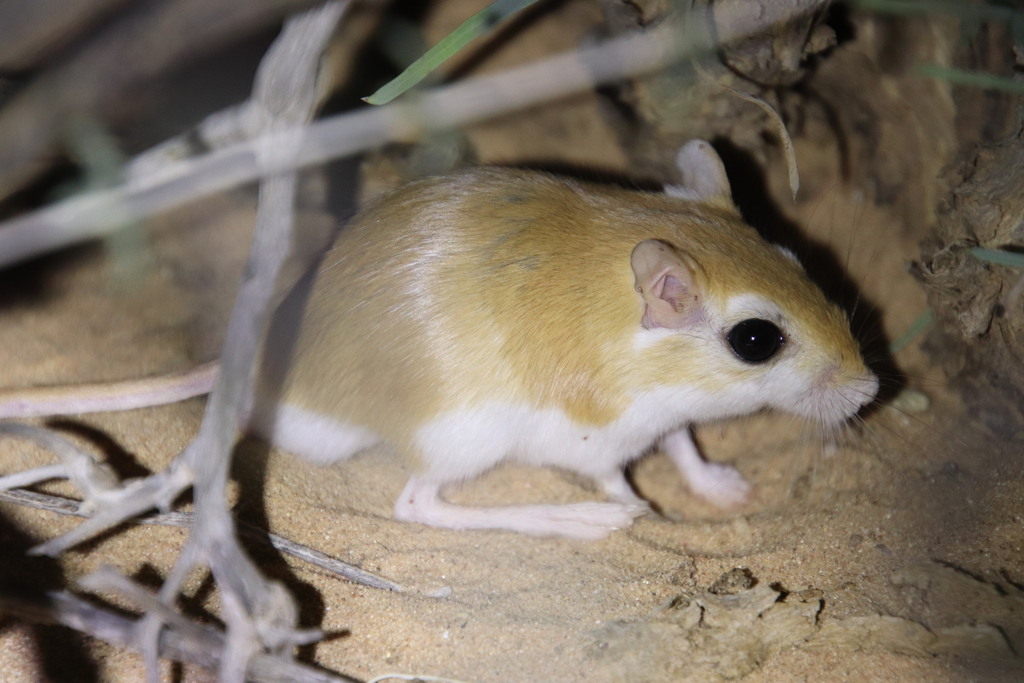
Riggenbach's Gerbil
Gerbillus tarabuli
Tarabul's gerbil (Gerbillus tarabuli) is a species of small rodent which is found in arid regions of north western Africa.
From the article Tarabul's gerbil on Wikipedia (CC BY-SA), quoted section by section
Description
Tarabul's gerbil is a small mouse like rodent with a long tail which ends in a tuft. It has tawny fur on the dorsal surface and white fur on its ventral surface which is clearly demarcated. The ears are plain with no black tips a white spot just behind them and the soles of its feet bear hair. The sympatric occidental gerbil Gerbillus occiduus has ears with black tips and no spot behind them. The head and body length averages 102.9 mm (4.05 in) and the tail length averages 148.4 mm (5.84 in).
Range & habitat
Tarabul's gerbil is found from northern Senegal, Mauritania, Western Sahara and Morocco east to Tibesti Mountains of Chad in the south and to Cyrenaica in eastern Libya in the north. The recently noted extension of its range into northern Senegal may be an indicator of increased desertification.
Wikipedia: “Distribution”
Listen
Looking for field recordings…
Where it lives
Recorded sightings
—
geo-referenced records in GBIF, from museums, herbaria and field observers.
Drag the globe to turn it. Dots are where records exist, not a range map; darker means more records.
In the stacks
Searching the stacks…
Every page naming Gerbillus tarabuli in the Biodiversity Heritage Library →
This page is assembled live from iNaturalist, GBIF, Wikipedia, the Source Library and the Internet Archive. It is not yet part of the hand-edited codex. iNaturalist taxon 44241.