- Animals
- ›Chordates
- ›Vertebrates
- ›Mammals
- ›Therians
- ›Placental Mammals
- ›Primates, Rodents, and Allies
- ›Rodents
- ›Mice, Rats, and Hamsters
- ›Muroids
- ›Old World Mice and Rats
- ›Gerbils
- ›Gerbillini
- ›Gerbillus
- ›Gerbillus
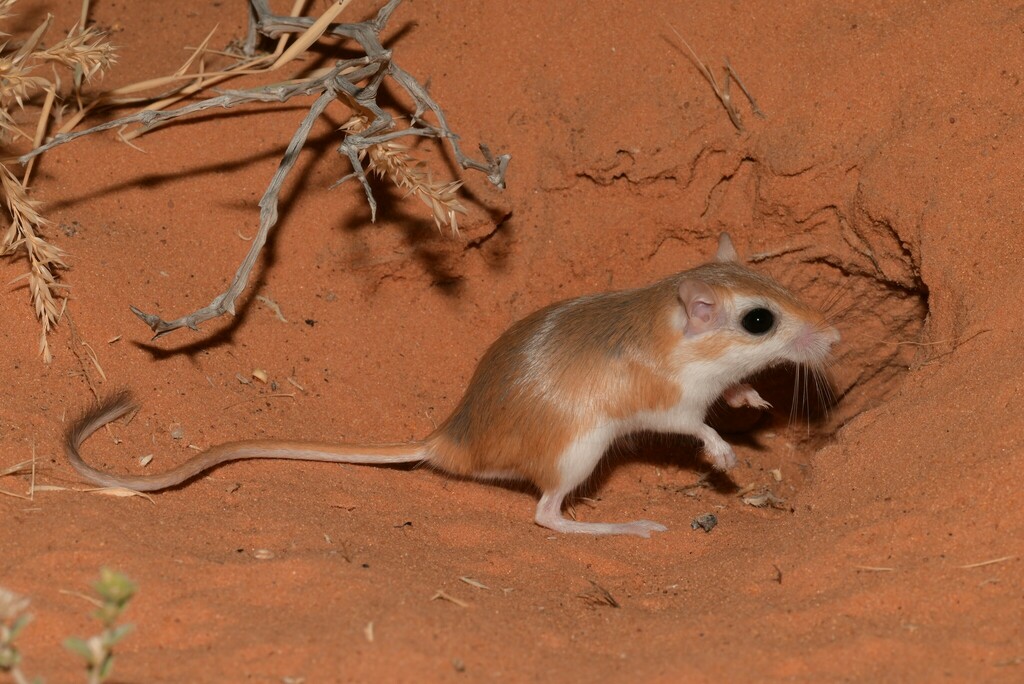
Cheesman's Gerbil
Gerbillus cheesmani
Cheesman's gerbil (Gerbillus cheesmani) is a small rodent in the subfamily Gerbillinae of the family Muridae. It is distributed mainly in Arabian Peninsula to southwestern Iran. It has orange-brown fur, white underparts, large eyes and a very long tail.
From the article Cheesman's gerbil on Wikipedia (CC BY-SA), quoted section by section
Description
This gerbil is similar in appearance to the lesser Egyptian gerbil (Gerbillus gerbillus) and Anderson's gerbil (Gerbillus andersoni). It has a head-and-body length of between 70 and 110 mm (2.8 and 4.3 in) and a tail of between 90 and 135 mm (3.5 and 5.3 in), and like them, the soles of the feet are hairy. The dorsal pelage is orange-brown and the underparts are white.
Range & habitat
Cheesman's gerbil is native to the Arabian Peninsula and the Middle East. Its range includes Saudi Arabia, United Arab Emirates, Oman, Yemen, Kuwait, Iraq, Iran, Syria and Jordan. Its natural habitat is arid plains with sandy soils, deserts and sabkha, flat coastal salt pans. it is often found in areas in which Haloxylon, Calligonum, Ephedra alata and Artemisia grow.
Wikipedia: “Distribution and habitat”
What it does
This is a nocturnal species, spending the heat of the day in a burrow and emerging at night to forage for seeds and grasses, although it may become omnivorous in some circumstances. The hair on the soles of the feet is one adaptation it has for running across sand, and it can also make long leaps. By feeding at night it is able to make use of the dew on plants and it can conserve moisture by producing dry faeces and very little urine. It carries damp vegetation to its burrow which raises the humidity level inside. The burrow entrance is often at the base of a shrubby plant, and the gerbil closes the entrance when it enters by flicking sand across with its tail. It is preyed on by predators such as owls, the Arabian red fox and Rüppell's fox.
Wikipedia: “Ecology”
Listen
Looking for field recordings…
Where it lives
Recorded sightings
—
geo-referenced records in GBIF, from museums, herbaria and field observers.
Drag the globe to turn it. Dots are where records exist, not a range map; darker means more records.
In the stacks
Searching the stacks…
Every page naming Gerbillus cheesmani in the Biodiversity Heritage Library →
This page is assembled live from iNaturalist, GBIF, Wikipedia, the Source Library and the Internet Archive. It is not yet part of the hand-edited codex. iNaturalist taxon 44189.