- Animals
- ›Chordates
- ›Vertebrates
- ›Mammals
- ›Therians
- ›Placental Mammals
- ›Primates, Rodents, and Allies
- ›Rodents
- ›Ctenohystricans
- ›Hystricognaths
- ›Cane Rats
- ›Thryonomys
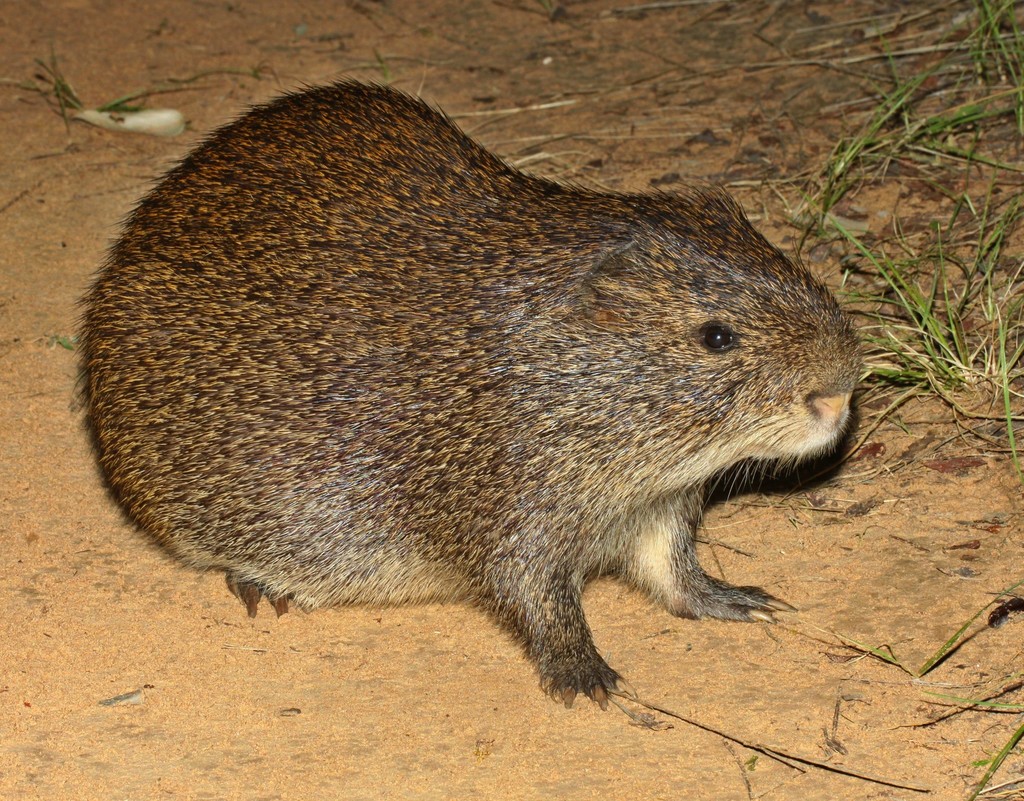
Greater Cane Rat
Thryonomys swinderianus
The greater cane rat (Thryonomys swinderianus) is one of two species of cane rats, a small family of African hystricognath rodents. The cane rat lives by reed-beds and riverbanks in Sub-Saharan Africa. Cane rats can grow to nearly 2 ft (0.61 m) in length and weigh a little less than 19 lb (8.6 kg). It has rounded ears, a short nose, and coarse bristly hair. Its forefeet are smaller than its hind feet, each with three toes.
From the article Greater cane rat on Wikipedia (CC BY-SA), quoted section by section
Description
Greater cane rats can measure in head-and-body length from 43 to 60 cm (17 to 24 in) with the tail measuring 16 to 19.5 cm (6.3 to 7.7 in). Typical weight is 3.2 to 5.2 kg (7.1 to 11.5 lb), in males averaging some 4.5 kg (9.9 lb), and females at 3.4 to 3.8 kg (7.5 to 8.4 lb). In some cases, greater cane rats can weigh to approximately 7 to 9 kg (15 to 20 lb). They are considered one of the largest rodents in Africa, behind only the Hystrix porcupines. It has rounded ears, a short nose, and coarse bristly hair. Its forefeet are smaller than its hind feet, each with three toes.
What it does
Cane rats are largely independent and they live in vaguely linked groups. Foraging is done alone. They are nocturnal and make nests from grasses or burrow underground. The typically reside near bodies of water, reed-beds, and thick vegetation. Individuals of the species may live in excess of four years. If frightened, they grunt and run towards water.
Wikipedia: “Behaviour”
Listen
Looking for field recordings…
Where it lives
Recorded sightings
—
geo-referenced records in GBIF, from museums, herbaria and field observers.
Drag the globe to turn it. Dots are where records exist, not a range map; darker means more records.
In the stacks
Searching the stacks…
Every page naming Thryonomys swinderianus in the Biodiversity Heritage Library →
This page is assembled live from iNaturalist, GBIF, Wikipedia, the Source Library and the Internet Archive. It is not yet part of the hand-edited codex. iNaturalist taxon 46279.