- Animals
- ›Chordates
- ›Vertebrates
- ›Mammals
- ›Therians
- ›Placental Mammals
- ›Primates, Rodents, and Allies
- ›Rodents
- ›Ctenohystricans
- ›Hystricognaths
- ›Cavies, Agoutis, and Pacas
- ›Agoutis and Acouchis
- ›Dasyprocta
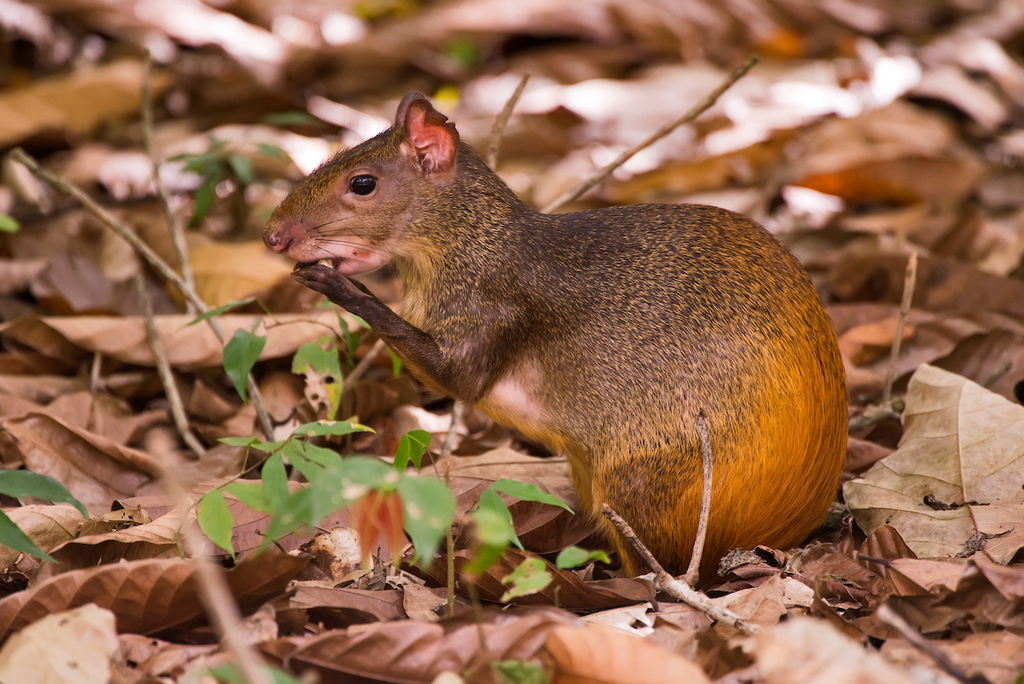
Red-rumped Agouti
Dasyprocta leporina
The red-rumped agouti (Dasyprocta leporina), also known as the golden-rumped agouti, orange-rumped agouti or Brazilian agouti, is a species of agouti from the family Dasyproctidae. It is native to northeastern South America, where found in Venezuela, Guyana, Suriname, French Guiana, northeastern Brazil, Trinidad and Tobago and Lesser Antilles. It has also been introduced to the Virgin Islands. Despite the alternative name Brazilian agouti, it is neither the only nor the most widespread species of agouti in...
From the article Red-rumped agouti on Wikipedia (CC BY-SA), quoted section by section
Description
The red-rumped agouti weighs about 3 to 6 kilograms (6.6 to 13.2 lb). It is about 48 to 64 cm (19 to 25 in) long. The females are larger than males but otherwise look similar. It is brownish with darker spots on the upper body. The fur becomes more orange as it goes past (going down) the middle area of the animal. The ears are somewhat square in shape. The front feet have four toes and the back have three each. It can be distinguished from other agoutis by their distinct coloring. It has no distinct breeding season, but females come into season twice a year and generally have one to four young. The gestation period is 104 to 120 days. On average, it takes 20 weeks for the young to be weaned. It lives in pairs or family groups of the parents and babies. It needs large areas for food, breeding, and territory; because of this, keeping it in captivity is difficult. It lives 15-20 yrs in captivity.
Range & habitat
It is native to northeastern South America, mainly in Venezuela, Guyana, Suriname, French Guiana, northeastern Brazil, Trinidad and Tobago and Saint Lucia in the Caribbean. It has also been introduced to Florida, the U.S. Virgin Islands, Grenada, and Dominica.
Wikipedia: “Distribution”
What it does
Food mostly consists of seeds, pulp, leaves, roots and fruits. It also feeds on insect larvae when plant resources are low. It is known to feed on and disperse Astrocaryum aculeatissimum seeds, as well as Hymenaea courbaril seeds.
Wikipedia: “Diet”
Listen
Looking for field recordings…
Where it lives
Recorded sightings
—
geo-referenced records in GBIF, from museums, herbaria and field observers.
Drag the globe to turn it. Dots are where records exist, not a range map; darker means more records.
In the stacks
Searching the stacks…
Every page naming Dasyprocta leporina in the Biodiversity Heritage Library →
This page is assembled live from iNaturalist, GBIF, Wikipedia, the Source Library and the Internet Archive. It is not yet part of the hand-edited codex. iNaturalist taxon 852338.