- Animals
- ›Chordates
- ›Vertebrates
- ›Mammals
- ›Therians
- ›Placental Mammals
- ›Primates, Rodents, and Allies
- ›Rodents
- ›Squirrels, Dormice, and Mountain Beavers
- ›Squirrels
- ›Typical and Flying Squirrels
- ›Flying Squirrels
- ›Trogopterus
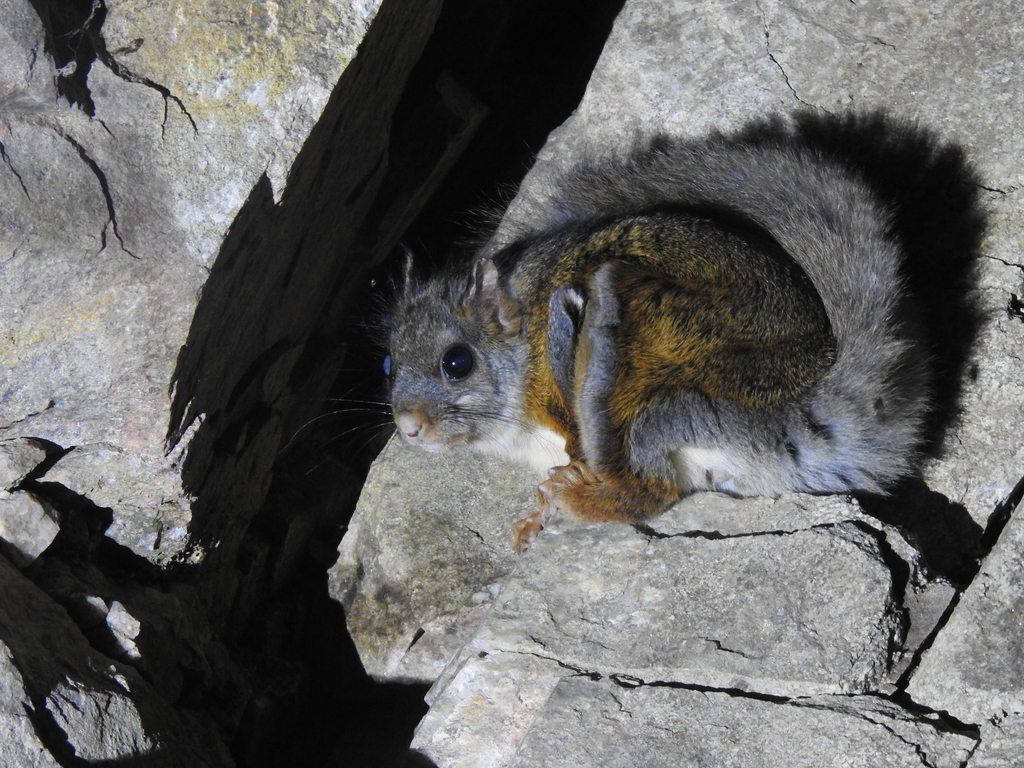
Complex-toothed Flying Squirrel
Trogopterus xanthipes
The complex-toothed flying squirrel (Trogopterus xanthipes) occurs in the southern Chinese provinces Hubei, Hunan, Guizhou, Sichuan, and Yunnan. The common name refers to the teeth, which differ from those of other species of flying squirrels.
From the article Complex-toothed flying squirrel on Wikipedia (CC BY-SA), quoted section by section
Description
Trogopterus xanthipes looks much like other flying squirrels, but with a characteristic tuft of black hair below the base of the ear. The fur is generally grey-brown, but white beneath. There is a slight reddish tinge to the face and the tail. The overall length is about 60 cm, of which the tail is about half.
What it does
Trogopterus xanthipes builds its nests in cliffs, usually around 30 m above the ground. They live in mountainous terrain in altitudes of 1300 to 1500 m above sea level, or even up to 2750 m according to some sources. Their activity pattern is nocturnal; they leave their nests at night to search for food, such as nuts, fruits, and leaves. They become sexually mature at about 22 months. A litter may comprise up to four young, and gestation lasts for roughly 80 to 90 days. Captive specimens have been reported to live for ten to twelve years.
Wikipedia: “Biology and reproduction”
In medicine
The species is collected as a meat animal, and also is captured for collection of the fecal matter, which is valued in traditional Chinese medicine as "five spirits grease" (五靈脂, wǔ líng zhī). It is used in the treatment of ulcers in the duodenum. Recent research has attempted to establish whether the fecal matter includes components of possible medical interest. Antithrombotic flavonoids have been reported. Various diterpenoids, both known and unknown, have been evaluated for cytotoxicity against human tumor cell lines, and so have various neolignans classed as trogopterins. Although none of the compounds showed clinically significant activity against important tumor cell lines, some did produce detectable cytotoxic effects, suggesting a source of lignans with cytotoxic activity.
== References ==
Wikipedia: “Medical and commercial interest”
Listen
Looking for field recordings…
Where it lives
Recorded sightings
—
geo-referenced records in GBIF, from museums, herbaria and field observers.
Drag the globe to turn it. Dots are where records exist, not a range map; darker means more records.
In the stacks
Searching the stacks…
Every page naming Trogopterus xanthipes in the Biodiversity Heritage Library →
This page is assembled live from iNaturalist, GBIF, Wikipedia, the Source Library and the Internet Archive. It is not yet part of the hand-edited codex. iNaturalist taxon 46142.