- Animals
- ›Chordates
- ›Vertebrates
- ›Mammals
- ›Therians
- ›Placental Mammals
- ›Primates, Rodents, and Allies
- ›Rodents
- ›Squirrels, Dormice, and Mountain Beavers
- ›Squirrels
- ›Ground and African Tree Squirrels
- ›African Tree Squirrels
- ›Paraxerus
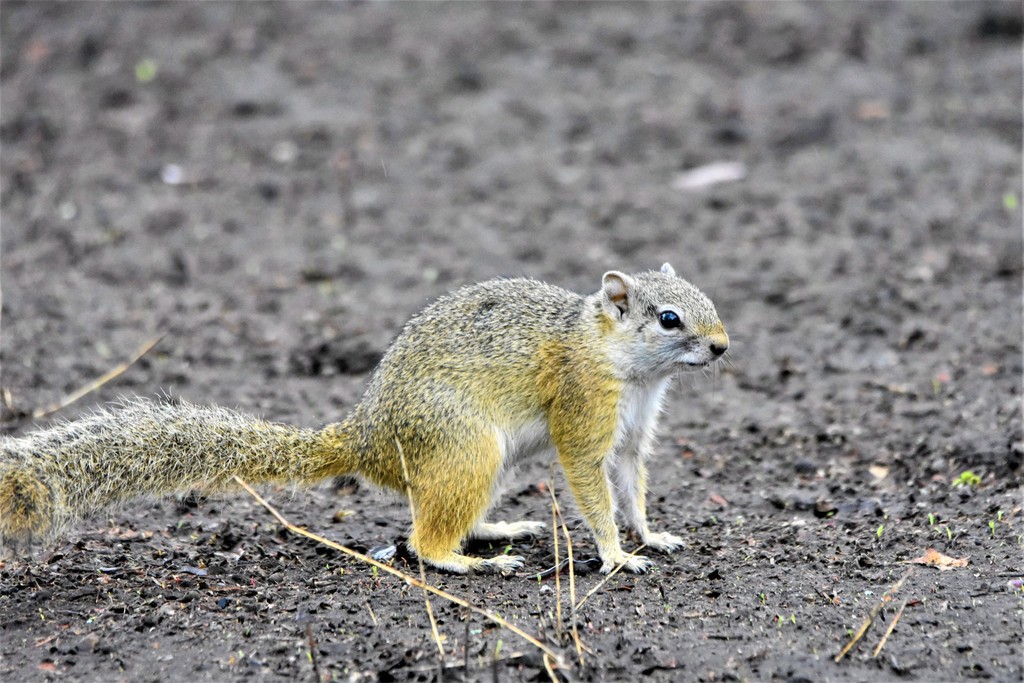
Smith's Bush Squirrel
Paraxerus cepapi
Smith's bush squirrel, the yellow-footed squirrel, or the tree squirrel in South Africa, Paraxerus cepapi, is an African bush squirrel found in Angola, Botswana, the Democratic Republic of the Congo, Malawi, Mozambique, Namibia, South Africa, Tanzania, Zambia, and Zimbabwe. It is a common rodent which is diurnal by nature.
From the article Smith's bush squirrel on Wikipedia (CC BY-SA), quoted section by section
Description
Its total length is 350 mm (14 in), half of which is tail; weight 200 g (7.1 oz). The coat colour varies throughout the region. In the western and arid parts of its range, it is pale grey, and in the eastern localities, more brown. Its head and legs are a rusty colour. Colouration on the chest varies from yellowish to buff in the east, to white in the west. This squirrel's belly is white. These alert and ever busy creatures carry their long tails extended backwards.
Wikipedia: “Appearance”
Range & habitat
It is found in Angola, Botswana, the DRCongo, Malawi, Mozambique, Namibia, South Africa, Tanzania, Zambia, and Zimbabwe. It is a common rodent which is diurnal by nature.
Wikipedia: “Range”
What it does
Smith's bush squirrels are primarily vegetarian, but like most rodents, they take insect prey and use their front feet to manipulate food items when feeding. They scatter-hoard seeds next to tree trunks or grass tufts, thereby facilitating tree regeneration.
Wikipedia: “Diet”
Listen
Looking for field recordings…
Where it lives
Recorded sightings
—
geo-referenced records in GBIF, from museums, herbaria and field observers.
Drag the globe to turn it. Dots are where records exist, not a range map; darker means more records.
In the stacks
Searching the stacks…
Every page naming Paraxerus cepapi in the Biodiversity Heritage Library →
This page is assembled live from iNaturalist, GBIF, Wikipedia, the Source Library and the Internet Archive. It is not yet part of the hand-edited codex. iNaturalist taxon 46110.