- Animals
- ›Chordates
- ›Vertebrates
- ›Mammals
- ›Therians
- ›Placental Mammals
- ›Primates, Rodents, and Allies
- ›Rodents
- ›Squirrels, Dormice, and Mountain Beavers
- ›Squirrels
- ›Typical and Flying Squirrels
- ›Typical Squirrels
- ›Tamiasciurus
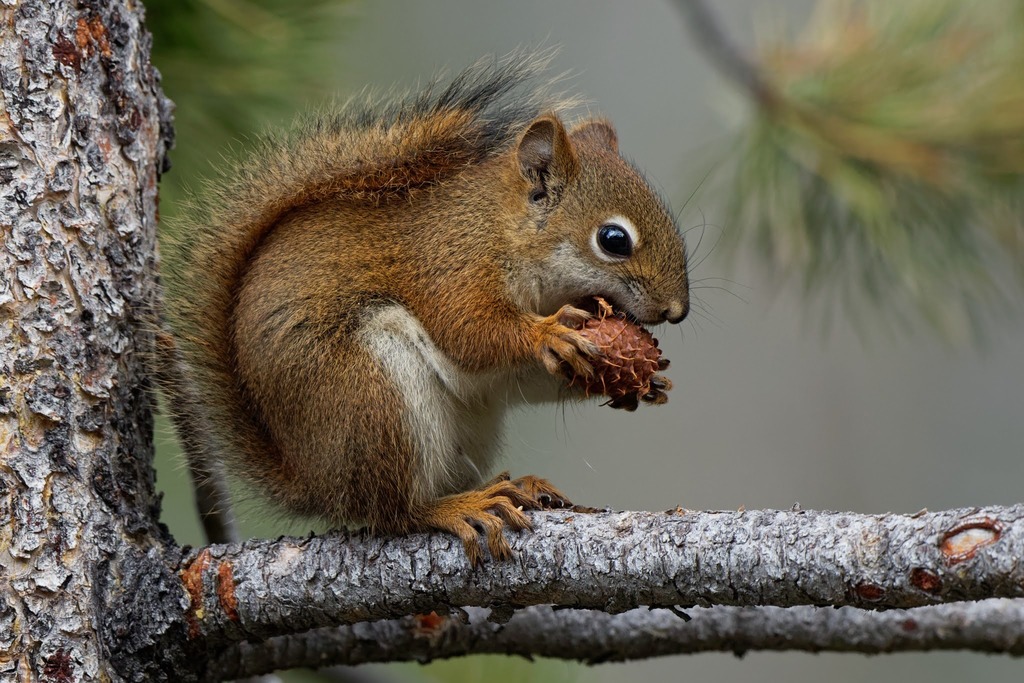
American Red Squirrel
Tamiasciurus hudsonicus
The American red squirrel (Tamiasciurus hudsonicus) is one of three species of tree squirrels currently classified in the genus Tamiasciurus, known as the pine squirrels (the others are the Douglas squirrel, T. douglasii, and the southwestern red squirrel, T. fremonti). The American red squirrel is variously known as the pine squirrel or piney squirrel, North American red squirrel, chickaree, boomer, or simply red squirrel. The squirrel is a small, 200–250 g (7.1–8.8 oz), diurnal mammal that defends a year-round exclusive territory. It feeds primarily on the seeds of conifer cones, and is widely distributed across much of the United States and Canada wherever conifers are common, except in the southwestern United States, where it is replaced by the formerly conspecific southwestern red squirrel, and along the Pacific coast of the United States, where its cousin the Douglas squirrel is found instead.
The squirrel has been expanding its range into hardwood forests.
From the article American red squirrel on Wikipedia (CC BY-SA), quoted section by section
Description
Red squirrels can be easily distinguished from other North American tree squirrels by their smaller size, 28–35 cm (11–14 in) total length (including tail), territorial behavior, and reddish fur with a white venter (underbelly). Red squirrels are somewhat larger than chipmunks. The Douglas squirrel is morphologically similar to the American red squirrels, but has a rust-colored venter and is restricted to the southwestern coast of British Columbia and in the Pacific Northwest of the United States. The ranges of the American red squirrel and the Douglas squirrel overlap in southern British Columbia, northwestern Washington and eastern Oregon.
Range & habitat
American red squirrels are widely distributed across the North American continent. Their range includes: most of Canada, excluding northern areas with no tree cover and the southwestern coast of British Columbia; the southern half of Alaska; the Rocky Mountains area of the United States, and northern half of the eastern United States. In Alberta, where the species is associated with mature white spruce or conifer-dominated forests, it has been detected in all of the province's natural regions. American red squirrels are abundant and not of conservation concern throughout much of their range. American red squirrels were introduced on Newfoundland and have lived there in abundance for decades. The endangered subspecies T. h. grahamensis, found only on Mt. Graham, Arizona, was formerly considered a member of this species, but is now considered a subspecies of the southwestern red squirrel (Tamiasciurus fremonti). The American red squirrel population on Vancouver Island is geographically and genetically unusual. Nuclear DNA places it within T. hudsonicus, while its mitochondrial DNA groups with the Douglas squirrel, a conflict attributed to historical hybridization, with gene flow having occurred between the island population and both mainland species. …
Wikipedia: “Distribution”
What it does
American red squirrels are primarily granivores, but incorporate other food items into their diets opportunistically. In the Yukon, extensive behavioral observations suggest white spruce seeds (Picea glauca) comprise more than 50% of a red squirrel's diet, but squirrels have also been observed eating spruce buds and needles, mushrooms, willow (Salix sp.) leaves, poplar (Populus sp.) buds and catkins, bearberry (Arctostaphylos sp.) flowers and berries, and animal material such as bird eggs or even snowshoe hare leverets (young). White spruce cones mature in late July and are harvested by red squirrels in August and September. These harvested cones are stored in a central cache and provide energy and nutrients for survival over the winter and reproduction the following spring. The fallen scales from consumed seed cones can collect in piles, called middens, up to 12 meters (39 feet) across. White spruce exhibits two- to six-year masting cycles, where a year of superabundant cone production (mast year) is followed by several years in which few cones are produced. …
Wikipedia: “Feeding”
Listen
Looking for field recordings…
Where it lives
Recorded sightings
—
geo-referenced records in GBIF, from museums, herbaria and field observers.
Drag the globe to turn it. Dots are where records exist, not a range map; darker means more records.
In the stacks
Searching the stacks…
Every page naming Tamiasciurus hudsonicus in the Biodiversity Heritage Library →
This page is assembled live from iNaturalist, GBIF, Wikipedia, the Source Library and the Internet Archive. It is not yet part of the hand-edited codex. iNaturalist taxon 46260.