- Animals
- ›Chordates
- ›Vertebrates
- ›Mammals
- ›Therians
- ›Placental Mammals
- ›Primates, Rodents, and Allies
- ›Rodents
- ›Squirrels, Dormice, and Mountain Beavers
- ›Squirrels
- ›Typical and Flying Squirrels
- ›Flying Squirrels
- ›Pteromys
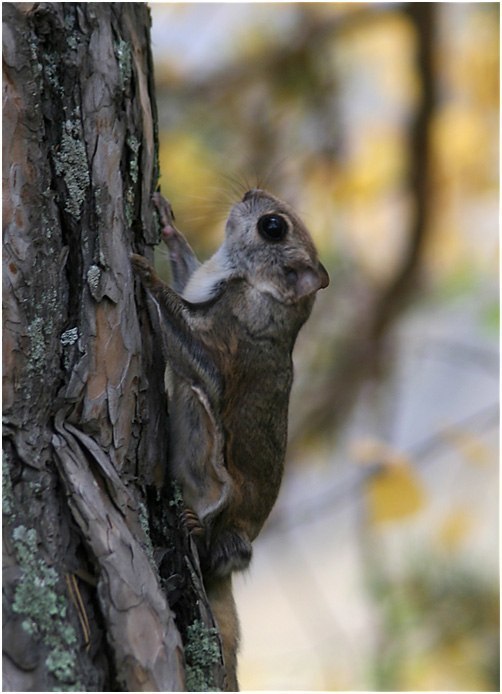
Siberian Flying Squirrel
Pteromys volans
The Siberian flying squirrel (Pteromys volans) is an Old World flying squirrel ranging from the Baltic Sea in the west, throughout Northern Asia to the coast of the Pacific Ocean in the east. It is the only species of flying squirrel in Europe and is considered vulnerable in the European Union where it occurs only in Estonia and Finland. In Latvia, it was last sighted in 2001 and has been considered to be locally extinct since 2013.
From the article Siberian flying squirrel on Wikipedia (CC BY-SA), quoted section by section
Description
A female Siberian flying squirrel weighs about 150 g (5.3 oz), the males being slightly smaller on average. The body is 13–20 cm (5.1–7.9 in) long, with a 9–14 cm (3.5–5.5 in) long flattened tail. The eyes are large and strikingly black. The coat is grey all over, the abdomen being slightly lighter than the back, with a black stripe between the neck and the forelimb. A distinctive feature of flying squirrels is the furry glide membrane or patagium, a flap of skin that stretches between the front and rear legs. By spreading this membrane the flying squirrel may glide from tree to tree across distances of over a hundred meters, and have been known to record a glide ratio of 3.31, but is normally 1-1.5.
Range & habitat
The nominate subspecies, P. v. volans is widespread across the Palearctic realm, specifically in Northern Europe, Siberia and East Asia, while other subspecies have limited distribution, with P. v. athene in Sakhalin, P. v. buechneri in China and P. v. orii in Hokkaido.
Wikipedia: “Distribution and habitat”
What it does
They mate early in the spring. In southern Finland the first mating season begins in late March, with a second mating season occurring in April. After a gestation period of five weeks, the female gives birth to a litter of usually two or three young, each weighing about 5 grams.
Wikipedia: “Reproduction”
In human culture
It is the emblem of Nuuksio National Park in Espoo municipality of Finland due to the density of the population in this region. In Estonia, the Siberian flying squirrel is depicted on the logo of the Estonian Nature Fund.
Listen
Looking for field recordings…
Where it lives
Recorded sightings
—
geo-referenced records in GBIF, from museums, herbaria and field observers.
Drag the globe to turn it. Dots are where records exist, not a range map; darker means more records.
In the stacks
Searching the stacks…
Every page naming Pteromys volans in the Biodiversity Heritage Library →
This page is assembled live from iNaturalist, GBIF, Wikipedia, the Source Library and the Internet Archive. It is not yet part of the hand-edited codex. iNaturalist taxon 46146.