- Animals
- ›Chordates
- ›Vertebrates
- ›Mammals
- ›Therians
- ›Placental Mammals
- ›Ungulates, Carnivorans, and Allies
- ›Bats
- ›Yinpterochiroptera
- ›Pteropodoidea
- ›Old World Fruit Bats
- ›Rousettinae
- ›Epomophorini
- ›Hypsignathus
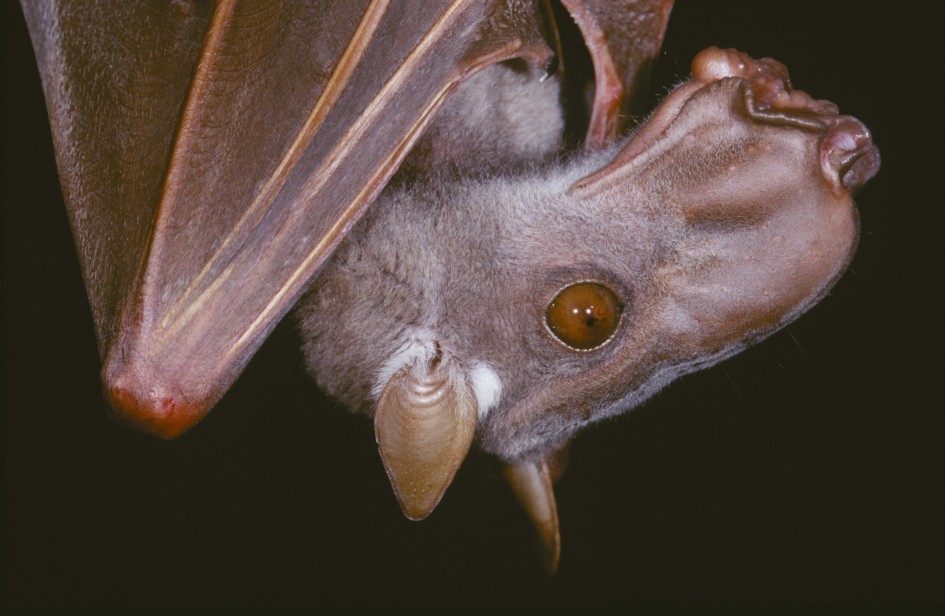
Hammer-headed Fruit Bat
Hypsignathus monstrosus
The hammer-headed bat (Hypsignathus monstrosus), also known as hammer-headed fruit bat, big-lipped bat, and hammerhead bat, is a megabat widely distributed in West and Central Africa. It is the only member of the genus Hypsignathus, which is part of the tribe Epomophorini along with four other genera. It is the largest bat in continental Africa, with wingspans approaching 1 m (3.3 ft), and males are almost twice as heavy as females. Males and females also greatly differ in appearance, making it the most sexually dimorphic bat species in the world. These differences include several adaptations that help males produce and amplify their voice; the males' larynges (vocal cords) are about three times as large as those of females, and they have large resonating chambers on their faces. Females appear more like a typical megabat, with fox-like faces.
The hammer-headed bat is frugivorous, consuming a variety of fruit such as figs, bananas, and mangoes, though a few instances of carnivory have been noted. Females tend to travel a consistent route to find predictable fruit supplies, whereas males travel more to find the highest quality fruit. It forages at night, sleeping during the day in tree roosts. Individuals may roost alone or in small groups. Unlike many other bat species that segregate based on sex, males and females will roost together during the day. It has two mating seasons each year during the dry seasons.
From the article Hammer-headed bat on Wikipedia (CC BY-SA), quoted section by section
Description
The hammer-headed bat is the largest bat in mainland Africa. Males have wingspans up to 90.1 cm (2.96 ft), and all individuals have forearm lengths exceeding 112 mm (4.4 in). It has pronounced sexual dimorphism, more so than any other bat species in the world, with males up to twice as heavy as females. The average weight of males is 420 g (15 oz), compared to 234 g (8.3 oz) for females. Other differences between the sexes relate to their social system, in which males produce loud, honking calls. Therefore, males have greatly enlarged larynges, about three times the size of females', extending through most of the thoracic cavity, and measuring half the length of the spine. The larynx is so large, it displaces other organs, including the heart, lungs, and gastrointestinal tract. Males also have resonating chambers to increase the volume of sound production. These chambers are pharyngeal air sacs connected to a large sinus in the humped snout. These numerous adaptations caused scientists Herbert Lang and James Chapin to remark, "In no other mammal is everything so entirely subordinated to the organs of voice". Males overall have boxy heads with enormous lips, while the females, with their narrower snouts, have more foxlike faces. Males and females both have dark brown fur, with a paler mantle (sides and back of neck). …
Range & habitat
The hammer-headed bat is a lowland species, always occurring below 1,800 m (5,900 ft) above sea level. Most records of this species occur in rainforest habitat, including lowland rainforest, swamp forest, riverine forests, and mosaics of forest and grassland. While it has been documented in savanna habitats, these records are rare, and it has been speculated that these individuals are vagrants. It has a wide range in West and Central Africa, including the following countries: Angola, Benin, Burkina Faso, Cameroon, Central African Republic, Republic of the Congo, Democratic Republic of the Congo, Ivory Coast, Equatorial Guinea, Ethiopia, Gabon, Ghana, Guinea, Guinea-Bissau, Kenya, Liberia, Nigeria, Sierra Leone, Sudan, Togo, and Uganda.
Wikipedia: “Distribution and habitat”
What it does
Hammer-headed bats are frugivores. Figs make up much of their diet, but they may also eat mangos, bananas and guavas. There are some complications inherent in a fruit diet such as insufficient protein intake; it is suggested that fruit bats compensate for this by possessing a proportionally longer intestine than insectivorous species. Males and females rely on different strategies for foraging. Females use trap-lining, in which they travel an established route with dependable and predictable food sources, even if the food is lower quality. Males, in contrast, search for areas rich with food, traveling up to 10 km (6.2 mi) to reach particularly good food patches. Upon finding suitable fruit, the hammer-headed bat may eat at the tree or pick the fruit and carry it away to another site for consumption. It chews the fruit, swallowing the juice and soft pulp, before spitting out the rest. The guano (faeces) typically contains seeds from ingested fruit, indicating that it may be an important seed disperser. Van Deusan (1968) reports H. monstrosus showing some carnivorous behaviour by attacking chickens to drink their blood, and scavenging for meat.
Wikipedia: “Diet and foraging”
At the table
As a frugivorous species, the hammer-headed bat is sometimes considered a pest of fruit crops. Its ability to produce extremely loud calls means that some consider it one of Africa's most significant nocturnal pests. Humans hunt this large bat to eat it. It is eaten in Nigeria, as well as seasonally in the Democratic Republic of the Congo.
Wikipedia: “As pests and food”
In human culture
The hammer-headed bat was described as a new species in 1861 by American scientist Harrison Allen. Allen placed the species into a newly-created genus, Hypsignathus. The holotype had been collected by French-American zoologist Paul Du Chaillu in Gabon. The genus name Hypsignathus comes from the Ancient Greek ὕψος (húpsos, 'high'), and γνάθος (gnáthos, 'jaw'). T. S. Palmer speculated that Allen chose the name Hypsignathus to allude to the "deeply arched mouth" of the species. The species name monstrosus is Latin for "having the qualities of a monster". A 2011 study found that Hypsignathus was the most basal member of the tribe Epomophorini, which also includes Epomops, Micropteropus, Epomophorus, and Nanonycteris. Initially, Allen identified the hammer-headed bat as a member of the subfamily Pteropodinae of the megabats. However, in 1997, Epomophorini was recognised as part of the subfamily Epomophorinae. Some taxonomists do not recognise Epomophorinae as a valid subfamily and include its taxa, including the Epomophorini, within Rousettinae.
Wikipedia: “Taxonomy and etymology”
Listen
Looking for field recordings…
Where it lives
Recorded sightings
—
geo-referenced records in GBIF, from museums, herbaria and field observers.
Drag the globe to turn it. Dots are where records exist, not a range map; darker means more records.
In the stacks
Searching the stacks…
Every page naming Hypsignathus monstrosus in the Biodiversity Heritage Library →
This page is assembled live from iNaturalist, GBIF, Wikipedia, the Source Library and the Internet Archive. It is not yet part of the hand-edited codex. iNaturalist taxon 40843.