- Animals
- ›Chordates
- ›Vertebrates
- ›Mammals
- ›Therians
- ›Placental Mammals
- ›Ungulates, Carnivorans, and Allies
- ›Bats
- ›Yinpterochiroptera
- ›Pteropodoidea
- ›Old World Fruit Bats
- ›Harpy and Naked-backed Fruit Bats
- ›Harpy Fruit Bats and allies
- ›Harpyionycteris
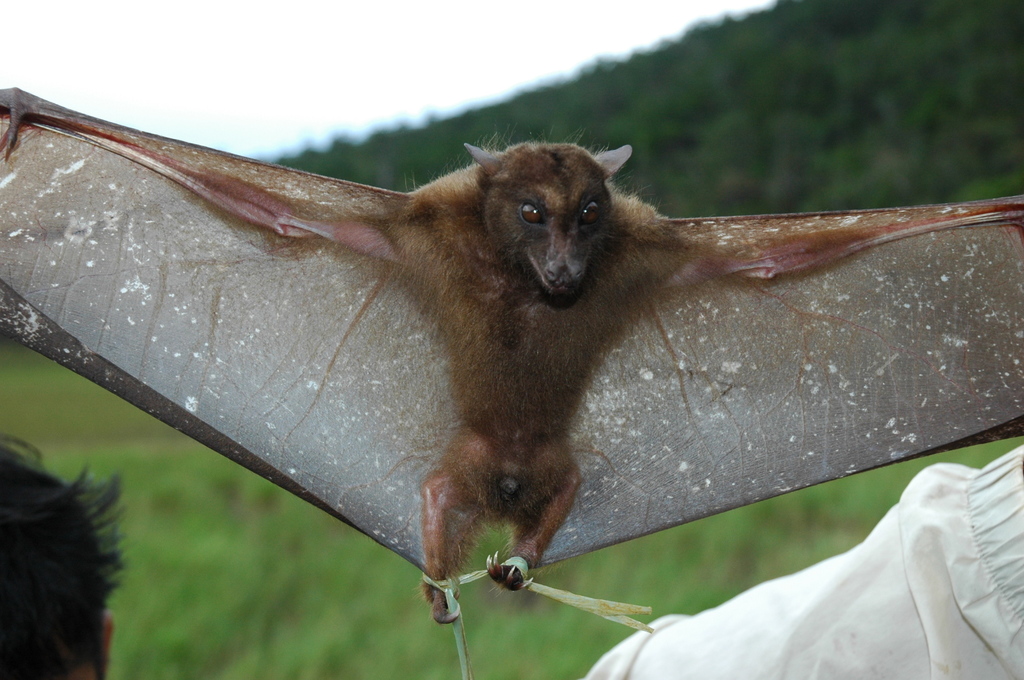
Harpy Fruit Bat
Harpyionycteris whiteheadi
The harpy fruit bat (Harpyionycteris whiteheadi) is a species of megabat in the family Pteropodidae. It is endemic to the Philippines.
From the article Harpy fruit bat on Wikipedia (CC BY-SA), quoted section by section
Description
The harpy fruit bat is two-tone in color, being mostly dark brown and lighter brown on its underside. It has no tail but does have a small, fur-covered uropatagium. Its overall length is 140–153 mm (5.5–6.0 in). Its canines, premaxillary bones, and upper incisors lean forward causing the upper and lower canines to cross forming nearly right angles when the mouth is closed. The molars are multicuspidate having five or six cusps on each. The lower canines have three cusps (tricuspidate). They weigh 83–142 g (2.9–5.0 oz).
Range & habitat
Harpy fruit bats are found on the Philippine islands of Biliran, Maripipi, Camiguin, Leyte, Southern Luzon, Mindanao, Mindoro, Negros, Cebu, Masbate, and Samar. They reside in primary (old growth), secondary, and lightly disturbed montane forests. Their range in elevation is between sea level and 1,800m, preferring to stay in habitats of "mid-elevation (around 500m)". As with other fruit bats, harpy fruit bats are crepuscular and "roost in trees" instead of caves.
Wikipedia: “Habitat and range”
What it does
The harpy fruit bat is frugivorous and eats from the viney pandans and some fig species. The excretion of seeds in the bat's guano helps with the dispersal of these plant species.
Wikipedia: “Diet”
In human culture
It was described as a new species in 1896 by British zoologist Oldfield Thomas. The specimens that he examined in Britain had been collected by English explorer John Whitehead, after whom the species name whiteheadi was chosen. Of Whitehead, Thomas wrote "Mr. Whitehead is to be congratulated on this interesting addition to the splendid discoveries he has already made in the Philippine Islands." The holotype was collected by Whitehead in December 1895 on the island of Mindoro at an elevation of 5,000 ft (1,500 m). Thomas created the genus Harpyionycteris for this species, and it was the only species in this genus until the description of the Sulawesi harpy fruit bat in 1921.
Wikipedia: “Taxonomy and etymology”
Listen
Looking for field recordings…
Where it lives
Recorded sightings
—
geo-referenced records in GBIF, from museums, herbaria and field observers.
Drag the globe to turn it. Dots are where records exist, not a range map; darker means more records.
In the stacks
Searching the stacks…
Every page naming Harpyionycteris whiteheadi in the Biodiversity Heritage Library →
This page is assembled live from iNaturalist, GBIF, Wikipedia, the Source Library and the Internet Archive. It is not yet part of the hand-edited codex. iNaturalist taxon 40788.