- Animals
- ›Chordates
- ›Vertebrates
- ›Mammals
- ›Therians
- ›Placental Mammals
- ›Ungulates, Carnivorans, and Allies
- ›Bats
- ›Yangochiroptera
- ›Vespertilionoid Bats
- ›Evening Bats
- ›Mouse-eared Bats
- ›Myotis
- ›Chrysopteron
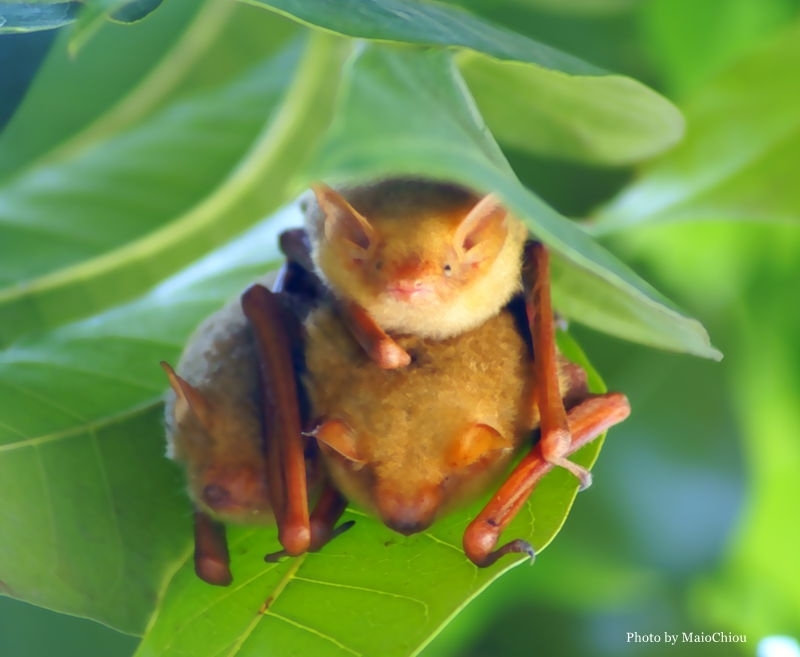
Hodgson's Bat
Myotis formosus
Hodgson's bat (Myotis formosus), also called the copper-winged bat or black-and-orange myotis, is a species of vesper bat in the genus Myotis, the mouse-eared bats. Favouring mountain forests, it is found throughout Central, Southeast, and East Asia, from Afghanistan to Taiwan. It is about 5 centimetres (2.0 in) long and is distinguished from most other species of bat in this range by its yellowish colouration.
From the article Hodgson's bat on Wikipedia (CC BY-SA), quoted section by section
Description
An adult Hodgson's bat has a head and body length of 4.3 to 5.7 centimetres (1.7 to 2.2 in), a tail length of 3.6 to 5.6 centimetres (1.4 to 2.2 in) and a forearm length of 4.3 to 5.2 centimetres (1.7 to 2.0 in) and weigh about 15 grams (0.53 oz). The colouring of the short dense fur that covers its body is much more yellow than is that of other bats found within its range.
Range & habitat
Hodgson's bat is native to Nangarhar Province in Afghanistan, the Sylhet Division of Bangladesh, the Indian provinces of Punjab, Jammu and Kashmir, Himachal Pradesh, Maharashtra, Meghalaya, Jharkhand, Sikkim, Uttarakhand, West Bengal, Bihar, Assam and Mizoram, and the Central and Western parts of Nepal at altitudes up to about 3,000 metres (9,840 ft). It is also known from eastern and central China and Taiwan, where it is likely sympatric with the previously-conspecific Myotis rufoniger. It is found in both upland and lowland primary and secondary forests and roosts in caves and trees, and sometimes buildings.
Wikipedia: “Distribution and habitat”
What it does
Hodgson's bat is an insectivore, locating its insect prey by echolocation during flight and catching it on the wing. In Taiwan, breeding begins in March and peaks in May. Up to two hundred females congregate in an underground maternity colony and give birth during May and June. Prior to this, the bats spend an average of nine hours foraging at night, but this time is reduced after giving birth. Newborn young measure about 2.15 centimetres (0.85 in) long and weigh about 3.7 grams (0.13 oz). They remain in the roost while the mother forages and for the first week stay in their birth location. After that, they begin to crawl around and by the third week they are able to take short flights. The mother spends much time grooming the newly-born youngster but by the time it is two weeks old, she normally roosts away from it. Between mid-August and early October the bats leave the maternity cave and spend the winter in hibernation in caves elsewhere.
Wikipedia: “Behaviour”
Listen
Looking for field recordings…
Where it lives
Recorded sightings
—
geo-referenced records in GBIF, from museums, herbaria and field observers.
Drag the globe to turn it. Dots are where records exist, not a range map; darker means more records.
In the stacks
Searching the stacks…
Every page naming Myotis formosus in the Biodiversity Heritage Library →
This page is assembled live from iNaturalist, GBIF, Wikipedia, the Source Library and the Internet Archive. It is not yet part of the hand-edited codex. iNaturalist taxon 40312.