- Animals
- ›Chordates
- ›Vertebrates
- ›Mammals
- ›Therians
- ›Placental Mammals
- ›Ungulates, Carnivorans, and Allies
- ›Bats
- ›Yangochiroptera
- ›Vespertilionoid Bats
- ›Evening Bats
- ›Mouse-eared Bats
- ›Myotis
- ›Myotis
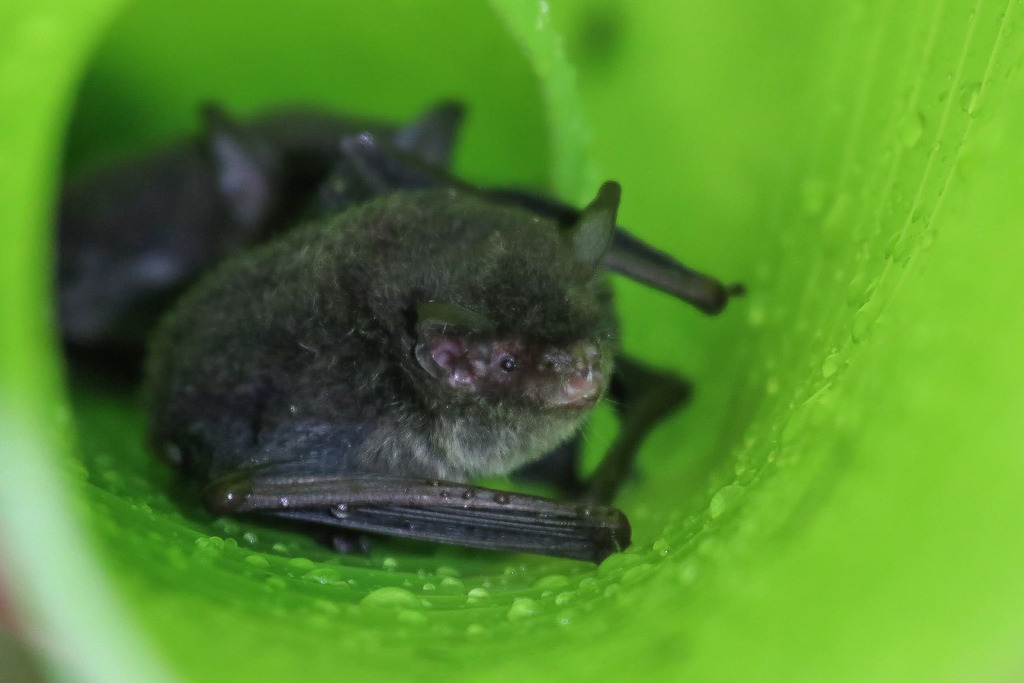
Whiskered Myotis
Myotis muricola
The wall-roosting mouse-eared bat, or Nepalese whiskered myotis (Myotis muricola) is a species of vesper bat whose type locality is Nepal.
From the article Wall-roosting mouse-eared bat on Wikipedia (CC BY-SA), quoted section by section
Description
The fur on the upper side of M.muricola is coloured brown or grey with dark bases, and the fur on the underside has dark bases and light brown tips. The ears are moderately long, slender, bent forwards and bluntly pointed (Francis, 2008). M.muricola has small feet with wing membranes attached at the base of the toes. The tail is long and completely enclosed in the interfemoral membrane. It has three pairs of premolars, with the upper canine much longer than the third premolar. The second premolar is small and slightly intruded from the tooth row (Yasuma, Andau, Apin, Tuh Yit Yu, & Kimsui, 2003).
Wikipedia: “Morphology”
Range & habitat
Myotis muricola is found in Afghanistan, Bangladesh, Bhutan, Cambodia, India, Indonesia, Laos, Malaysia, Myanmar, Nepal, Pakistan, Papua New Guinea, the Philippines, Thailand, and Vietnam (Simmons, 2005).
Wikipedia: “Distributions”
What it does
Myotis muricola is a nocturnal and insectivorous bat. It tends to feed during the first two hours after sunset and before dawn, using ultrasonic echolocation (Richardson, 1993). It catches insects in flight or perched on foliage, the ground, or on a water surface. Small insects are usually caught directly in the mouth, while larger ones are scooped out of the air using the tail membrane and flipped into the mouth, or brought to the mouth with the wing tips (Bonaccooso, 1998). It drinks by swooping low over the surface of a body of water, or by collecting droplets of water from the rooves of the tunnels or caves in which it roosts (Richardson, 1993).
Wikipedia: “Ecology”
Listen
Looking for field recordings…
Where it lives
Recorded sightings
—
geo-referenced records in GBIF, from museums, herbaria and field observers.
Drag the globe to turn it. Dots are where records exist, not a range map; darker means more records.
In the stacks
Searching the stacks…
Every page naming Myotis muricola in the Biodiversity Heritage Library →
This page is assembled live from iNaturalist, GBIF, Wikipedia, the Source Library and the Internet Archive. It is not yet part of the hand-edited codex. iNaturalist taxon 40292.