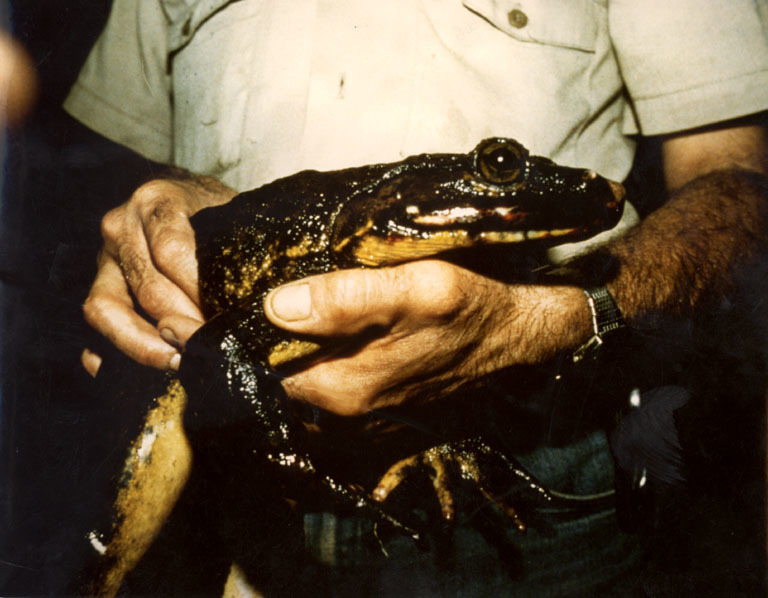
Goliath Frog
Conraua goliath
The goliath frog (Conraua goliath), otherwise known commonly as the giant slippery frog and the goliath bullfrog, is a species of frog in the family Conrauidae. The goliath frog is the largest living frog. Specimens can reach up to about 45 centimetres (18 in) in snout–vent length and 4.5 kilograms (9.9 lb) in weight. This species has a relatively small habitat range in Cameroon and Equatorial Guinea. Its numbers are dwindling due to habitat destruction, collection for food, and the pet trade.
From the article Goliath frog on Wikipedia (CC BY-SA), quoted section by section
Description
The male and female are very similar. In a sample of 15 individuals, weights ranged between 600 and 3,250 g (1.3 and 7.2 lb), and snout–vent lengths were between 17 and 32 cm (6.7 and 12.6 in). In total length, including outstretched legs, the largest specimens can slightly exceed 80 cm (31 in). The heaviest verified specimen, caught in the Muni River system in 1960, weighed 3,305 g (7.3 lb) and had a snout–vent length of 34.0 cm (13.4 in). The longest verified specimen, caught in the same river system in 1966, weighed 3,100 g (6.8 lb) and had a snout–vent length of 35.6 cm (14.0 in). There are unverified claims of considerably larger specimens, but they are dubious. Their eyes can be nearly 2.5 cm (1.0 in) in diameter. The conspicuous tympanum has a diameter around 0.5 cm (0.20 in) and is separated from the eye by about 5 cm (2.0 in) in adults. Goliath frog eggs and tadpoles are about the same size as other frogs despite their very large adult form. A lateral fold extends from the eye to the posterior portion of the tympanum. Their toes are fully webbed, with large interdigital membranes extending down to the toe tips. The second toe is the longest. The skin on the dorsum and on top of the limbs is granular. Dorsal coloration is green sienna, while the abdomen and ventral part of the limbs are yellow/orange. …
Range & habitat
The goliath frog is mainly found near waterfalls in Equatorial Guinea and Cameroon. Their habitat is divided into two main seasons: the dry season which occurs from November to April and the rainy season which occurs from May to October. Due to its large size, the goliath frog has an extremely selective distribution. This species is primarily located in a dense equatorial forest fringe which is somewhat parallel to the coast and surrounded by rivers. The goliath frog has been located in Sanaga Basin (mainly appearing near the Nachtigal cascades and in the Sakbayeme rapids), Kienke Basin, Ntem Basin (mainly being located near the rapids of the Mensolo and Nsana), and Mbía Basin (where it was found to be very abundant in the rapids and cascades). These distribution patterns emphasize its limited environment which tends to have a clear preference for water territories.
Wikipedia: “Habitat and distribution”
What it does
It was determined in a study that the goliath frog consumes a wide variety of food, suggesting that the frog is omnivorous with a carnivorous preference. Their prey are terrestrial, aquatic, and semi-aquatic, indicating that they hunt both on land and in water. Food preferences were different among the different weight groups of frogs, possibly correlating to different stages of development. Frogs weighing less than 400 g (14 oz) consumed annelids, arachnids, myriapods, insects, crustaceans, gastropods, and reptiles. Frogs weighing more than 1,000 g (35 oz) consumed arachnids, myriapods, insects, crustaceans, and gastropods with a significantly higher occurrence of myriapods. Annelids and reptiles were present only in the diet of lower weight frogs, emphasizing a more diversified diet for younger goliath frogs.
Wikipedia: “Diet”
Listen
Looking for field recordings…
Where it lives
Recorded sightings
—
geo-referenced records in GBIF, from museums, herbaria and field observers.
Drag the globe to turn it. Dots are where records exist, not a range map; darker means more records.
In the stacks
Searching the stacks…
Every page naming Conraua goliath in the Biodiversity Heritage Library →
This page is assembled live from iNaturalist, GBIF, Wikipedia, the Source Library and the Internet Archive. It is not yet part of the hand-edited codex. iNaturalist taxon 25737.