- Animals
- ›Chordates
- ›Vertebrates
- ›Amphibians
- ›Frogs and Toads
- ›African Reed Frogs
- ›Typical Reed Frogs
- ›Afrixalus
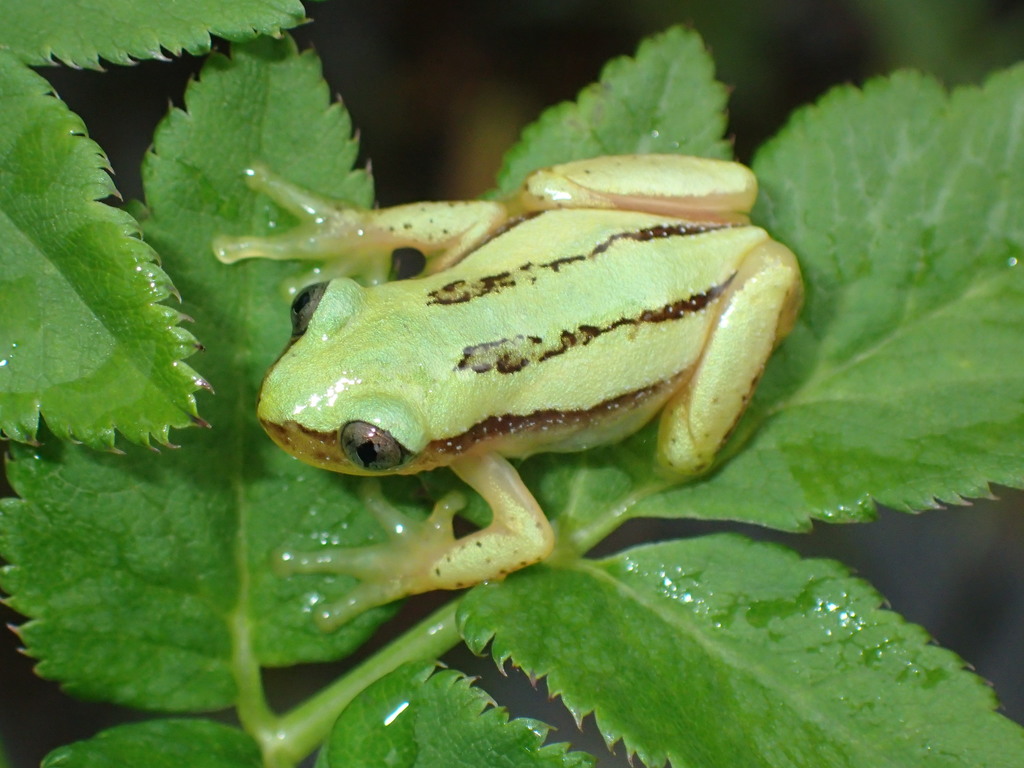
Clarke's banana frog
Afrixalus clarkei
Afrixalus clarkei is a species of frog in the family Hyperoliidae. It is endemic to southwestern Ethiopia and has been recorded from near Chira, Jimma, Bonga, and Bodare. The specific name clarkei honours Mr and Mrs R. O. S. Clarke (hence emendation to plural clarkeorum, but such change is nevertheless considered unjustified under the International Code of Zoological Nomenclature), who are acknowledged for their help and hospitality. Common name Clarke's banana frog has been coined for this species.
From the article Afrixalus clarkei on Wikipedia (CC BY-SA), quoted section by section
Description
Adult males measure 20–23 mm (0.8–0.9 in) and adult females 23–24 mm (0.9–0.9 in) in snout–vent length. The head is broad with short snout. The tympanum ranges from completely hidden to somewhat noticeable. The fingers are unwebbed or have some webbing between the fingers III and IV. The toes are moderately webbed. Dorsal skin is smooth, but chest and abdomen may be rather coarsely granular. The dorsum is yellow-green to bright green, sometimes rarely olive to dark brown, with some scattered small white flecks and larger dark brown spots. There is a pair of dorsolateral lines or rows of dark brown spots, and broad brown lateral stripe running from the tip of the snout over the eye and reaching almost the groin. Males have yellow gular flap. The male advertisement call consists of an initial creak, followed by a small number of metallic clicks.
Range & habitat
Afrixalus clarkei is found in tropical deciduous forests and forest edges as well as in some moderately modified secondary habitats such as coffee plantations at elevations of 820–2,030 m (2,690–6,660 ft) above sea level. It has recently been recorded also in marshes and riverine floodplains in open disturbed landscapes. Afrixalus clarkei breeds in marshy pools with emergent vegetation. It is threatened by habitat loss caused by selective logging and encroachment of agriculture and human settlements. It is present in the Kafa Biosphere Reserve.
== References ==
Wikipedia: “Habitat and conservation”
Listen
Looking for field recordings…
Where it lives
Recorded sightings
—
geo-referenced records in GBIF, from museums, herbaria and field observers.
Drag the globe to turn it. Dots are where records exist, not a range map; darker means more records.
In the stacks
Searching the stacks…
Every page naming Afrixalus clarkei in the Biodiversity Heritage Library →
This page is assembled live from iNaturalist, GBIF, Wikipedia, the Source Library and the Internet Archive. It is not yet part of the hand-edited codex. iNaturalist taxon 64833.