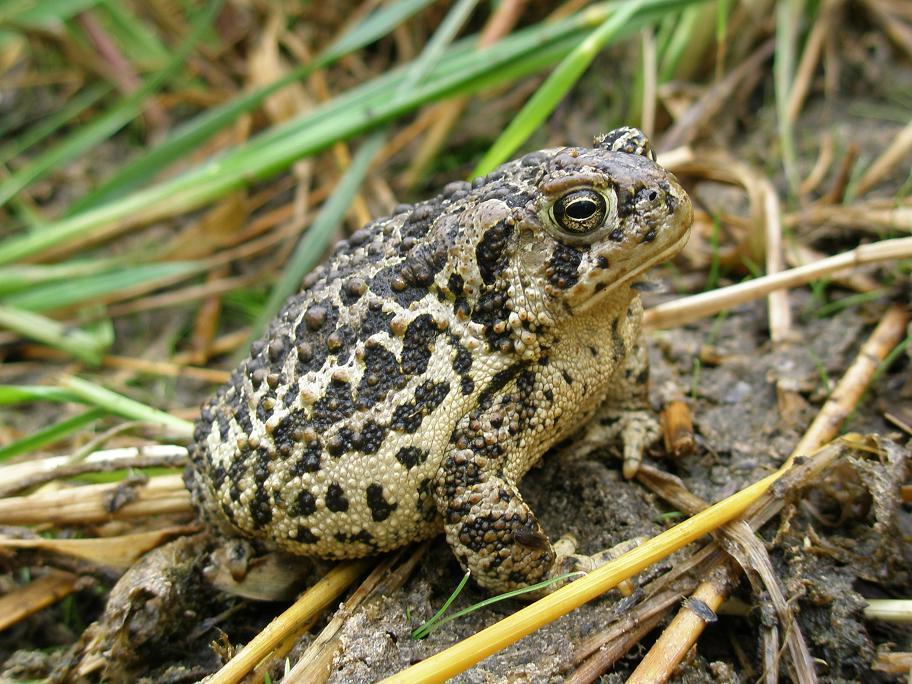
Wyoming Toad
Anaxyrus baxteri
The Wyoming toad (Anaxyrus baxteri), also known commonly as Baxter's toad, is a species of toad in the family Bufonidae. The Wyoming toad is an extremely rare amphibian that exists only in captivity and within Mortenson Lake National Wildlife Refuge in Wyoming in the United States. The Wyoming toad was listed as an endangered species in 1984, and listed as extinct in the wild since 1991. As with black-footed ferrets at the Tom Thorne and Beth Williams Wildlife Research Center at Sybille in Wheatland, Wyoming, the effort to save the Wyoming toad has been a cooperative effort among state and federal agencies and private landowners.
The Wyoming toad was common from the 1950s through the early 1970s, but its distribution was limited to the Laramie Basin in Albany County. The population crashed around 1975 and was extremely low by 1980. The Wyoming toad was federally listed as endangered in January 1984.
From the article Wyoming toad on Wikipedia (CC BY-SA), quoted section by section
Description
The Wyoming toad is dark brown, gray or green, with small dark markings on its underside. It carries small, rounded, blotchy warts on its dorsal surface as well as blurry light lines. The male toad has a dark throat. The individual toads can be identified by the variation in their skin colors and wart patterns. The toad can grow up to 5.6 cm (2.2 in) in length, and females grow slightly larger than males. It also has sensitive skin that has low adaptability and is prone to permitting infection by chytrid fungus, a strong threat to the Wyoming toad. The toad cannot handle rapid climate change and cannot adapt to differing amounts of water irrigation or diverged irrigation. The toad is mainly active at night and has very poor eyesight; it relies on the movement of its prey to hunt.
Wikipedia: “Characteristics”
Range & habitat
The Wyoming toad frequents floodplains and the short grass edges of ponds, creeks and lakes. The species frequently uses abandoned pocket gopher and ground squirrel burrows as hibernacula. Habitat typical characteristics may be seen to vary along the Wyoming toad's age spectrum. Studies at Mortensen Lake in Albany County show that adult Wyoming toads are attracted to habitats with greater vegetation while younger toads are more drawn to areas of lesser vegetation. Adults tend to drift further inland away from shorelines, while younger toads tend to settle closer to the shorelines. Though these habitat variations and substrate conditions varying accordingly, adults are located in areas with slightly cooler temperatures. For the typical adult, substrate surface temperatures were seen to be 20.31 °C (68.56 °F) versus 23.05 °C (73.49 °F) for younger specimens. Adult Wyoming toads demonstrate very little change in location. The measures of the toad's substrate surface temperature and distance from shorelines tend to be most accurate indicators of possible sightings. When surface temperatures exceed 20 °C (68 °F) and the shoreline is within one to two miles, optimal locating conditions are achieved.
Wikipedia: “Habitat”
What it does
Toads emerge from hibernation in early May to migrate to the north shore for mating. They return to the south shore by late September or early October for hibernation. The younger toads are active as long as one month later than are older toads, which gives them more time to store energy for hibernation and reduce intraspecific competition. The mating call of the Wyoming toad has a low frequency along with a slow pulse rate, but the duration is longer than that of other types of toads. Wyoming toads mature earlier, with males at only two years and females at three years, than other higher-elevation bufonids in their Wyoming habitat. Disease has played a major role in the decline of the Wyoming toad.
Reproduction. There are believed to be 100 Wyoming toads still living in the wild, and as a result, a recovery group was formed by the U.S. Fish and Wildlife Service's Saratoga National Fish Hatchery in 1998. The goal of this recovery group was to perform captive breeding and reintroduce tadpoles into the wild. However, the captive breeding program has seen low reproductive output because of low ovulation and fertilization rates. Female toads were given a dose of luteinizing hormone releasing hormone (LHRHa), which induces spawning in fish, while male toads were treated with human chorionic gonadotropin (hCG). …
Wikipedia: “Behavior”
At the table
Normal disease: Wyoming toads have a shorter life span than those of other toad species, and they are very vulnerable to infectious diseases, especially the chytrid fungus that was found at Mortenson Lake in 2000–2001. Their environment is conducive to the spread of other infectious fungi and bacteria (such as Aeromonas hydrophila). The cause of death in the majority of wild and captive toads from 1989 until 1996 appeared to be caused by the fungus Basidiobolus ranarum. Malathion: Within the Wyoming toad's habitat, malathion has been used to control the mosquito population. The combination of malathion and bacterial (Aeromonas hydrophila) infection could be causing increased mortality rates. Increased irrigation and water shortages: Increased irrigation has reduced the extent and quality of the floodplain wetlands where the toad has formerly resided. New wetland habitat has been created by flood irrigation and the construction of reservoirs. However, in dry years when junior water rights are not met, less irrigation water flows through Pioneer Canal, and Mortenson Lake collects less seepage, causing reduced flooding in riparian areas and decreased wetland quality. Natural predation: Toads are the prey of many avian and mammalian species at all life stages. …
Wikipedia: “Other causes of population decline”
In human culture
The specific name, baxteri, is in honor of American zoologist George T. Baxter who discovered the relict population.
Wikipedia: “Etymology”
Listen
Looking for field recordings…
Where it lives
Recorded sightings
—
geo-referenced records in GBIF, from museums, herbaria and field observers.
Drag the globe to turn it. Dots are where records exist, not a range map; darker means more records.
In the stacks
Searching the stacks…
Every page naming Anaxyrus baxteri in the Biodiversity Heritage Library →
This page is assembled live from iNaturalist, GBIF, Wikipedia, the Source Library and the Internet Archive. It is not yet part of the hand-edited codex. iNaturalist taxon 64969.