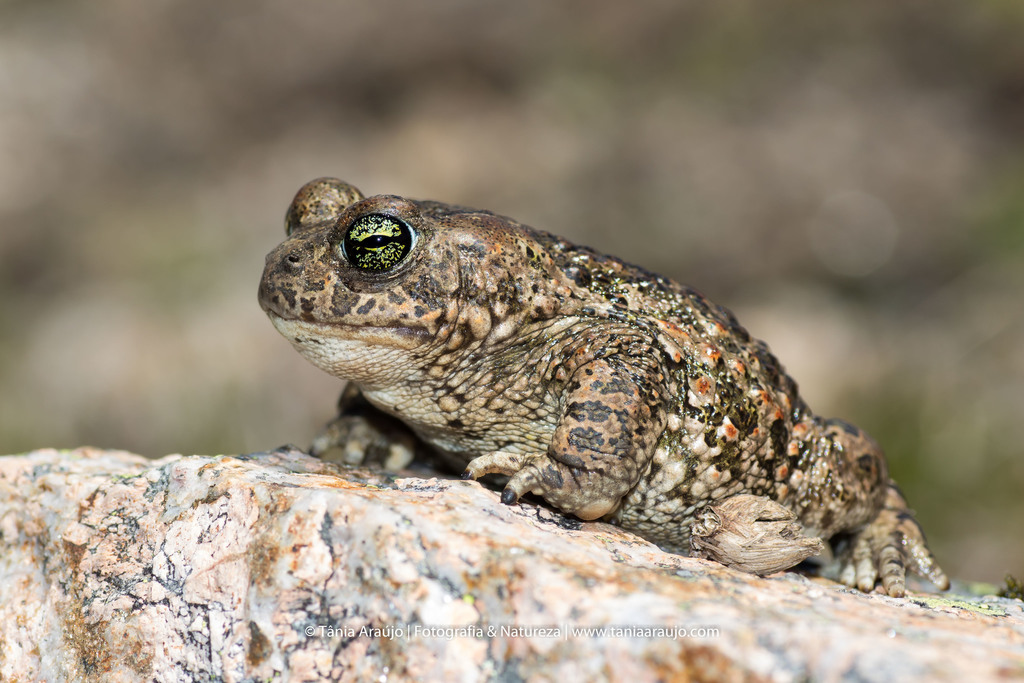
Natterjack Toad
Epidalea calamita
The natterjack toad (Epidalea calamita) is a toad native to sandy and heathland areas of Europe. Adults are 60–70 mm (2.4–2.8 in) in length, and are distinguished from common toads by a yellow line down the middle of the back and parallel paratoid glands. They have relatively short legs, which gives them a distinctive gait, contrasting with the hopping movement of many other toad species.
Natterjacks have a very loud and distinctive mating call amplified by the single vocal sac found under the chin of the male.
From the article Natterjack toad on Wikipedia (CC BY-SA), quoted section by section
Range & habitat
Populations of the natterjack extend through 17 European countries. In the UK, the toad is now almost completely confined to coastal sites. The natterjack is the only species of toad native to Ireland. It is found in County Kerry (Dingle Peninsula and Derrynane) and also in County Wexford, where it was introduced to a dune site. In mainland Europe, particularly in the southern part of its range, it lives inland in a variety of habitats.
Wikipedia: “Distribution”
What it does
The natterjack toad spawns between the end of April and July, laying strings of eggs in shallow, warm pools. Because the natterjack toad is often present in low numbers, its loud mating calls are important so that the sexes can find each other. Natterjacks can only spawn in pools that have a very slightly sloping bottom, and tolerate only sparse vegetation on the banks and in the water. Since pools of this description are often temporary, sometimes the tadpoles die when the pools dry out. The natterjack compensates for that risk by mating over an extended period each summer. Thus, in September, the age of the juveniles can vary from one to three months. Early breeders seldom breed again later in the season, though some females do spawn twice in a year.
Wikipedia: “Reproduction”
In human culture
Natterjacks live for up to 15 years, and feed mainly on insects, especially beetles. At night, they move around open terrain with sparse vegetation, and their tracks can often be seen in loose sand. They move considerable distances each night, enabling the species to colonize new habitats shut up.
Reproduction. The natterjack toad spawns between the end of April and July, laying strings of eggs in shallow, warm pools. Because the natterjack toad is often present in low numbers, its loud mating calls are important so that the sexes can find each other. Natterjacks can only spawn in pools that have a very slightly sloping bottom, and tolerate only sparse vegetation on the banks and in the water. Since pools of this description are often temporary, sometimes the tadpoles die when the pools dry out. The natterjack compensates for that risk by mating over an extended period each summer. Thus, in September, the age of the juveniles can vary from one to three months. Early breeders seldom breed again later in the season, though some females do spawn twice in a year.
Wikipedia: “Life history”
Listen
Looking for field recordings…
Where it lives
Recorded sightings
—
geo-referenced records in GBIF, from museums, herbaria and field observers.
Drag the globe to turn it. Dots are where records exist, not a range map; darker means more records.
In the stacks
Searching the stacks…
Every page naming Epidalea calamita in the Biodiversity Heritage Library →
This page is assembled live from iNaturalist, GBIF, Wikipedia, the Source Library and the Internet Archive. It is not yet part of the hand-edited codex. iNaturalist taxon 65450.