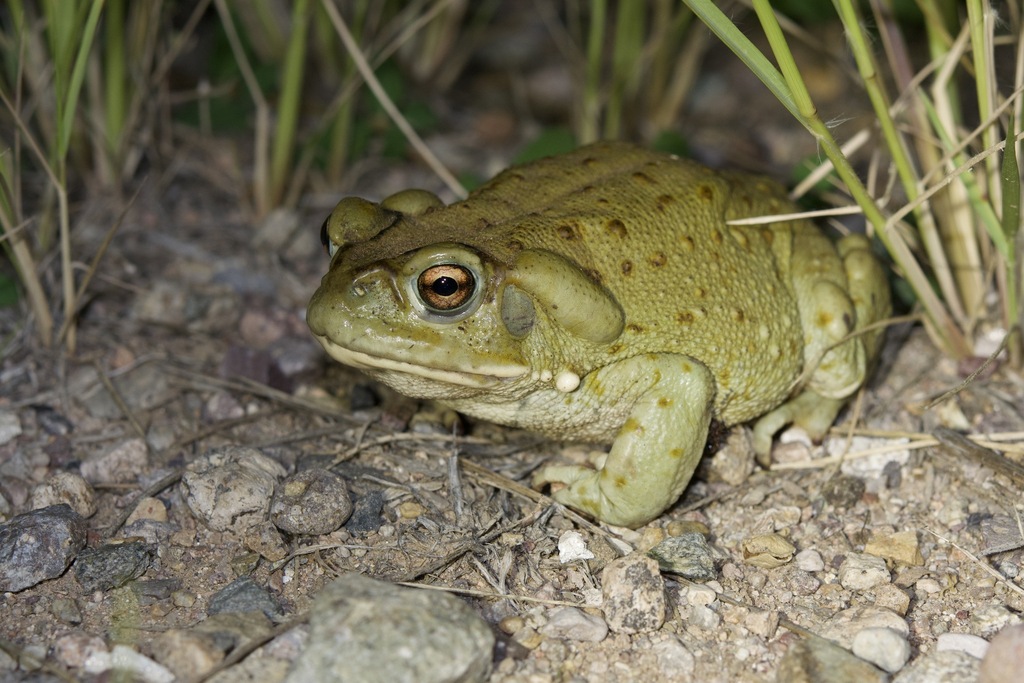
Sonoran Desert Toad
Incilius alvarius
The Colorado River toad (Incilius alvarius), (previously Bufo alvarius) also known as the Sonoran Desert toad, is a toad species found in northwestern Mexico and the southwestern United States. It is well known for its ability to exude toxins that have psychoactive properties from glands within its skin.
The toad's scientific name was formerly Bufo alvarius, the name by which the toad is generally still known. In the early 2000s, the increasingly important role of molecular genetic techniques in taxonomy and their ability to examine phylogenetic relationships allowed scientists to discover numerous distinct genera within the old Bufo group.
From the article Colorado River toad on Wikipedia (CC BY-SA), quoted section by section
Description
The Colorado River toad can grow to about 190 millimetres (7.5 in) long and is the largest toad in the United States apart from the non-native cane toad (Rhinella marina). It has a smooth, leathery skin and is olive green or mottled brown in color. Just behind the large golden eye with a horizontal pupil is a bulging kidney-shaped parotoid gland. Below this is a large circular pale green area which is the tympanum or ear drum. By the corner of the mouth there is a white wart and there are white glands on the legs. All these glands produce toxic secretions. Its call is described as, "a weak, low-pitched toot, lasting less than a second." Dogs (Canis familiaris) that have attacked toads have suffered paralysis or even death. Raccoons (Procyon lotor) have learned to pull a toad away from a pond by the back leg, turn it on its back and start feeding on its belly, a strategy that keeps the raccoon well away from the poison glands. Unlike other vertebrates, this amphibian obtains water mostly by osmotic absorption across its abdomen. Toads in the family Bufonidae have a region of skin known as "the seat patch", which extends from mid abdomen to the hind legs and is specialized for rapid rehydration. Most of the rehydration is done through absorption of water from small pools or wet objects.
Range & habitat
In the United States, the Colorado River toad is found in the lower Colorado River and the Gila River catchment areas, in extreme southwestern New Mexico and much of southern Arizona. It is considered possibly extirpated from California. In Mexico, the toad is found in the states of Sonora, Sinaloa, and Chihuahua. It lives in both desert and semi-arid areas throughout its range. It is semiaquatic and is often found in streams, near springs, in canals and drainage ditches, and under water troughs. The Colorado River toad is known to breed in artificial water bodies (e.g., flood control impoundments, reservoirs) and as a result, the distributions and breeding habitats of these species may have been recently altered in south-central Arizona. It often makes its home in rodent burrows and is nocturnal.
Wikipedia: “Distribution and habitat”
At the table
The toad's primary defense system are glands that produce a poison that may be potent enough to kill a grown dog. These parotoid glands also produce 5-methoxy-N,N-dimethyltryptamine (5-MeO-DMT) and bufotenin (which is named after the Bufo genus of toads); both of these chemicals belong to the family of hallucinogenic tryptamines.
Bufotenin is a chemical constituent in the secretions and eggs of several species of toads belonging to the genus Bufo, but the Colorado River toad (Incilius alvarius) is the only toad species in which bufotenin is present in large enough quantities for a psychoactive effect. Extracts of toad secretion, containing bufotenin and other bioactive compounds, have been used in some traditional medicines such as ch'an su (probably derived from Bufo gargarizans), which has been used medicinally for centuries in China, as an herbal remedy often illegally imported to the USA that can be prepared as a tea. The toad was "recurrently depicted in Mesoamerican art", which some authors have interpreted as indicating that the effects of ingesting Bufo secretions have been known in Mesoamerica for many years; however, others doubt that this art provides sufficient ethnohistorical evidence to support the claim. In addition to bufotenin, Bufo secretions also contain digoxin-like cardiac glycosides, and ingestion of the poison can be fatal. …
Wikipedia: “Psychotropic uses”
Listen
Looking for field recordings…
Where it lives
Recorded sightings
—
geo-referenced records in GBIF, from museums, herbaria and field observers.
Drag the globe to turn it. Dots are where records exist, not a range map; darker means more records.
In the stacks
Searching the stacks…
Every page naming Incilius alvarius in the Biodiversity Heritage Library →
This page is assembled live from iNaturalist, GBIF, Wikipedia, the Source Library and the Internet Archive. It is not yet part of the hand-edited codex. iNaturalist taxon 65828.