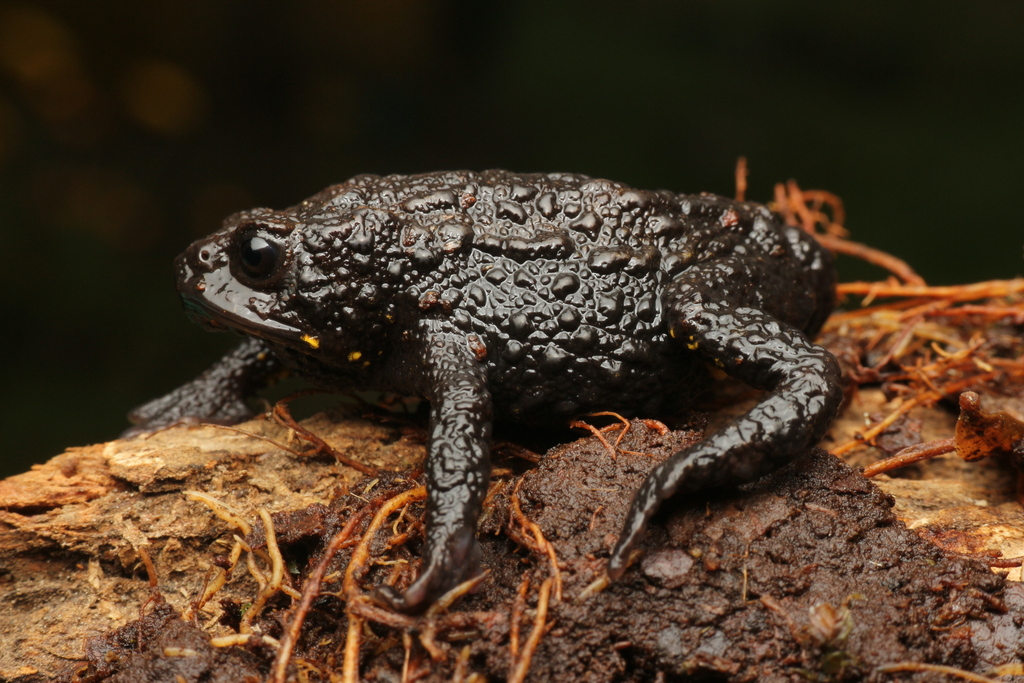
Herveo Plump Toad
Osornophryne percrassa
The Herveo plump toad (Osornophryne percrassa) is a species of toad in the family Bufonidae. It is endemic to the Cordillera Central in the Antioquia, Caldas, Quindío, and Tolima Departments, Colombia.
From the article Herveo plump toad on Wikipedia (CC BY-SA), quoted section by section
Description
Osornophryne percrassa are relatively small toads: males measure 23–28 mm (0.91–1.10 in) and females 27–38 mm (1.1–1.5 in) in snout–vent length. It differs from other Osornophryne by its truncated snout in lateral view, with a little non-projected papilla at the end, and by its light spots on the belly.
Range & habitat
Its natural habitats are Andean forests and páramos at elevations of 2,700–3,700 m (8,900–12,100 ft) asl. It is a ground-dwelling species found among leaf-litter and rocks, or in terrestrial and arboreal bromeliads. Development is direct. It is an uncommon species threatened by habitat loss and fragmentation, mainly from agriculture, and by pollution from the fumigation of illegal crops. Climate change might also pose a threat. The species is known from a number of protected areas.
== References ==
Wikipedia: “Habitat and conservation”
Listen
Looking for field recordings…
Where it lives
Recorded sightings
—
geo-referenced records in GBIF, from museums, herbaria and field observers.
Drag the globe to turn it. Dots are where records exist, not a range map; darker means more records.
In the stacks
Searching the stacks…
Every page naming Osornophryne percrassa in the Biodiversity Heritage Library →
This page is assembled live from iNaturalist, GBIF, Wikipedia, the Source Library and the Internet Archive. It is not yet part of the hand-edited codex. iNaturalist taxon 21806.