- Animals
- ›Chordates
- ›Vertebrates
- ›Cartilaginous Fishes
- ›Sharks and Rays
- ›Sharks
- ›Galean Sharks
- ›Mackerel Sharks
- ›Sand Tiger Sharks
- ›Carcharias
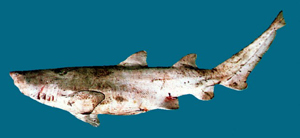
Indian Sand Tiger Shark
Carcharias tricuspidatus
The sand tiger shark (Carcharias taurus), also commonly known as the spotted ragged-tooth shark in South Africa, grey nurse shark in Australia, or blue-nurse sand tiger in India, is a species of shark that inhabits subtropical and temperate waters worldwide. It inhabits the continental shelf, from sandy shorelines (hence the name sand tiger shark) and submerged reefs to a depth of around 191 m (627 ft). They dwell in the waters of East Asia, Australia, Western and Southern Africa, the Red sea, and the east coasts of North and South America. The sand tiger shark also inhabited the Mediterranean; however, it was last seen there in 2003 and is presumed extirpated. Despite its common names, it is not closely related to either the tiger shark (Galeocerdo cuvier) or the nurse shark (Ginglymostoma cirratum).
Despite its fearsome appearance and strong swimming ability, it is a relatively placid and slow-moving shark with no confirmed human fatalities. This species has a sharp, pointy head, and a bulky body. The sand tiger's length can reach 3.2 m (10.5 ft) but is normally 2.2–2.5 m in length. They are grey with reddish-brown spots on their backs. Shivers (groups) have been observed to hunt large schools of fish. Their diet consists of bony fish, crustaceans, squid, skates and other sharks. Unlike other sharks, the sand tiger can gulp air from the surface, allowing it to be suspended in the water column with minimal effort. During pregnancy, the most developed embryo will feed on its siblings, a reproductive strategy known as intrauterine cannibalism i.e.
From the article Sand tiger shark on Wikipedia (CC BY-SA), quoted section by section
Description
Adult sand tigers range from 2 m (6.6 ft) to 3.2 m (10.5 ft) in length with most specimens reaching a length of around 2.2–2.5 m and 91 kg (201 lb) to 159 kg (351 lb) in weight. The head is pointy, as opposed to round, while the snout is flattened with a conical shape. Its body is stout and bulky and its mouth extends beyond the eyes. The eyes of the sand tiger shark are small, lacking eyelids. A sand tiger usually swims with its mouth open displaying three rows of protruding, smooth-edged, sharp-pointed teeth. The males have grey claspers with white tips located on the underside of their body. The caudal fin is elongated with a long upper lobe (i.e. strongly heterocercal). They have two large, broad-based grey dorsal fins set back beyond the pectoral fins. The sand tiger shark has a grey-brown back and pale underside. Adults tend to have reddish-brown spots scattered, mostly on the hind part of the body. In August 2007, an albino specimen was photographed off South West Rocks, Australia. The teeth of these sharks have no transverse serrations (as have many other sharks) but they have a large, smooth main cusp with a tiny cusplet on each side of the main cusp. The upper front teeth are separated from the teeth on the side of the mouth by small intermediate teeth.
Range & habitat
Sand tiger sharks roam the epipelagic and mesopelagic regions of the ocean, sandy coastal waters, estuaries, shallow bays, and rocky or tropical reefs, at depths of up to 190 m (623 ft). The sand tiger shark can be found in the Atlantic, Pacific and Indian Oceans, and in the Adriatic Seas. In the Western Atlantic Ocean, it is found in coastal waters around from the Gulf of Maine to Florida, in the northern Gulf of Mexico, around the Bahamas and Bermuda, and from southern Brazil to northern Argentina. It is also found in the eastern Atlantic Ocean from the Mediterranean Sea to the Canary Islands, at the Cape Verde islands, along the coasts of Senegal and Ghana, and from southern Nigeria to Cameroon. In the western Indian Ocean, the shark ranges from South Africa to southern Mozambique, but excluding Madagascar. The sand tiger shark has also been sighted in the Red Sea and may be found as far east as India. In the western Pacific, it has been sighted in the waters around the coasts of Japan and Australia, but not around New Zealand.
Wikipedia: “Geographical range”
What it does
The majority of prey items of sand tigers are demersal (i.e. from the sea bottom), suggesting that they hunt extensively on the sea bottom as far out as the continental shelf. Their diet consists mainly of teleosts and other elasmobranchs. Bony fish (teleosts) form about 60% of sand tigers' food, the remaining prey being sharks, skates, other rays, lobsters, crabs and squid. In Argentina, the prey includes mostly demersal fishes, e.g. the striped weakfish (Cynoscion guatucupa) and whitemouth croaker (Micropogonias furnieri). The most important elasmobranch prey is the bottom-living narrownose smooth-hound shark (Mustelus schmitti.). Benthic (i.e. free-swimming) rays and skates are also taken, including fanskates, eagle rays and the angular angel shark, with larger individuals feeding on a higher number of benthic elasmobranchs than smaller individuals. Stomach content analysis indicates that smaller sand tigers mainly focus on the sea bottom and as they grow larger they start to take more pelagic prey. This perspective of the diet of sand tigers is consistent with similar observations in the north west Atlantic and in South Africa where large sand tigers capture a wider range of shark and skate species as prey, from the surf zone to the continental shelf, indicating the opportunistic nature of sand tiger feeding. …
Wikipedia: “Diet”
At the table
In Argentina, the prey items of sand tigers largely coincided with important commercial fisheries targets. Humans affect sand tiger food availability and the sharks, in turn, compete with humans for food that, in turn, has already been heavily exploited by the fisheries industry. The same applies to the bottom-living sea catfish (Galeichthys feliceps), a fisheries resource off the South African coast.
Wikipedia: “Competition for food with humans”
Where it lives
Recorded sightings
—
geo-referenced records in GBIF, from museums, herbaria and field observers.
Drag the globe to turn it. Dots are where records exist, not a range map; darker means more records.
In the stacks
Searching the stacks…
Every page naming Carcharias tricuspidatus in the Biodiversity Heritage Library →
This page is assembled live from iNaturalist, GBIF, Wikipedia, the Source Library and the Internet Archive. It is not yet part of the hand-edited codex. iNaturalist taxon 607466.