- Animals
- ›Chordates
- ›Vertebrates
- ›Cartilaginous Fishes
- ›Sharks and Rays
- ›Sharks
- ›Galean Sharks
- ›Mackerel Sharks
- ›Crocodile Sharks
- ›Pseudocarcharias
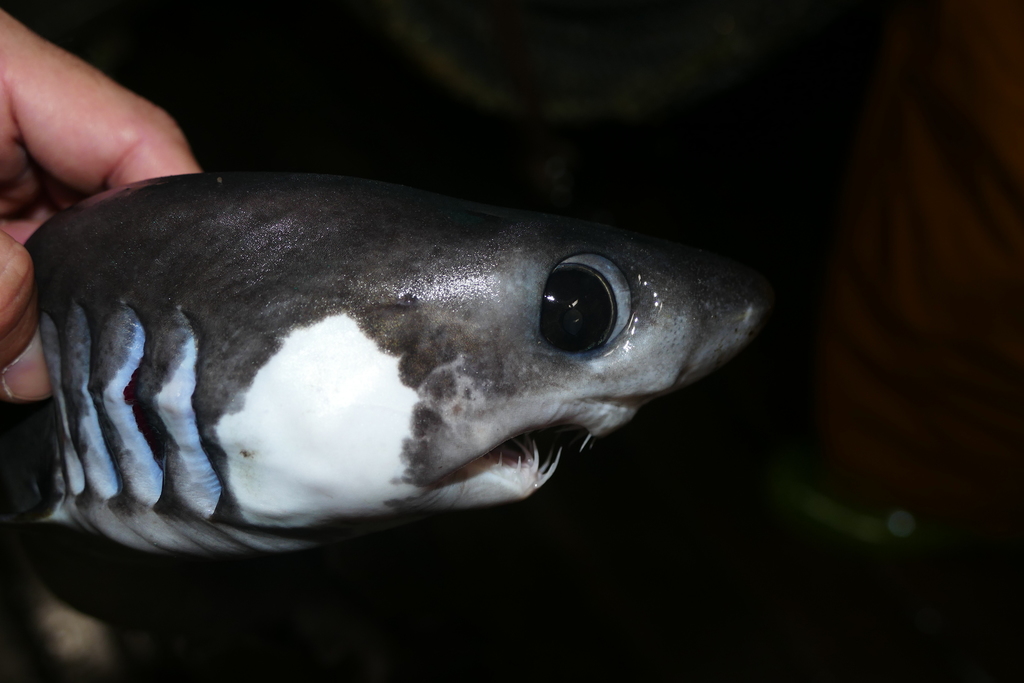
Crocodile Shark
Pseudocarcharias kamoharai
The crocodile shark (Pseudocarcharias kamoharai) is a species of mackerel shark and the only extant member of the family Pseudocarchariidae. A specialized inhabitant of the mesopelagic zone, the crocodile shark can be found worldwide in tropical waters from the surface to a depth of 590 m (1,940 ft). It performs a diel vertical migration, staying below a depth of 200 m (660 ft) during the day and ascending into shallower water at night to feed. Typically measuring only 1 m (3.3 ft) in length, the crocodile shark is the smallest living mackerel shark. It can be distinguished by its elongated cigar-shaped body, extremely large eyes, and relatively small fins.
An active-swimming predator of pelagic bony fishes, squid and shrimp, the crocodile shark has a sizable oily liver that allows it to maintain its position in the water column with minimal effort. The size and structure of its eyes suggests that it is adapted for hunting at night. The crocodile shark is aplacental viviparous, with females typically giving birth to litters of four. The fetuses are oophagous, meaning that they feed on undeveloped eggs ovulated for this purpose by their mother. Due to its small size, the crocodile shark poses little danger to humans and is of little commercial importance. This species was responsible for damaging deep sea fiberoptic cables when the technology was first deployed in 1985. In 2017, one crocodile shark was spotted on a UK beach spotted by a family walking on the beach.
From the article Crocodile shark on Wikipedia (CC BY-SA), quoted section by section
Description
The crocodile shark has a spindle-shaped body with a short head and a bulbous, pointed snout. The eyes are very large and lack nictitating membranes (protective third eyelids). The five pairs of gill slits are long, extending onto the dorsal surface. The sizable, arched jaws can be protruded almost to the tip of the snout and contain large teeth, shaped like spikes in the front and knives on the sides. There are fewer than 30 tooth rows in either jaw; in the upper jaw, the first two large teeth are separated from the lateral teeth by a row of small intermediate teeth. The pectoral fins are small, broad, and rounded. The pelvic fins are nearly as large as the pectorals. The first dorsal fin is small, low and angular; the second dorsal fin is smaller than the first but larger than the anal fin. The caudal fin is asymmetrical with a moderately long upper lobe. The caudal peduncle is slightly compressed with weak lateral keels. The dermal denticles are small, with a flattened crown bearing small ridges and backward-pointing cusps It is dark brown above and paler below, sometimes with a few dark blotches on the sides and belly and/or a white blotch between the corner of the mouth and the first gill slit. The fins have thin translucent to white margins. The crocodile shark grows to a maximum length of 1.1 m (3.6 ft). …
Range & habitat
The crocodile shark is almost circumtropical in distribution. In the Atlantic Ocean, it is known from off Brazil, Cape Verde, Guinea-Bissau, Guinea, Angola, South Africa, and Saint Helena Island, though it has not yet been reported from the northwestern Atlantic. In the Indian Ocean, it occurs in the Mozambique Channel and possibly the Agulhas Current and the Bay of Bengal. In the Pacific, it occurs from Japan, Taiwan, and the Korean Peninsula in the northwest, southward to Indonesia, Australia, and New Zealand, and eastward to the western coast of the Americas from Baja California to Chile, including the Marshall, Phoenix, Palmyra, Johnston, Marquesas, Line, and Hawaiian Islands in between. In New Zealand this species has been recorded at the Three Kings Ridge, off the coast of Northland and on the northern Kermadec Ridge. From distribution records, the crocodile shark's range seems to be bound by the latitudes 37°N and 44°S, where the average sea surface temperature is 20 °C (68 °F). This species is not evenly distributed but is rather locally abundant in certain areas, suggesting that it is not strongly migratory. The crocodile shark is usually found in the pelagic zone from the surface to a depth of 590 m (1,940 ft). …
Wikipedia: “Distribution and habitat”
What it does
With a long body, small fins, and large liver rich in squalene and other low-density lipids, the crocodile shark is convergently similar to mesopelagic dogfish sharks such as the cookiecutter shark (Isistius brasiliensis). The liver may comprise a fifth of the shark's weight, and acts as an incompressible float that allows it to maintain neutral buoyancy in the water column with little effort. Like many other inhabitants of the mesopelagic zone, the crocodile shark apparently migrates closer to the surface at night to feed and descends into deeper water during the day, being rarely found above a depth of 200 m (660 ft) during daytime. The large eyes of the crocodile shark, equipped with a reflective green or yellow retina and lacking an expanded iris, suggest that it is a nocturnal hunter that relies on sight to pick out the silhouettes or bioluminescence of its prey. Little is known of the crocodile shark's feeding habits; it is thought to be an active, fast-swimming predator based on its strong musculature, large tail, and behavior when captured. On one occasion, a crocodile shark off Cape Point, South Africa, jumped out of the water in pursuit of bait. Its diet consists of small to medium-sized bony fishes (including bristlemouths and lanternfishes), squid (including onychoteuthids, mastigoteuthids, pholidoteuthids, and cranchiids) and shrimp. …
Wikipedia: “Biology and ecology”
Where it lives
Recorded sightings
—
geo-referenced records in GBIF, from museums, herbaria and field observers.
Drag the globe to turn it. Dots are where records exist, not a range map; darker means more records.
In the stacks
Searching the stacks…
Every page naming Pseudocarcharias kamoharai in the Biodiversity Heritage Library →
This page is assembled live from iNaturalist, GBIF, Wikipedia, the Source Library and the Internet Archive. It is not yet part of the hand-edited codex. iNaturalist taxon 110962.