- Animals
- ›Chordates
- ›Vertebrates
- ›Cartilaginous Fishes
- ›Sharks and Rays
- ›Rays
- ›Skates
- ›Hardnose Skates
- ›Rajella
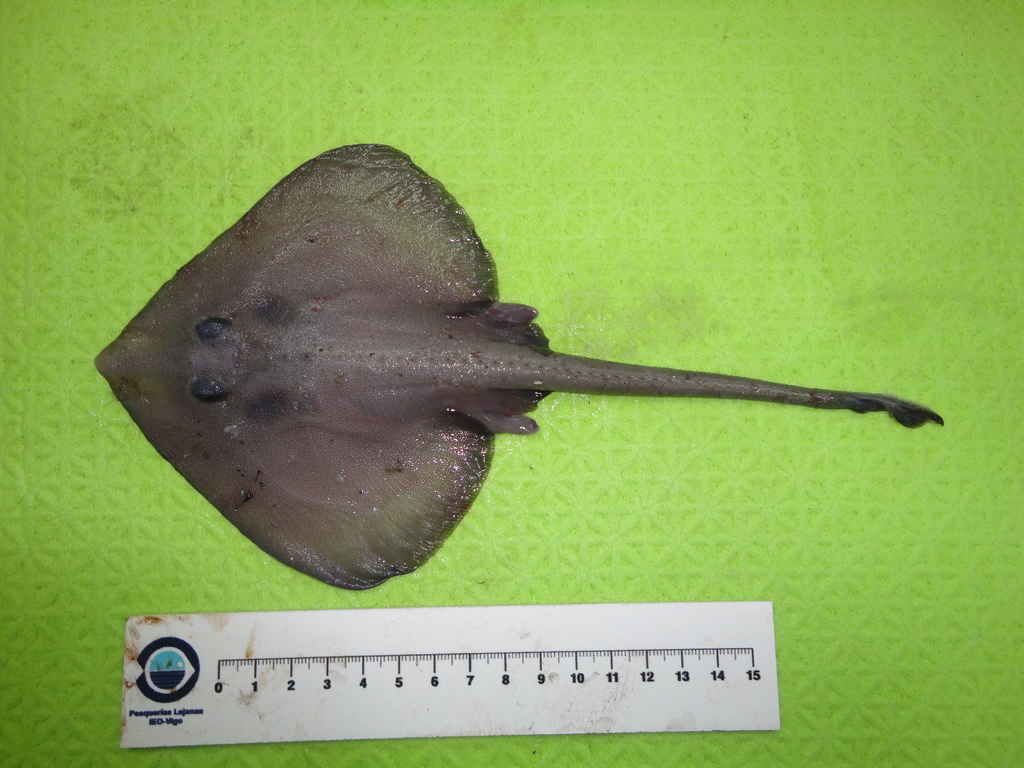
Abyssal Skate
Rajella bathyphila
The deepwater ray (Rajella bathyphila), also called the deepwater skate or abyssal skate, is a species of skate in the family Rajidae.
From the article Deepwater ray on Wikipedia (CC BY-SA), quoted section by section
Description
Like all rays, the deepwater ray has a flattened body with broad, wing-like pectoral fins. The dorsal surface of adults is white. The outer edges of pectoral and pelvic fins shade to darker. The upper surface is spinulose, but there are bare patches in the centre of the pectoral fins and on sides of body in adult males. The dorsal fins are confluent. Its maximum length is 90 cm (3.0 ft).
Range & habitat
The deepwater ray is bathydemersal; it has been recorded at 600–2,300 m (2,000–7,500 ft), mostly below 1,300–1,400 m (4,300–4,600 ft). It has been found in seas worldwide, concentrated in the North Atlantic, living on continental slopes and abyssal plains. They ccur in water temperatures between 2.5–4 °C (36.5–39.2 °F).
Wikipedia: “Distribution”
What it does
Juveniles feed on small benthic invertebrates, while larger deepwater rays feed on larger invertebrates and fish. It is parasitised by Echeneibothrium bathyphilum, a cestode tapeworm of the order Rhinebothriidea.
Wikipedia: “Behaviour”
Where it lives
Recorded sightings
—
geo-referenced records in GBIF, from museums, herbaria and field observers.
Drag the globe to turn it. Dots are where records exist, not a range map; darker means more records.
In the stacks
Searching the stacks…
Every page naming Rajella bathyphila in the Biodiversity Heritage Library →
This page is assembled live from iNaturalist, GBIF, Wikipedia, the Source Library and the Internet Archive. It is not yet part of the hand-edited codex. iNaturalist taxon 111539.