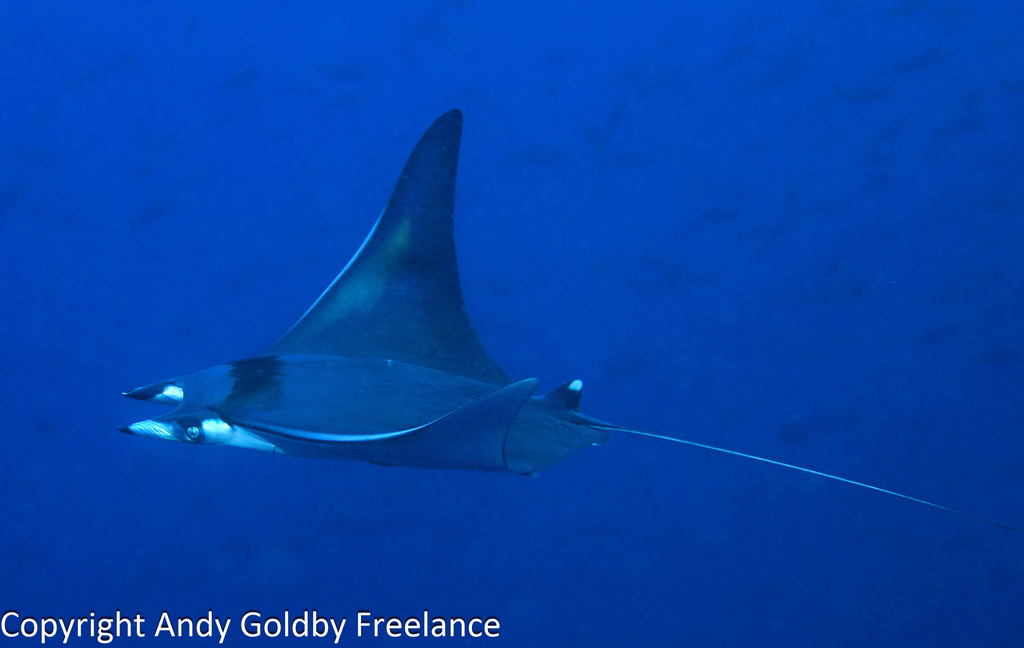
Bentfin Devil Ray
Mobula thurstoni
The bentfin devil ray (Mobula thurstoni), also known as the lesser devil ray, smoothtail devil ray, smoothtail mobula or Thurston's devil ray, is a species of ray in the family Mobulidae. It is found worldwide in tropical, subtropical and warm temperate oceans, with records from Australia, Brazil, Chile, Costa Rica, Ecuador, Egypt, El Salvador, Eritrea, Guatemala, Honduras, India, Indonesia, Ivory Coast, Japan, Malaysia, Maldives, Mexico, Myanmar, Nicaragua, Oman, Pakistan, Peru, the Philippines, Saudi Arabia, Senegal, South Africa, Sri Lanka, Thailand, United Arab Emirates, United States (California), Uruguay, Vanuatu and throughout the central and western Pacific. It likely occurs in many other locations in tropical, subtropical and warm temperate oceans. It is found both offshore and near the coast.
From the article Bentfin devil ray on Wikipedia (CC BY-SA), quoted section by section
Description
The bentfin devil ray can reach a disc width of 189 cm (6.2 ft) and weigh about 54 kg (120 lb). The length of the disc is about 1.95 times its width. The front edge of the disc is nearly straight near the snout, but curves sinuously as it approaches the broad, triangular pectoral fins. The back edge is concave, becoming straight as it approaches the tail. On either side of the snout are cephalic flaps, and the mouth is on the underside of the head. The dorsal fin is about 80% as high as it is long. The length of the tail is between half the disc width and the whole disc width, and the tail does not bear a spine. The upper surface of this ray varies from dark grey to olive-gray, and the under surface is white. The rear of the tip of the pectoral fins is black and the front edge of these fins is white, as is the tip of the dorsal fin.
Range & habitat
This species is probably circumglobal, and has been recorded from tropical and sub-tropical waters in the Atlantic Ocean, the Indian Ocean and the Pacific Ocean. In inshore waters it is mainly pelagic, seldom going as deep as 100 m (330 ft).
Wikipedia: “Distribution and habitat”
What it does
Like other closely related species, the bentfin devil ray feeds on plankton. It funnels water into its mouth as it swims. The ray filters plankton from the water through its gill rakers. In the Gulf of California, the commonest item in the diet is Nyctiphanes simplex, a species of krill, but this fish also feeds seasonally on opossum shrimps.
Wikipedia: “Ecology”
Where it lives
Recorded sightings
—
geo-referenced records in GBIF, from museums, herbaria and field observers.
Drag the globe to turn it. Dots are where records exist, not a range map; darker means more records.
In the stacks
Searching the stacks…
Every page naming Mobula thurstoni in the Biodiversity Heritage Library →
This page is assembled live from iNaturalist, GBIF, Wikipedia, the Source Library and the Internet Archive. It is not yet part of the hand-edited codex. iNaturalist taxon 105927.