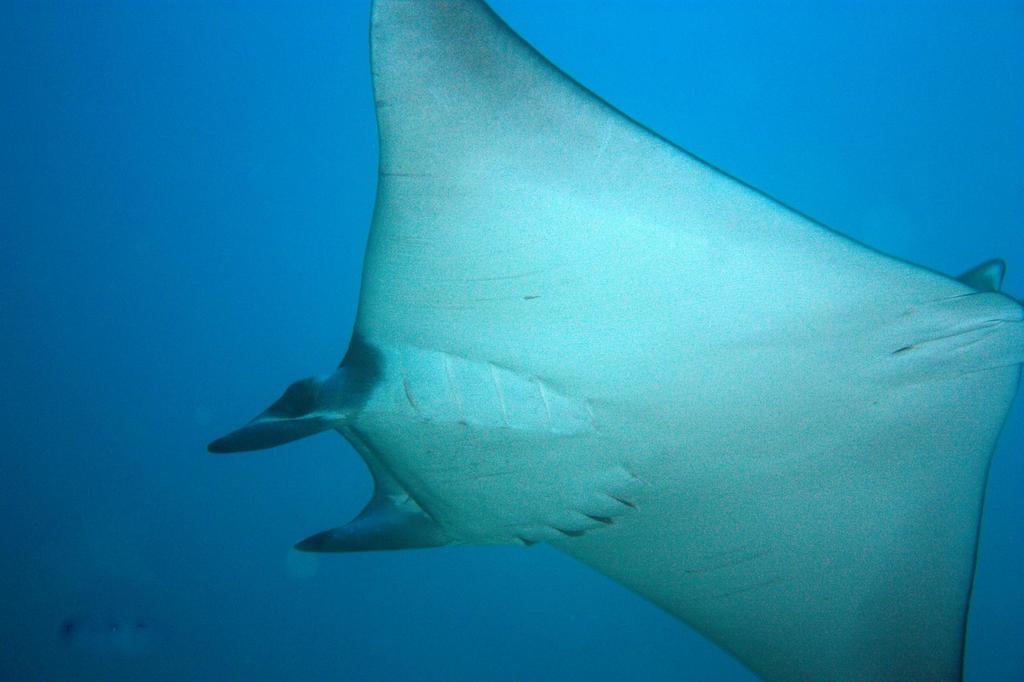
Munk's Pygmy Devil Ray
Mobula munkiana
Mobula munkiana, commonly known as the manta de monk, Munk's devil ray, pygmy devil ray, smoothtail mobula, or Munk's pygmy devil ray, is a species of ray in the family Mobulidae. They are commonly mistaken for their close relatives, M. thurstoni (bentfin devil ray) and M. mobular (giant devil ray). Although they are the smallest of the species in genus Mobula, they make up for their size with their incredible speed and agility. These characteristics are a likely explanation for their lack of natural predators, although they have been known to be hunted by orcas and are often fished by humans. One of the defining characteristics of this group are their acrobatic performances that are conducted while jumping in the air in schools of thousands. It is thought that these spectacles are a functional part of their lifestyle, including kickstarting mating rituals. The species was first described in 1987 after the Italian ecologist Giuseppe Notarbartolo di Sciara observed one of these acrobatic spectacles and decided to name them after his scientific mentor, Walter Munk.
From the article Mobula munkiana on Wikipedia (CC BY-SA), quoted section by section
Description
Part of the elasmobranch division Batomorphi, pygmy devil rays are large fish with horizontally flattened bodies, bulging eyes on the sides of their heads, and gill slits on the underside. On either side of the central disc, the pygmy devil rays have wide, pointed pectoral fins with which they swim. Protruding from the front of their heads is a pair of fleshy lobes that enable them to funnel food into their mouths as they move through the water. They also have a small dorsal fin with a brownish to mauve-gray rim outlining a lighter gray area in the center, a long and slender tail, and no caudal spine. The upper surface of this fish is lavender-gray to a dark purple-gray, and the underside is white, tinged with gray towards the tips of the pectoral fins. Towards the head, they have a dark gray stripe that resembles the look of a collar. This species can grow up to a width of 1.1 metres (3.6 ft), making them the smallest species of devil ray (although they are only slightly smaller than M. hypostoma and M. kuhlii). The width size is a useful determining factor for the age of the ray. Neonates and juveniles are typically classified as less than 97 cm for females and less than 98 cm for males. The juveniles and neonates can be differentiated from one another because neonates still have an umbilical cord scar present.
Range & habitat
Mobula munkiana rays are found in tropical parts of the eastern Pacific Ocean, ranging from the Gulf of California to Peru, as well as near offshore islands such as the Galapagos, Cocos, and Malpelo. They are often found in coastal waters near the surface or the seabed, likely in schools, but sometimes alone or in small groups. Most of their time is spent at the sea surface because this is where food sources are most abundant while in the open ocean. When they are in shallower waters during reproductive season, they tend to reside near the seabed where food congregates on the bottom. It is suspected that they are a migratory species, but their migratory movements are poorly understood and may relate to differences in the temperature of surface waters.
Wikipedia: “Distribution and habitat”
What it does
Munk's pygmy devil rays are pelagic planktivorous, which means they feed on plankton, specifically zooplankton. Additionally, they are known to eat mysids and krill. As the rays swim, water flows into their mouths and out through the gill slits, which filters out small particles and absorbs oxygen from the water. Alongside other devil ray species, they have filter pads that are covered with filter lobes. The M. munkiana specifically has a high number of goblet cells that secrete mucus along the epithical layer, which helps trap the food. Because of this type of filter feeding, they are often found in areas of massive upwelling, such as the Costa Rican Dome. The shallow breaking zones are their preferred area, as this is where zooplankton is usually most abundant.
Wikipedia: “Feeding”
Where it lives
Recorded sightings
—
geo-referenced records in GBIF, from museums, herbaria and field observers.
Drag the globe to turn it. Dots are where records exist, not a range map; darker means more records.
In the stacks
Searching the stacks…
Every page naming Mobula munkiana in the Biodiversity Heritage Library →
This page is assembled live from iNaturalist, GBIF, Wikipedia, the Source Library and the Internet Archive. It is not yet part of the hand-edited codex. iNaturalist taxon 105924.