- Animals
- ›Chordates
- ›Vertebrates
- ›Cartilaginous Fishes
- ›Sharks and Rays
- ›Sharks
- ›Galean Sharks
- ›Ground Sharks
- ›Deepwater Catsharks
- ›Halaelurus
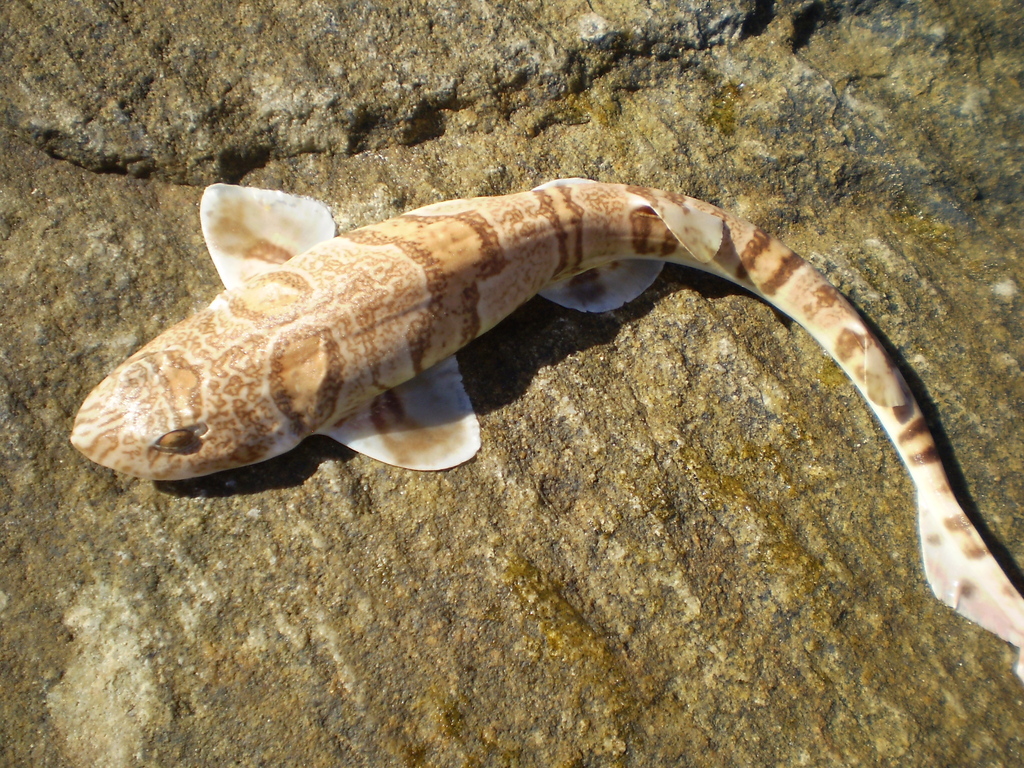
Tiger Catshark
Halaelurus natalensis
The tiger catshark (Halaelurus natalensis) is a species of shark belonging to the family Pentanchidae, the deepwater catsharks. It is found over sandy areas and near reef peripheries off South Africa and perhaps Mozambique, from close to shore to usually no deeper than 100 m (330 ft). Reaching a length of 50 cm (20 in), this small, slim shark has a broad, flattened head with an upturned snout tip. It can additionally be identified by its dorsal colour pattern of ten dark brown saddles on a yellowish brown background.
Bottom-dwelling and inactive, the tiger catshark feeds on a wide variety of fishes and invertebrates from on or near the sea floor. An oviparous species, the female retains her eggs internally until the embryos are at an advanced state of development, resulting in a relatively short hatching time after laying. Between 12 and 22 encapsulated eggs are produced at a time, which the female attaches to the bottom. The tiger catshark is caught incidentally by commercial and recreational fishers but has no economic value. It has been listed as vulnerable by the International Union for Conservation of Nature (IUCN).
From the article Tiger catshark on Wikipedia (CC BY-SA), quoted section by section
Description
The body of the tiger catshark is slim and firm, and it grows up to 50 cm (20 in) long. The head is broad and flattened, with a distinct and upturned snout tip. The horizontally oval eyes are situated high on the head and protected by rudimentary nictitating membranes. Beneath each eye is a broad ridge, and behind is a spiracle. The medium-sized nostrils are divided by lobe-like flaps of skin on their anterior rims. The nasal flaps do not reach the large mouth, which forms a wide arch and bears short furrows around the corners. When the mouth is closed, the centre of the lower jaw falls well short of the upper, leaving the upper teeth exposed. The teeth are small and 3-cusped (rarely 5-cusped), with the central cusp the longest. The five pairs of gill slits are placed higher than the level of the mouth and face somewhat upwards. The pectoral fins are fairly large and rounded. The origin of the first dorsal fin lies over the last third of the pelvic fin bases, while the origin of the much larger second dorsal fin lies over the rear of the anal fin. The claspers of adult males are moderately long and tapering, though those of some individuals may be knob-shaped and spiky. The anal fin is roughly equal in size to the pelvic fins, and smaller but longer-based than the second dorsal fin. …
Range & habitat
The tiger catshark is endemic to southern Africa, but the limits of its distribution are not well known. It is known to occur off the Western and Eastern Cape, South Africa, while easterly records from KwaZulu-Natal and Mozambique are uncertain due to confusion with the lined catshark. A common, bottom-dwelling inhabitant of the continental shelf, this shark favours sandy flats and the edges of reefs. It is usually found from the shore to a depth of 100 m (330 ft); sharks in the eastern part of its range tend to occur in deeper water than those in the west. There are species records from as deep as 172 m (564 ft), as well as a single dubious record from 355 m (1,165 ft) down on the continental slope. It may segregate by size, with the adults found farther from shore.
Wikipedia: “Distribution and habitat”
What it does
The tiger catshark is a sluggish predator of a diverse array of benthic organisms. Its diet is dominated by bony fishes and crustaceans, and also includes cephalopods, polychaete worms, smaller sharks, and scavenged fish offal. It has been observed at the spawning grounds of the chokka squid (Loligo vulgaris reynaudi), feeding on squid that have descended to the bottom to mate and deposit eggs. Documented predators of this species include the broadnose sevengill shark (Notorynchus cepedianus) and the ragged tooth shark (Carcharias taurus). Reproduction in the tiger catshark is oviparous: females produce 6–11 (typically 6–9) eggs in each of their two oviducts at a time. The eggs are contained in tough capsules around 4 cm (1.6 in) long and 1.5 cm (0.59 in) across; the capsule has thick tendrils at the corners that allow it to be secured to the sea floor. The female retains the eggs internally until the embryos are substantially developed, measuring at least 4.3 cm (1.7 in) long. Thus, the eggs hatch within only one or two months of being laid, reducing the amount of time that they are exposed to predators. Males and females begin to reach sexual maturity at lengths of 29–35 cm (11–14 in) and 30–44 cm (12–17 in) respectively.
Wikipedia: “Biology and ecology”
Where it lives
Recorded sightings
—
geo-referenced records in GBIF, from museums, herbaria and field observers.
Drag the globe to turn it. Dots are where records exist, not a range map; darker means more records.
In the stacks
Searching the stacks…
Every page naming Halaelurus natalensis in the Biodiversity Heritage Library →
This page is assembled live from iNaturalist, GBIF, Wikipedia, the Source Library and the Internet Archive. It is not yet part of the hand-edited codex. iNaturalist taxon 102020.