- Animals
- ›Chordates
- ›Vertebrates
- ›Cartilaginous Fishes
- ›Sharks and Rays
- ›Sharks
- ›Galean Sharks
- ›Ground Sharks
- ›Deepwater Catsharks
- ›Apristurus
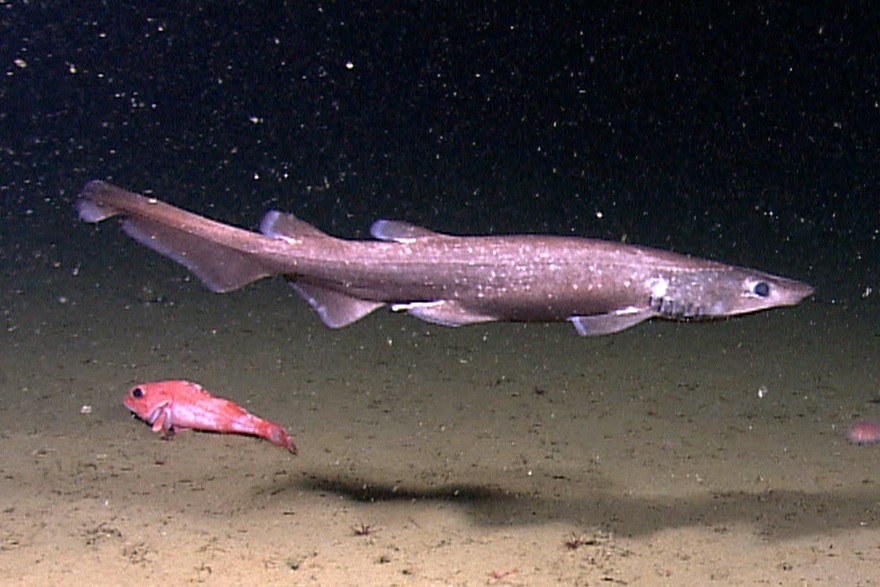
Brown Catshark
Apristurus brunneus
The brown catshark (Apristurus brunneus) is commonly found in the Pacific Ocean, ranging from the northern Pacific waters off the coast of British Columbia and south to the Baja California peninsula in Mexico. They may live as far south as Ecuador and Peru. Brown catsharks are deep-water sharks that live on the outer continental shelf and the upper slope. They have been known to live at depths ranging from 30 to 650 m and live on the bottom, usually in muddy or sandy areas.
The brown catshark, when originally described, was called Catulus brunneus.
From the article Brown catshark on Wikipedia (CC BY-SA), quoted section by section
Description
Brown catsharks have long, slender bodies with broad, bell-shaped snouts. They are dark brown with light-colored markings on the posterior margins of their fins. Their bodies are soft and flabby, with a weak skin that can easily be harmed. Brown catsharks' two dorsal fins are the same size and do not have spines. The first dorsal fin originates to the front of the pelvic fin and the second dorsal fin is located in front of the anal fin's insertion. They typically reach a maximum size of 68 cm in total length, but they average between 30 and 60 cm.
What it does
Very little is known about the behavior of brown catsharks; they are believed to be solitary, nocturnal creatures. They are thought to be migratory, but most of the year near the edge of the continental shelf. Communication specific to brown catsharks is unknown. However, as with most other sharks, including other members of the family Scyliorhinidae, they are believed to have a well-developed sense of smell, and are electroreceptive, which allows them to detect electricity emitted by other animals, and may also allow them to detect magnetic fields, which aides in navigation.
Wikipedia: “Behavior”
At the table
Brown catsharks feed on many bottom-dwelling species, including small shrimp, euphausiids, squid, and small fish. It is unknown whether brown catsharks are important predators within their ecosystem.
Wikipedia: “Food habits and predation”
Where it lives
Recorded sightings
—
geo-referenced records in GBIF, from museums, herbaria and field observers.
Drag the globe to turn it. Dots are where records exist, not a range map; darker means more records.
In the stacks
Searching the stacks…
Every page naming Apristurus brunneus in the Biodiversity Heritage Library →
This page is assembled live from iNaturalist, GBIF, Wikipedia, the Source Library and the Internet Archive. It is not yet part of the hand-edited codex. iNaturalist taxon 94439.