- Animals
- ›Chordates
- ›Vertebrates
- ›Cartilaginous Fishes
- ›Sharks and Rays
- ›Sharks
- ›Squalean Sharks
- ›Angel Sharks
- ›Angel Sharks
- ›Squatina
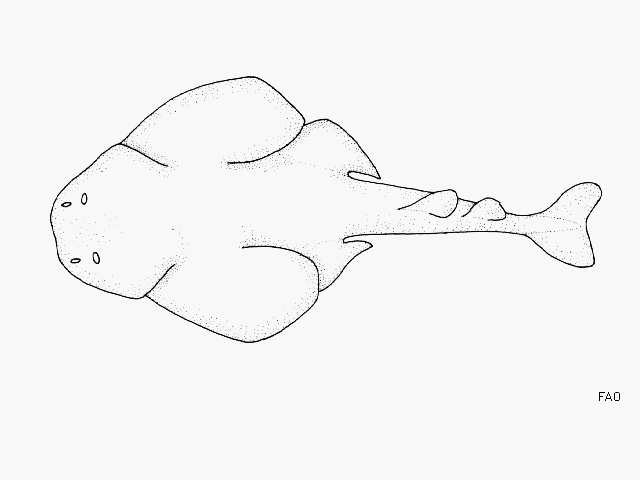
Taiwan Angelshark
Squatina formosa
The Taiwan angelshark (Squatina formosa) is an angelshark in the family Squatinidae. The Taiwan angelshark is one of four species of Squatina in the waters around Taiwan and Japan. It is a demersal, ray-like shark that grows to 1–2 meters in length.
From the article Taiwan angelshark on Wikipedia (CC BY-SA), quoted section by section
Description
Taiwan angelsharks are ray-like sharks. Since they are demersal sharks and spend most of their time resting on the sediment, their eyes and spiracles are located dorsally. The dorsal surface is covered in somewhat rough dermal denticles. The overall shape of the head is rounded and about 20 percent of the total body length. The widest part of the head is just before the gill openings. The species has tubercles between the mouth and eyes. Its teeth are small and cone-like without serrations, forming three rows. Taiwan angel sharks have large, broad pectoral fins, spineless dorsal fins, no anal fins, and a caudal fin that is hypocercal (the lower lobe is larger and more pronounced than the upper lobe). Both dorsal fins are lobed and are approximately the same size. An adult Taiwan angel shark can grow to be up to 2 m in length. Growth is generally slow and maturity happens late in life. Reproduction is ovoviviparous. Like other benthic sharks, is dark in coloration, brown with many black and white splotches on the dorsal side. The abdomen is lighter, pale white, with black splotches.
Range & habitat
Taiwan angelsharks are endemic to the waters of the continental shelf off Taiwan, between latitudes 20° N and 24° N). They occur at depths of 100–300 m, sometimes in shallower waters. The species is an ambush predator and buries itself in the sediment to wait for prey to come into range.
Wikipedia: “Distribution and habitat”
Where it lives
Recorded sightings
—
geo-referenced records in GBIF, from museums, herbaria and field observers.
Drag the globe to turn it. Dots are where records exist, not a range map; darker means more records.
In the stacks
Searching the stacks…
Every page naming Squatina formosa in the Biodiversity Heritage Library →
This page is assembled live from iNaturalist, GBIF, Wikipedia, the Source Library and the Internet Archive. It is not yet part of the hand-edited codex. iNaturalist taxon 113053.