- Animals
- ›Chordates
- ›Vertebrates
- ›Cartilaginous Fishes
- ›Sharks and Rays
- ›Sharks
- ›Squalean Sharks
- ›Angel Sharks
- ›Angel Sharks
- ›Squatina
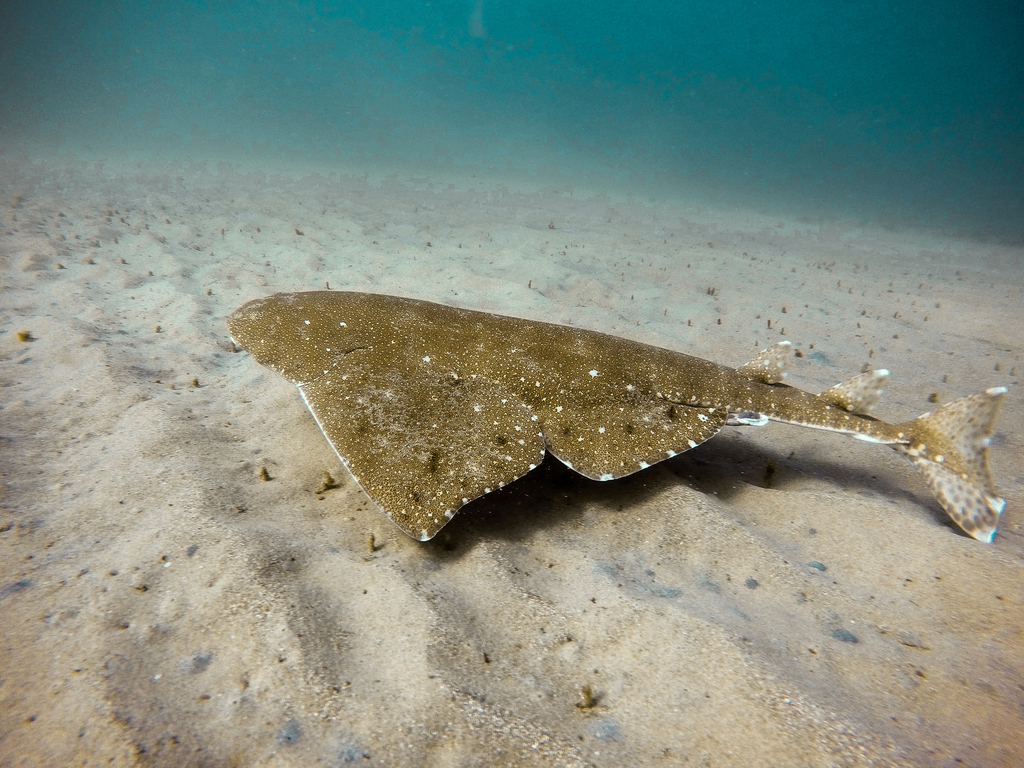
Australian Angelshark
Squatina australis
The Australian angelshark (Squatina australis) is a species of angelshark, family Squatinidae, found in the subtropical waters of southern Australia from Western Australia to New South Wales between latitudes 18°S and 41°S, at depths down to 255 m (840 ft). Its length is up to 1.52 m (5 ft). Reproduction is ovoviviparous, with up to 20 pups in a litter.
From the article Australian angelshark on Wikipedia (CC BY-SA), quoted section by section
Description
The Australian angelshark has a broad, vertically compressed body and large triangular pectoral fins with free trailing flaps. The snout has fringed barbels beside the nostrils and a pair of spiracles. Each of these is set at a distance from the eye of about one and a half times the diameter of the eye. There are two small dorsal fins set far back and the tail fin is small. The maximum length is about 152 centimetres (60 in) and this shark has no large eyespots on the body. Male individuals are fully mature at around 800 millimetres (31 in) total length.
Range & habitat
The Australian angelshark is native to the continental shelf of southern Australia being found along the coasts of Western Australia, South Australia, Victoria, Tasmania and New South Wales at depths down to about 130 metres (430 ft). It is usually found on sandy or muddy seabeds and in seagrass meadows, often close to rocky reefs.
Wikipedia: “Distribution and habitat”
What it does
The Australian angelshark lies semi-submerged in the sediment on the seabed during the day, eating anything that comes too close. It emerges at night to actively seek out prey. Its diet consists of small fish, crustaceans and other invertebrates. This shark is ovoviviparous, retaining its developing embryos in its oviduct, with a litter of up to twenty young being born. Little is known of its breeding habits, but the closely related Pacific angelshark (Squatina californica) has a gestation period of about ten months.
Wikipedia: “Behaviour”
Where it lives
Recorded sightings
—
geo-referenced records in GBIF, from museums, herbaria and field observers.
Drag the globe to turn it. Dots are where records exist, not a range map; darker means more records.
In the stacks
Searching the stacks…
Every page naming Squatina australis in the Biodiversity Heritage Library →
This page is assembled live from iNaturalist, GBIF, Wikipedia, the Source Library and the Internet Archive. It is not yet part of the hand-edited codex. iNaturalist taxon 113050.