- Animals
- ›Chordates
- ›Vertebrates
- ›Cartilaginous Fishes
- ›Sharks and Rays
- ›Sharks
- ›Squalean Sharks
- ›Angel Sharks
- ›Angel Sharks
- ›Squatina
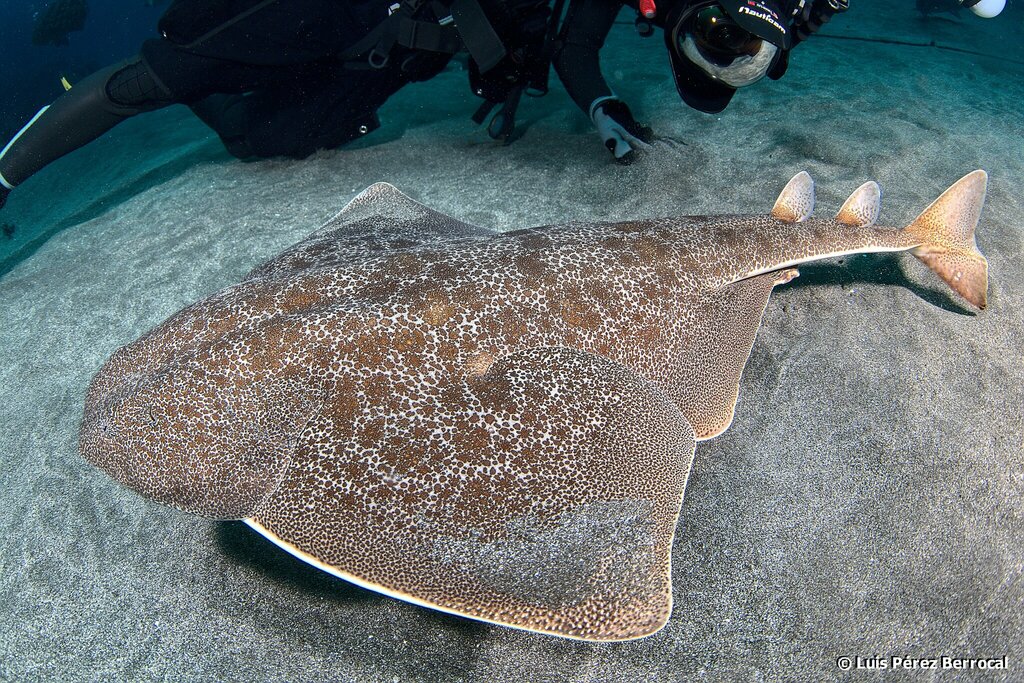
Japanese Angelshark
Squatina japonica
The Japanese angelshark (Squatina japonica) is a species of angelshark, family Squatinidae, found in the northwestern Pacific Ocean off China, Japan, and Korea. It is a bottom-dwelling shark found in sandy habitats down to 300 m (980 ft) deep. This species has the flattened shape with wing-like pectoral and pelvic fins typical of its family, and grows to 1.5 m (4.9 ft) or more in length. Its two dorsal fins are placed behind the pelvic fins, and a row of large thorns occurs along its dorsal midline. Its upper surface is cryptically patterned, with numerous squarish dark spots on a brown background.
Feeding on fishes, cephalopods, and crustaceans, the Japanese angelshark is a nocturnal ambush predator that spends most of the day lying still on the sea floor. This species gives birth to live young, which are sustained during gestation by yolk. The litter size varies from two to 10. The Japanese angelshark is not dangerous to humans unless provoked. It is fished in large numbers and used for meat and shagreen, a type of leather.
From the article Japanese angelshark on Wikipedia (CC BY-SA), quoted section by section
Description
The Japanese angelshark is fairly narrow-bodied and has greatly enlarged pectoral and pelvic fins. The skin folds along the sides of the head lack distinct lobes. The eyes are oval and widely spaced; closely behind are crescent-shaped spiracles with large, boxy projections inside their anterior rims. Each nostril is large and preceded by a small flap of skin bearing two barbels; the outer barbel is thin, while the inner barbel has a spoon-like tip and a smooth to slightly fringed flange at the base. The wide mouth is terminally placed and has furrows at the corners. There are 10 tooth rows on either side of both jaws, separated by a gap in the middle; the teeth are small, narrow, and pointed. There are five pairs of gill slits located on the sides of the head. The frontmost portion of each pectoral fin forms a triangular lobe separate from the head. The outer corners of the pectoral fins are angular, and their rear tips are rounded. The pelvic fins have convex margins. The two angular dorsal fins are similar in shape and size, and are located behind the pelvic fins. The caudal peduncle is flattened with a keel running along either side, and supports a roughly triangular caudal fin with rounded corners. The lower lobe of the caudal fin is larger than the upper. …
Range & habitat
The Japanese angelshark is native to the cooler waters of the northwestern Pacific; its range extends from the eastern coast of Honshu, Japan, to Taiwan, and includes the southern Sea of Japan, the Yellow Sea, the East China Sea, and the Taiwan Strait. Some older sources reported it may occur in the Philippines, but recent research suggests the only angel shark species in that area is S. caillieti. The Japanese angelshark inhabits the continental shelf, usually in the shallows, but also to as deep as 300 m (980 ft). It is a bottom-dweller found over sandy bottoms, often close to rocky reefs.
Wikipedia: “Distribution and habitat”
What it does
During the day, the Japanese angelshark mostly lies partly buried on the bottom; its complex color pattern provides camouflage as it ambushes nearby prey. At night, this species becomes more active. Its diet consists of demersal fishes, cephalopods, and crustaceans. It may be found alone or in proximity to others of its species. Parasites documented from this species include the tapeworms Phyliobothrium marginatum and Tylocephalum squatinae, the copepods Eudactylina squatini and Trebius shiinoi, and the praniza larvae of the isopod Gnathia trimaculata. The Japanese angelshark is viviparous, and as in other members of its family the developing embryos are nourished by yolk. Litters of two to ten pups are birthed in spring and summer, with the newborns measuring 22 cm (8.7 in) long. Females mature sexually at 80 cm (31 in) long, while male maturation size is unknown.
Wikipedia: “Biology and ecology”
Where it lives
Recorded sightings
—
geo-referenced records in GBIF, from museums, herbaria and field observers.
Drag the globe to turn it. Dots are where records exist, not a range map; darker means more records.
In the stacks
Searching the stacks…
Every page naming Squatina japonica in the Biodiversity Heritage Library →
This page is assembled live from iNaturalist, GBIF, Wikipedia, the Source Library and the Internet Archive. It is not yet part of the hand-edited codex. iNaturalist taxon 113056.