- Animals
- ›Chordates
- ›Vertebrates
- ›Cartilaginous Fishes
- ›Sharks and Rays
- ›Sharks
- ›Squalean Sharks
- ›Angel Sharks
- ›Angel Sharks
- ›Squatina
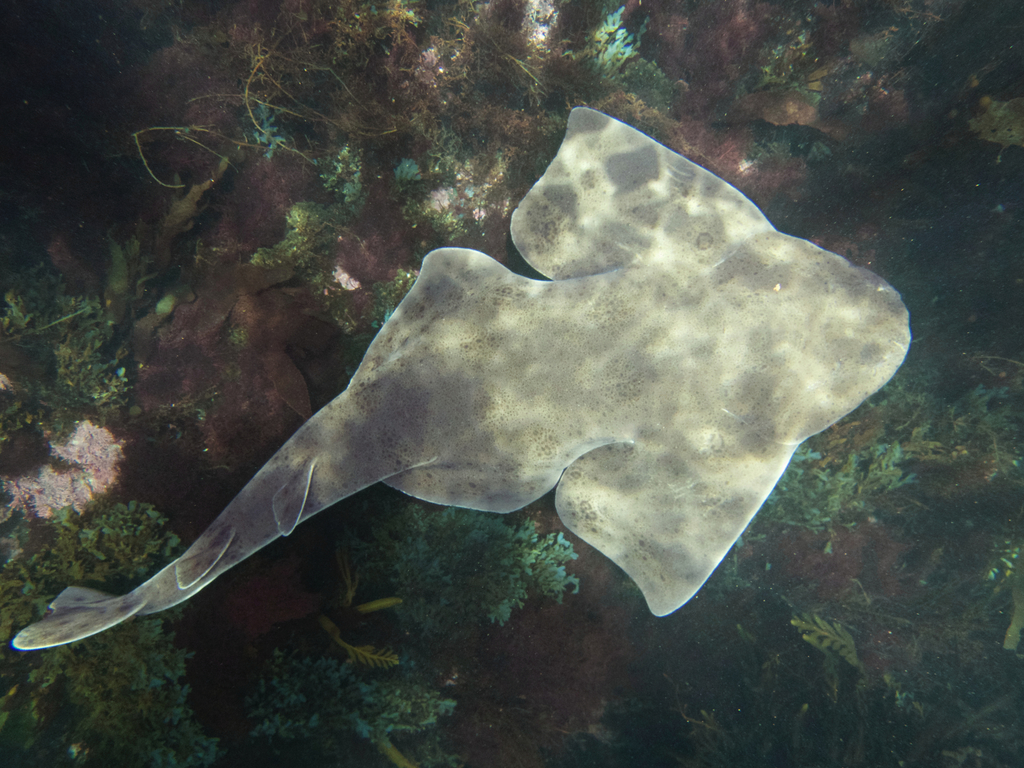
Pacific Angelshark
Squatina californica
The Pacific angelshark (Squatina californica) is a species of angelshark, family Squatinidae, found in the eastern Pacific Ocean from Alaska to the Gulf of California, and from Ecuador to Chile, although those in the Gulf of California and southeastern Pacific may in fact be separate species. The Pacific angelshark inhabits shallow, coastal waters on sandy flats, usually near rocky reefs, kelp forests, or other underwater features. This species resembles other angel sharks in appearance, with a flattened body and greatly enlarged pectoral and pelvic fins. Characteristic features of this shark include a pair of cone-shaped barbels on its snout, angular pectoral fins, and a brown or gray dorsal coloration with many small dark markings. It attains a maximum length of 1.5 m (4.9 ft).
An ambush predator, the Pacific angelshark conceals itself on the sea floor and waits for approaching prey, primarily bony fishes and squid. Prey are targeted visually and, with a quick upward thrust of the head, snatched in protrusible jaws. Individual sharks actively choose ideal ambush sites, where they stay for several days before moving on to a new one. This species is more active at night than during the day, when it stays buried in sediment and seldom moves. Reproduction is ovoviviparous, with the embryos hatching inside the mother's uterus and being sustained by a yolk sac until birth. Females give birth to an average of six young every spring.
From the article Pacific angelshark on Wikipedia (CC BY-SA), quoted section by section
Description
With its flattened body and wing-like pectoral fins, the Pacific angelshark superficially resembles a ray. Unlike in rays, its five pairs of gill slits are located on the sides of the head rather than underneath, and the expanded anterior lobes of its pectoral fins are separate rather than fused to the head. The eyes are located on top of the head, with the spiracles behind. There are folds of skin without triangular lobes on the sides of head. The mouth is very wide and placed terminally (at the front of the snout); a pair of cone-shaped barbels with spoon-like tips are located above. There are 9 tooth rows on either side of the upper jaw and 10 tooth rows on either side of the lower jaw, with toothless gaps at the middle of both jaws. Each tooth has a broad base and a single narrow, smooth-edged cusp. Pacific angelsharks are founded in Clover Point, Vancouver Island to southern Baja California and Gulf of California and Peru. Although, there are unverifiable records from southeastern Alaska and Chile. Common from Tomales Bay, northern California southward. Pacific angelsharks grow to be 175 cm (68.9 in) long, and at birth about 25 cm (9.8 in). Depth: surf zone to 205 m (672 ft). The pectoral and pelvic fins are broad and angular with pointed tips. The two dorsal fins are located far back on the body, and there is no anal fin. …
Range & habitat
Pacific angelsharks are found in cold to warm-temperate waters from the southeastern corner of Alaska to the Gulf of California, including the entire Baja peninsula, and are most common off central and southern California. It may also occur from Ecuador to the southern tip of Chile (see taxonomic uncertainty above). This bottom-dwelling shark prefers habitats with soft, flat bottoms close to shore, such as estuaries and bays, and are often found near rocky reefs, submarine canyons, and kelp forests. On occasion, they have been seen swimming 15–91 m (49–299 ft) above the sea floor. Off California, the Pacific angelshark is most common at a depth of 3–45 m (9.8–147.6 ft), but has been reported from as deep as 205 m (673 ft). A number of genetically discrete subpopulations have been identified across the northern range of the Pacific angelshark. Several subpopulations exist along the coast from Point Conception northward to Alaska. In the Southern California Bight, there are at least three separate subpopulations off the mainland and northern and southern Channel Islands. The subpopulation along the Pacific coast of Baja California are distinct from those in the Gulf of California. …
Wikipedia: “Distribution and habitat”
What it does
During the day, Pacific angelsharks are almost never seen in the open, instead resting motionless on the sea floor buried under a thin layer of sediment that disguises their outlines. At night some individuals remain motionless, waiting for prey, while others may be encountered on the bottom unburied or actively swimming. Large sharks, including the great white shark (Carcharodon carcharias) and the broadnose sevengill shark (Notorynchus cepedianus), and the northern elephant seal (Mirounga angustirostris) are known to consume Pacific angelsharks. Known parasites of this species include the copepod Trebius latifurcatus, which infests the skin, the myxosporidian Chloromyxum levigatum, which infests the gall bladder, and the tapeworm Paraberrapex manifestus, which infests the spiral valve intestine. The leech Branchellion lobata may be attached around this shark's cloaca, inside the intestine, and even inside the uterus and on developing embryos.
Feeding. A sedentary ambush predator, the Pacific angelshark feeds mainly on bony fishes, including kelp bass, croakers, flatfishes, damselfishes, mackerels, and sardines. During the winter and early spring, spawning squid are abundant and become the primary source of food. …
Wikipedia: “Biology and ecology”
Where it lives
Recorded sightings
—
geo-referenced records in GBIF, from museums, herbaria and field observers.
Drag the globe to turn it. Dots are where records exist, not a range map; darker means more records.
In the stacks
Searching the stacks…
Every page naming Squatina californica in the Biodiversity Heritage Library →
This page is assembled live from iNaturalist, GBIF, Wikipedia, the Source Library and the Internet Archive. It is not yet part of the hand-edited codex. iNaturalist taxon 113051.