- Animals
- ›Chordates
- ›Vertebrates
- ›Ray-finned Fishes
- ›Spiny-rayed fishes
- ›Anglerfishes
- ›Pelagic Anglerfishes
- ›Wolftrap Anglers
- ›Lasiognathus
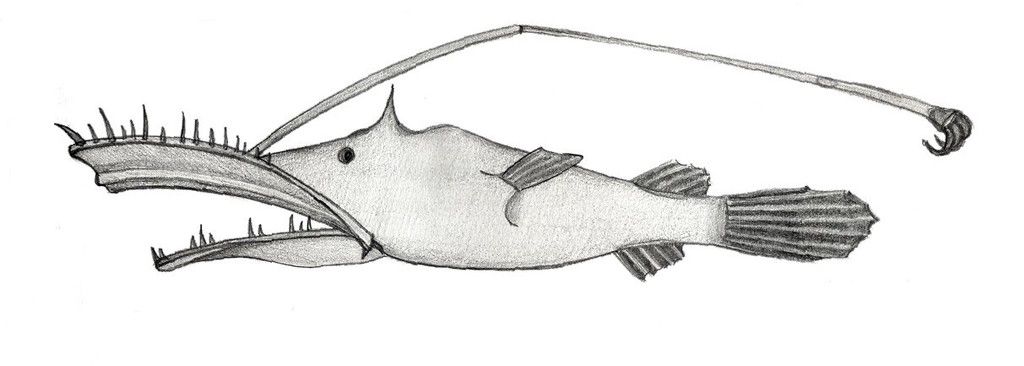
Lasiognathus beebei
Lasiognathus beebei is a species of wolftrap angler known from around the Hawaiian Islands in the Pacific Ocean and from around Madeira and Bermuda in the Atlantic. It is found at depths of around 1,100 metres (3,600 ft). The females of this species grow to a length of 11.5 centimetres (4.5 in) TL. This species is distinguishable by its hooks being placed on a short, transverse, fan-shaped distal escal appendage as opposed to the elongated, cylindrical appendage of...
From the article Lasiognathus beebei on Wikipedia (CC BY-SA), quoted section by section
Description
Lasiognathus beebei has 6 or 7 soft rays in its dorsal fin and 4 or 5 soft rays in its anal fin. It is distinguished from its congeners by the morphology of the esca which has a bulb without a membrane-like crest, a compressed fan-shaped appendage on its tip, three bony hooks along its rear margin which do not have long extensions emerging from their bases and a cylindrical rear appendage which tapers to a point. The illicium is just under half of the standard length, being longer in larger specimens. This species has a maximum published total length of 11.5 cm (4.5 in).
Range & habitat
Lasiognathus beebei has been recorded from several widely scattered localities in the North Atlantic, as well as off Oahu in Hawaii. Its actual distribution is probably wider than this. It has been caught from depths between 0 and 1,100 m (0 and 3,609 ft).
Wikipedia: “Distribution and habitat”
In human culture
Lasiognathus beebei is a member of the genus Lasiognathus, this name is a combination of lasios, meaning "bearded", and gnathus, which means "jaw". This may be a reference to the many long teeth in the upper jaw, giving the appearance of a beard. The specific name honors the American naturalist William Beebe.
Wikipedia: “Etymology”
Where it lives
Recorded sightings
—
geo-referenced records in GBIF, from museums, herbaria and field observers.
Drag the globe to turn it. Dots are where records exist, not a range map; darker means more records.
In the stacks
Searching the stacks…
Every page naming Lasiognathus beebei in the Biodiversity Heritage Library →
This page is assembled live from iNaturalist, GBIF, Wikipedia, the Source Library and the Internet Archive. It is not yet part of the hand-edited codex. iNaturalist taxon 459405.