- Animals
- ›Chordates
- ›Vertebrates
- ›Ray-finned Fishes
- ›Spiny-rayed fishes
- ›Silversides
- ›Atherinoidei
- ›Blue-eyes
- ›Pseudomugil
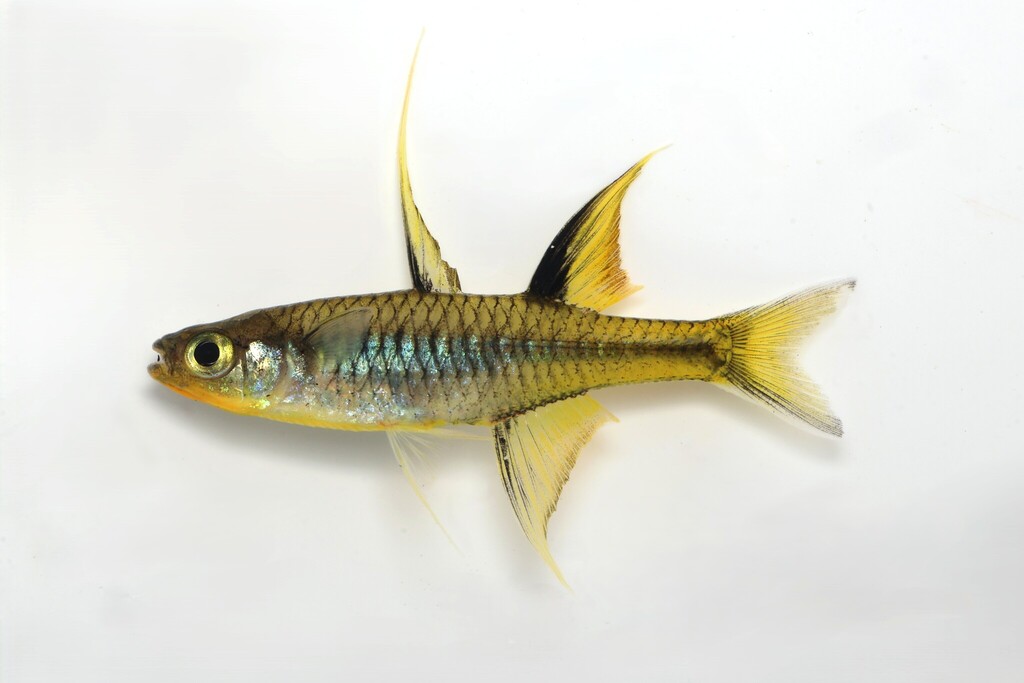
Pacific Blue Eye
Pseudomugil signifer
The Pacific blue-eye (Pseudomugil signifer) is a species of fish in the subfamily Pseudomugilinae native to eastern Australia. Described by Austrian naturalist Rudolf Kner in 1866, it comprises two subspecies that have been regarded as separate species in the past and may be once again with further study. It is a common fish of rivers and estuaries along the eastern seaboard from Cape York in North Queensland to southern New South Wales, the Burdekin Gap in central-north Queensland dividing the ranges of the two subspecies.
A small silvery fish averaging around 3.25 cm in total length (1+1⁄8–1+3⁄8 in), the Pacific blue-eye is recognisable by its blue eye-ring and two dorsal fins. It forms loose schools of tens to thousands of individuals. It eats water-borne insects as well as flying insects that land on the water's surface, foraging for them by sight. The Pacific blue-eye adapts readily to captivity.
From the article Pacific blue-eye on Wikipedia (CC BY-SA), quoted section by section
Description
The Pacific blue-eye generally reaches a total length of around 3–3.5 cm (1+1⁄8–1+3⁄8 in) long; males can reach 8.8 cm (3+1⁄2 in) and females 6.3 cm (2+1⁄2 in). The size of Pacific blue-eyes found north of the Burdekin Gap increases directly with distance from the gap, males and females being the same size. South of the Burdekin Gap, the species exhibits marked size difference between sexes, which becomes more pronounced as the distance from the gap increases. The elongate body is partly transparent and pale yellow or olive with a silver operculum and belly. The scales are relatively large and longer vertically than horizontally. The eye is large and has a blue iris. There are two dorsal fins, the first arising in line with or just posterior to the longest pectoral fin ray. The forked tail fin has rounded tips. The bottom and top edges of the tail fin are edged with white. The male has extended filaments on its dorsal, anal, and pelvic fins. There are black markings at the base of the anterior rays of the anal and rear dorsal fins, and the front (anterior edge) is sometimes white and the rear (posterior) edge greyish in colour. The male's fins may turn orange during the breeding season. Preserved specimens generally discolour to yellow or tan. …
Range & habitat
The Pacific blue-eye is found from Narooma in southern New South Wales north to the Rocky River in Cape York, though it is uncommon in eastern Cape York. It lives in small, generally slow-moving, streams to estuaries, as well as dune lagoons and salt marshes. It is also found in brackish and marine waters on some Queensland offshore islands such as Hinchinbrook Island, Lizard Island, Low Island, and Dunk Island. It has been recorded as far as 300 km (185 mi) upstream in the Mary and Dawson Rivers in Queensland. Numbers can be prolific in some locations, such as the Mary River. Conversely, it is uncommon in the Elliott and Kolan Rivers. Fish species it is commonly found with include Marjorie's hardyhead (Craterocephalus marjoriae), crimson-spotted rainbowfish (Melanotaenia duboulayi), Australian smelt (Retropinna semoni) and western carp gudgeon (Hypseleotris klunzingeri). In the wet tropics, the Pacific blue-eye is mostly found in streams flowing up to 30 cm (12 in) per second, or rarely 90 cm (35 in) per second. Within fast-flowing areas, it shelters in areas of slower-moving water—less than 20 cm (8 in) per second—sometimes in the lower half of the water column or in the lee of underwater rocks. Further south in southeastern Queensland it is mostly found in water flowing more slowly than 10 cm (4 in) per second. …
Wikipedia: “Distribution and habitat”
What it does
The Pacific blue-eye is found in loose schools of tens to thousands of fish. They are generally found in the middle to upper water column within 1 metre (3 ft) of the riverbank and often close to underwater cover. The Pacific blue-eye is euryhaline—it can survive in a wide range of water salinities from fresh-water to marine environments. It responds to changes in salinity (and the resulting change in buoyancy) by changing the volume of its swim bladder, which takes up to 6 hours and 40 minutes when salinity is reduced and around 5 hours when it is increased. In the meantime, the fish can swim with a head-up or head-down posture, which either increases or decreases buoyancy respectively. This adaptation helps the fish in the range of salinities it encounters in its estuarine environment. In a school of Pacific blue-eyes that is threatened, a few individuals accelerate and change direction, which initiates an escape wave that spreads through the whole cohort. Animals are known to dart in random directions and speeds as an escape response when threatened. Pacific blue-eyes on their own dart in this manner for up to ten seconds after being faced with a threat at close range. This period is briefer when faced with more distant threats or for fish in schools.
Wikipedia: “Behaviour”
Where it lives
Recorded sightings
—
geo-referenced records in GBIF, from museums, herbaria and field observers.
Drag the globe to turn it. Dots are where records exist, not a range map; darker means more records.
In the stacks
Searching the stacks…
Every page naming Pseudomugil signifer in the Biodiversity Heritage Library →
This page is assembled live from iNaturalist, GBIF, Wikipedia, the Source Library and the Internet Archive. It is not yet part of the hand-edited codex. iNaturalist taxon 369054.