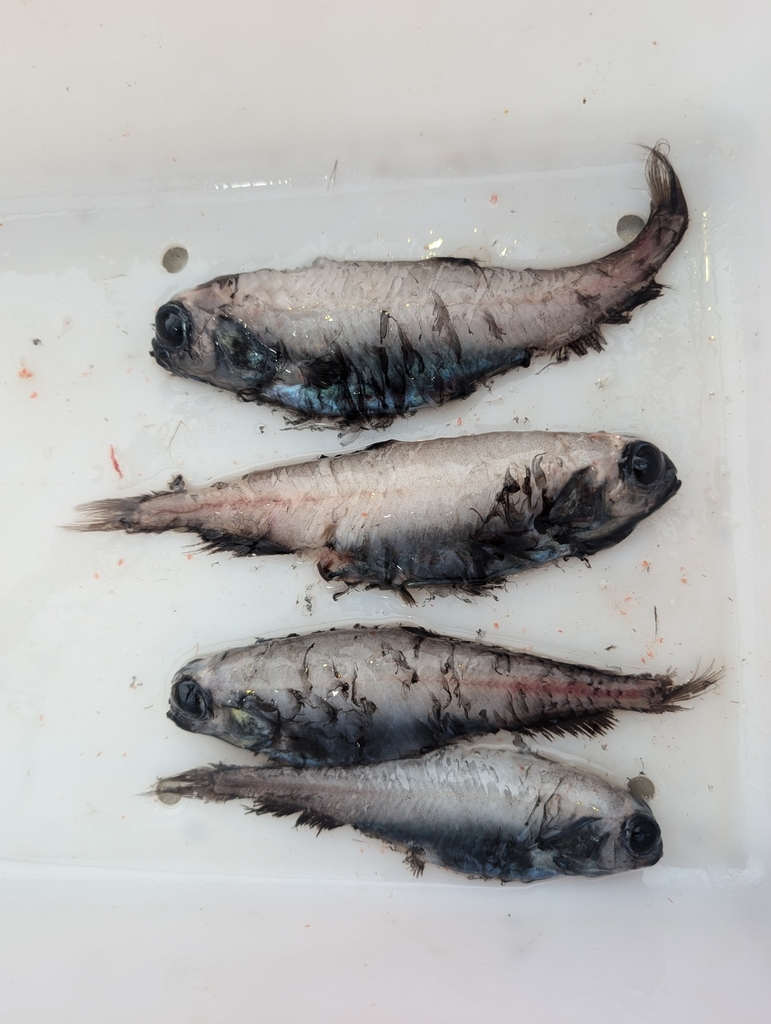
Stout Blacksmelt
Pseudobathylagus milleri
Pseudobathylagus milleri, the Stout blacksmelt, also called the Owlfish due to its large eyes relative to its body, is a species of deep-sea smelt native to the north Pacific Ocean where it is found to depths of 6,600 m (21,700 ft). This species grows to a length of 16.5 cm (6.5 in). It is the only species in the genus Pseudobathylagus.
From the article Pseudobathylagus on Wikipedia (CC BY-SA), quoted section by section
Description
Pseudobathylagus milleri is a deep-sea smelt that was originally characterized as Bathylagus milleri by D. S. Jordan and C. H. Gilbert in 1898 based on a specimen collected at Cortes Bank, 1,419 m (4,660 ft) from the surface. It was named after their linguist colleague at Stanford University, Walter Miller, for his contribution to zoological nomenclature. In 1939, W. M. Chapman described a new species Bathylagus alascanus, named after the location they were collected from, Alaska. However, Chapman's specimens were later considered to be also B. milleri. In 1986, N. V. Parin described anatomical differences compared to Bathylagus species, such as the absence of orbitosphenoid and postcleithrum. He thus reclassified it to Pseudobathylagus milleri (from Greek ψεύδης, pseudés = false), which is currently the only species under Pseudobathylagus. Parin also noted that the eyes of larvae are not stalked, which is a common feature among Bathylagus. The eyes are remarkably larger compared to other fishes in Bathylagidae as well, leading to the common name "Owlfish".
Wikipedia: “Description, taxonomy, and etymology”
What it does
Pseudobathylagus milleri is widely distributed across the North Pacific Ocean, having been spotted from the east coast of Japan to the west coast of the U.S., and as far north as the Bering Sea. As a deep-sea smelt, Pseudobathylagus milleri generally lives in the mesopelagic and bathypelagic zones of the ocean. Nevertheless, specimens have been collected from depths of as shallow as 250 m (820 ft) and as deep as 6,600 m (21,700 ft). Their diet include small crustaceans such as Copepoda and Gammaridea. Gut content examination also found parasitic digenean trematodes in Pseudobathylagus milleri, including Aponurus argentini in the stomach, and Steringophorus congeri and Paraccacladium sp. in the intestine.
Wikipedia: “Ecology”
Where it lives
Recorded sightings
—
geo-referenced records in GBIF, from museums, herbaria and field observers.
Drag the globe to turn it. Dots are where records exist, not a range map; darker means more records.
In the stacks
Searching the stacks…
Every page naming Pseudobathylagus milleri in the Biodiversity Heritage Library →
This page is assembled live from iNaturalist, GBIF, Wikipedia, the Source Library and the Internet Archive. It is not yet part of the hand-edited codex. iNaturalist taxon 110941.