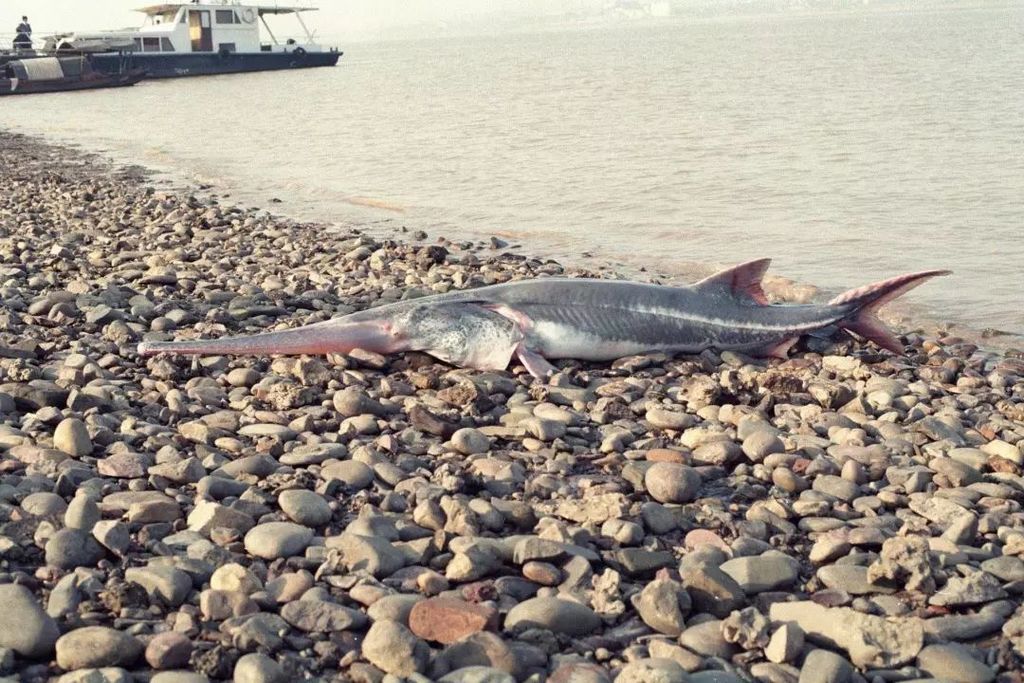
Chinese Paddlefish
Psephurus gladius
The Chinese paddlefish (Psephurus gladius; simplified Chinese: 白鲟; traditional Chinese: 白鱘; pinyin: báixún: literal translation: "white sturgeon"), also known as the Chinese swordfish, is an extinct species of fish that was formerly native to the Yangtze and Yellow River basins in China. With records of specimens over 3.6 metres (12 ft) and possibly 7 m (23 ft) in length, it was one of the largest species of primarily freshwater fish. It was the only species in the genus Psephurus and one of two recent species of paddlefish (Polyodontidae), the other being the still-living American paddlefish (Polyodon spathula). The species was not a strictly freshwater fish, with individuals having migrated down the Yangtze into the sea as juveniles, where they spent time in coastal waters, before returning into the river by adulthood, and migrating upriver to spawn. Unlike the American paddlefish, which is a filter feeder on plankton, the Chinese paddlefish was a piscivorous predator that primarily consumed small to medium-sized fish.
Since the 1990s, the species was officially listed by the International Union for Conservation of Nature (IUCN) as critically endangered, and was last seen alive in 2003. A 2019 paper including scientists from the Yangtze River Fisheries Research Institute found the species to be extinct based on its absence from extensive capture surveys, with the extinction suggested to have occurred by 2005, and no later than 2010, although it had become functionally extinct by 1993.
From the article Chinese paddlefish on Wikipedia (CC BY-SA), quoted section by section
Description
The Chinese paddlefish had a white underbelly, and its back and head were grey. Its dorsal and anal fins were situated considerably far back on the body. The paddle-like rostrum was narrow and pointed, and was between a quarter and up to a third of total body length. Its eyes were small and round. The tail fin was heterocercal (spine extending into the upper lobe), with the lower lobe being well developed. The skull is more elongate and narrower than that of the American paddlefish, and lacks the sculpturing present on the skull bones of other paddlefish, with the stellate (star-shaped) bones on the rostrum less numerous than those of the American paddlefish. The teeth were small, sharp, canine shaped and inward curling, and became proportionally smaller relative to the jaw during growth, and in mature adults were completely fused into the bone. Compared to Polyodon, the jaws were shorter, and had a proportionately narrower gape, and unlike the American paddlefish, but similar to fossil paddlefish, the upper jaw was not firmly attached to the braincase. Like other paddlefish, the skeleton was largely cartilaginous. …
Range & habitat
The Chinese paddlefish was native to the Yangtze (Chang Jiang) River basin and its estuary at the East China Sea. Historically it was also recorded in the Yellow River basin (which is connected to the Yangtze by the Grand Canal) and its estuary at the Yellow Sea. They were also historically found in coastal waters of the East China Sea and the Yellow Sea; occasionally spring tides would bring individuals into the lower reaches of the Qiantang and Yong rivers of Zhejiang province. It primarily inhabited the rivers, particularly in the case of the Yangtze the relatively more prey-rich lower-middle reaches as opposed to the relatively food-poor upper reaches, but sometimes travelled into large lakes. During fall and winter, breeding-age adults migrated from the rest of the Yangtze river system to the lower Jinsha River (a name given to the upper part of the Yangtze) in the section of the river around the city of Yibin in southern Sichuan, to congregate for spawning, which occurred in spring of the following year, from mid-March to early April. Males and females are suggested to have reached sexual maturity and began spawning at 5 and 6 years of age respectively, with spawning males being reported as approximately 5–10 years of age, while spawning females were generally 6 to 16 years of age. …
Wikipedia: “Distribution, habitat and ecology”
In human culture
The species was first named as a species of Polyodon (the genus of the American paddlefish) by Eduard von Martens in 1862. It was placed into a separate, monotypic genus by Albert Günther in 1873. The species was also given a different name, Spatularia angustifolium by Johann Jakob Kaup also in 1862, but this is considered a junior synonym of P. gladius. Paddlefish (Polyodontidae) are one of two living families of Acipenseriformes alongside sturgeons (Acipenseridae). The oldest records of Acipenseriformes date to the Early Jurassic, over 190 million years ago. The oldest paddlefish fossil is that of Protopsephurus from the Early Cretaceous of China, dating to around 120 million years ago. The oldest representatives of the genus containing the American paddlefish, Polyodon date to around 65 million years ago, from the beginning of the Paleocene. Various molecular clock estimates have been given for the age of the divergence between the American and Chinese paddlefish, including 68 million years ago 72 million years ago, and 100 million years ago, all dating to the middle to Upper Cretaceous.
Relationships of recent and fossil paddlefish genera, after Grande et al. (2002).
Wikipedia: “Taxonomy and evolutionary history”
Where it lives
Recorded sightings
—
geo-referenced records in GBIF, from museums, herbaria and field observers.
Drag the globe to turn it. Dots are where records exist, not a range map; darker means more records.
In the stacks
Searching the stacks…
Every page naming Psephurus gladius in the Biodiversity Heritage Library →
This page is assembled live from iNaturalist, GBIF, Wikipedia, the Source Library and the Internet Archive. It is not yet part of the hand-edited codex. iNaturalist taxon 110770.