- Animals
- ›Chordates
- ›Vertebrates
- ›Ray-finned Fishes
- ›Spiny-rayed fishes
- ›Pipefishes and Allies
- ›Goatfishes
- ›Goatfishes
- ›Parupeneus
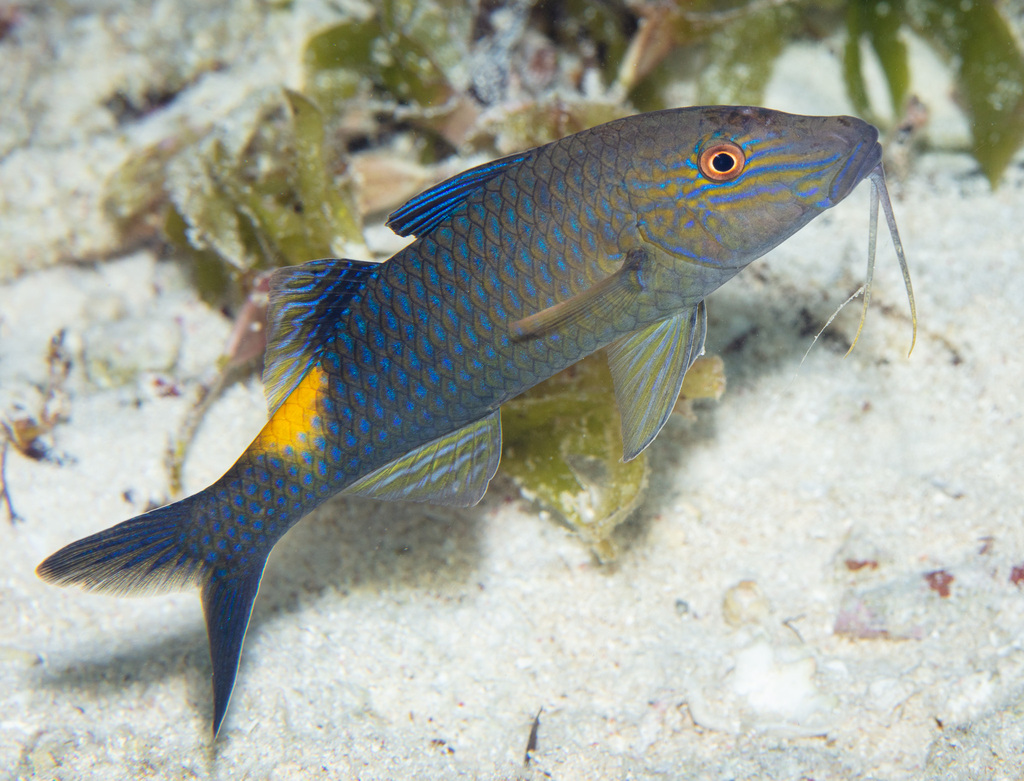
Goldsaddle Goatfish
Parupeneus cyclostomus
Parupeneus cyclostomus, commonly known as the yellow-saddle goatfish, blue goatfish or bright goatfish, is one of 66 currently known species of goatfish. The characteristic yellow patch, or saddle, located on the upper part of the fish's caudal peduncle, gives the yellow-saddle goatfish their common name. Different life stages of this fish may be found at varying depths, however, most yellow-saddle goatfish remain at around 20 metres (70 ft) of depth or in coastal regions with reefs. They can be found in isolation or small schools, and often rely on each other for hunting purposes. Native to the Indo-Pacific, this reef-dweller occurs primarily in tropical and temperate habitats. It is a commercially important species and has recently been considered an environmental indicator to gauge the impact of habitat modification, coastal degradation, pollution, and commercial fisheries. Yellow-saddle goatfish, along with other species of goatfish, is of high economic importance in many parts of the world as both a source of food and for the aquarium trade. Goatfish are often sought out as game fish, though they have been reported to carry the ciguatera toxin.
From the article Parupeneus cyclostomus on Wikipedia (CC BY-SA), quoted section by section
Description
It can reach 50 cm (20 in) in total length, though most do not exceed 35 cm (14 in). The size variations may depend on many factors including age, habitat conditions, and resource availability. Goatfish have dorsal spines that range from 2.79–3.05 centimetres (1.1–1.2 in) long. These spines provide protection against predators and help make them very efficient swimmers. In addition to spines, these fish also typically have elongated snouts, which has two characteristic barbels extending approximately 3 centimetres (1.2 in) in length, but can extend longer than the fish's entire head.
Colour phases. There are two main color phases of this fish, however, other variants of goatfish exist. The most common color variant has a pale ventral side with a striking blue-green dorsal side that may contain vibrant blue hues or spots. One of the most recognizable features of this fish is a bright yellow patch (saddle) placed on the upper half of the caudal peduncle. This distinctive patch is characteristic of these fish and gives them the name 'saddled' goatfish. It is thought that this patch serves as an identifying marker to members of the same species or provides these fish with camouflage in vibrant coral habitats. The less common color phase of the fish is entirely yellow or golden. …
Range & habitat
Goatfish are a versatile species that exhibit varied behaviors depending on their age and environment. This fish occurs solitarily or in groups when young, in all areas of the coral reefs and detrital bottom areas from 1 to 95 m (0 to 310 ft) deep. They can be found in reef flats, rocky bottoms, lagoons, and seaweed reefs. Juveniles can typically be found in small schools however, adults usually live a solitary lifestyle except for when hunting. Young goatfish are most abundant in seagrass beds, as they pose an important feeding ground for many juvenile fishes. Often, these fish form heterotypic schools, meaning they may school with other species of fishes, such as wrasses, other species of goatfish, or other reef-dwelling species. The formation of heterotypic schools allows goatfish to benefit from collaborative hunting, and even camouflage. The fish are commonly found inhabiting diverse ecosystems of coral reefs where they thrive in temperate, tropical, and sub-tropical waters. These environments provide an ideal habitat for yellow-saddle goatfish due to the readily available shelter, food, and conspecifics. The geographic range of these fish spans the Indo-Pacific and Atlantic oceans from the Red Sea to South Africa, the Hawaiian Islands, and the Ryukyu Islands. Additionally, their range covers the islands of French Polynesia and the Ogasawara Islands. …
Wikipedia: “Habitat and distribution”
What it does
Goatfish have a diverse diet that primarily consists of worms, invertebrates, and even other small fish or crustaceans. This species is opportunistic, and will usually feed on whatever prey is the most readily available. Their very generalized diet and unique hunting strategy highlight this species as a key predator of the coastal reef environment.
A defining feature of this fish is its distinctive pair of chemosensory barbels located on the fish's chin. The barbels are extremely sensitive, making them essential tools for foraging and navigating through the complex structures of coral reefs. While hunting, the fish will use these barbels to sift through sand and other soft materials to detect hidden worms, crustaceans, or other small fishes. In addition to its foraging technique, goatfish engage in cooperative hunting strategies. These tactics involve multiple fish each occupying different roles. Each fish may perform the duties of a chaser, a blocker, or a cluster fish. The "chaser" will typically attack or pursue the prey directly, a "blocker" strategically positions themselves to prevent prey from escaping, and "cluster" fish work with the blocker to corner prey and ensure successful capture. This behavior highlights the yellow-saddle goatfish's ability to adapt to complex reef structures.
Wikipedia: “Diet and feeding”
Where it lives
Recorded sightings
—
geo-referenced records in GBIF, from museums, herbaria and field observers.
Drag the globe to turn it. Dots are where records exist, not a range map; darker means more records.
In the stacks
Searching the stacks…
Every page naming Parupeneus cyclostomus in the Biodiversity Heritage Library →
This page is assembled live from iNaturalist, GBIF, Wikipedia, the Source Library and the Internet Archive. It is not yet part of the hand-edited codex. iNaturalist taxon 122514.