- Animals
- ›Chordates
- ›Vertebrates
- ›Ray-finned Fishes
- ›Spiny-rayed fishes
- ›Butterflyfishes, Angelfishes, and Allies
- ›Angelfishes
- ›Pomacanthus
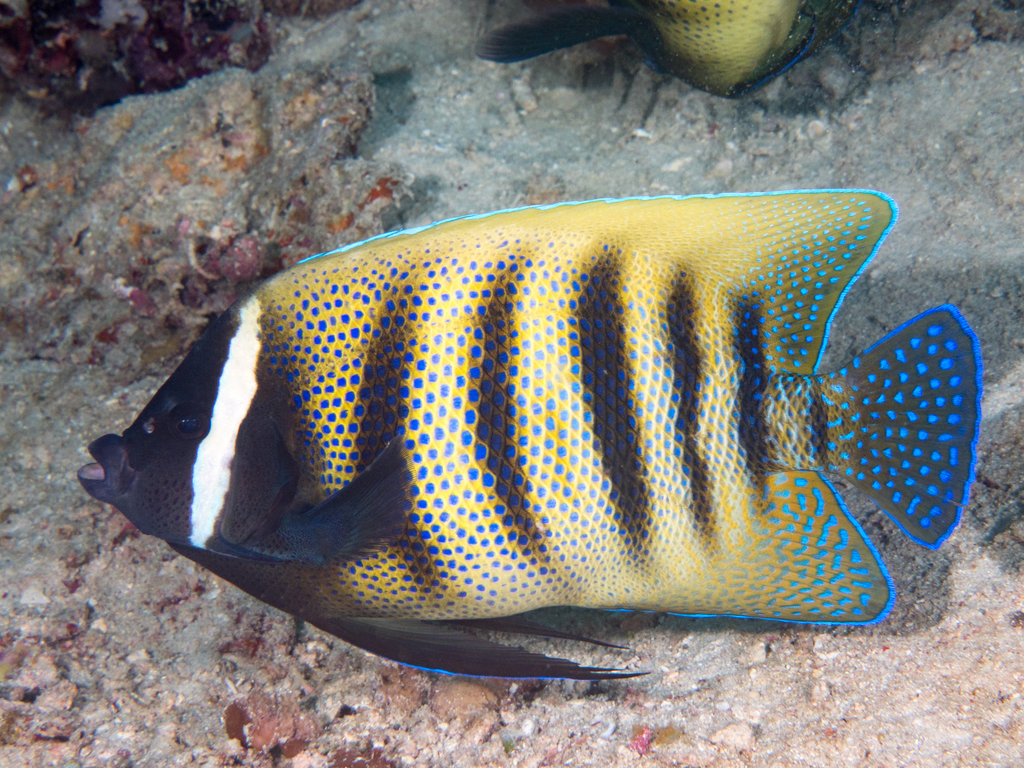
Sixband Angelfish
Pomacanthus sexstriatus
The sixbar angelfish (Pomacanthus sexstriatus), also known as the six banded angelfish, is a marine angelfish, with an easily recognisable yellow body with black vertical stripes (usually six on each side, hence 'sixbar'), one white vertical stripe on each side of its black head, fluorescent blue spots on the body, fins and tail and fluorescent blue lines on the top and bottom fin and tail. They are common in South Pacific reefs, most commonly the Great...
From the article Sixbar angelfish on Wikipedia (CC BY-SA), quoted section by section
Range & habitat
The sixbar angelfish is found from Sri Lanka through the Malay Archipelago to the Solomon Islands longitudinally, and from the Ryukyu Islands and Palau and to New Caledonia and Australia latitudinally. In Australia, its range extends from Shark Bay in Western Australia along the northern coast to the Capricorn and Bunker Group off Queensland. It is also found around the Rowley Shoals and Scott Reef of Western Australia, and Ashmore Reef in the Timor Sea.
Wikipedia: “Distribution”
What it does
The sixbar angelfish is occasionally collected for the aquarium trade. Only the juveniles are suitable for home aquaria, as the adults are too large.
Wikipedia: “Human interactions”
In human culture
The specific name sexstriatus means "six-banded". Like the common names, this is a reference to the six vertical bands on the flanks of the adults of this species.
Wikipedia: “Etymology”
Where it lives
Recorded sightings
—
geo-referenced records in GBIF, from museums, herbaria and field observers.
Drag the globe to turn it. Dots are where records exist, not a range map; darker means more records.
In the stacks
Searching the stacks…
Every page naming Pomacanthus sexstriatus in the Biodiversity Heritage Library →
This page is assembled live from iNaturalist, GBIF, Wikipedia, the Source Library and the Internet Archive. It is not yet part of the hand-edited codex. iNaturalist taxon 110020.