- Animals
- ›Chordates
- ›Vertebrates
- ›Ray-finned Fishes
- ›Spiny-rayed fishes
- ›Butterflyfishes, Angelfishes, and Allies
- ›Spadefishes
- ›Chaetodipterus
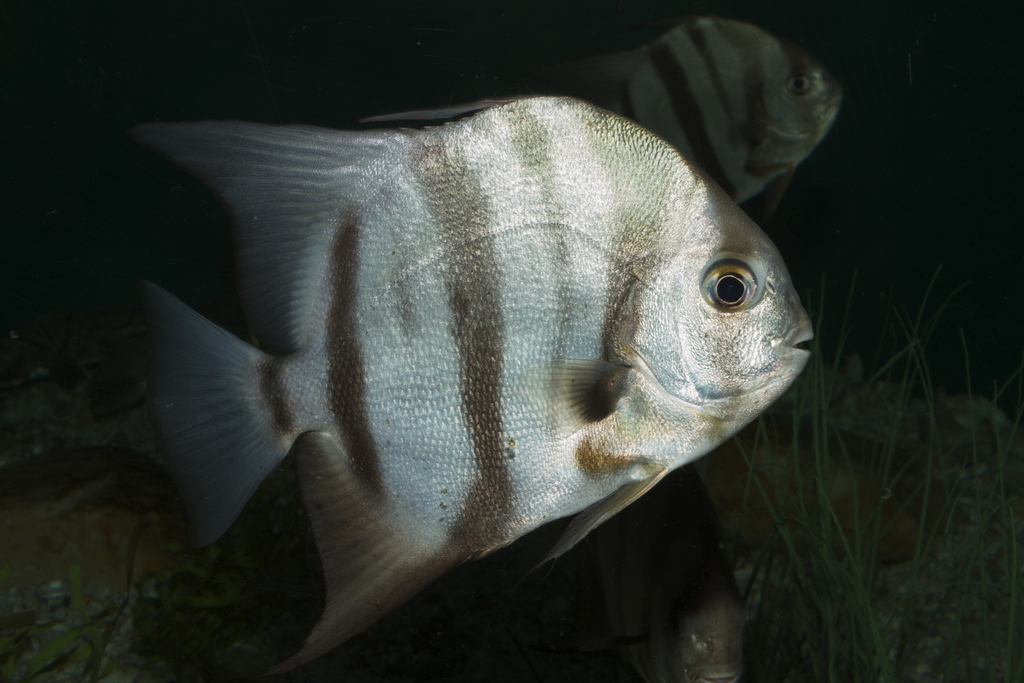
Atlantic Spadefish
Chaetodipterus faber
The Atlantic spadefish (Chaetodipterus faber) is a species of marine ray-finned fish belonging to the family Ephippidae, the spadefishes. It is the symbol of the North Carolina Aquariums.
From the article Atlantic spadefish on Wikipedia (CC BY-SA), quoted section by section
Description
The disk-shaped body is very deep and compressed, and the snout is blunt. There are nine dorsal spines and 21–24 soft dorsal rays, and there are three anal spines and 17–19 anal rays. The second dorsal and anal fins of adults have long, trailing anterior lobes, giving an "angelfish-like" appearance. The body is silver in color with irregular black vertical bands that fade gradually with age. There are four to six black vertical bands on each side, with the first running through the eye and the last running through the caudal peduncle. The mouth is small, with the maxilla of adults ending beneath the nostrils. The teeth are small and brushlike, and there are no teeth on the roof of the mouth. The head and fins are covered with ctenoid scales. Specimens commonly weigh from 3 to 10 pounds (1.4 to 4.5 kg), although individuals as large as 20 pounds (9.1 kg) have been recorded. Their maximum length is about 36 inches (91 cm).
Range & habitat
The species is endemic to the western Atlantic Ocean. They are found off the coast of the southeastern United States as far north as Massachusetts, the Gulf of Mexico, and in the Caribbean. They are also found in Bermuda and the eastern coast of Brazil. The fish inhabits marine and brackish waters typically in subtropical climates. They are common in shallow waters along coastlines with depths of 3–35 metres (9.8–114.8 ft). Juveniles commonly inhabit estuaries until maturity and adults prefer mangroves, beaches, and harbors.
Wikipedia: “Distribution and habitat”
What it does
Atlantic spadefish feed on small, benthic invertebrates including crustaceans, mollusks, annelids, and cnidarians. They also feed on plankton in the water column.
Wikipedia: “Diet”
In human culture
The scientific name is derived from the Greek word "chaíti" meaning "mane" and "dipteros" meaning "with two fins." The Atlantic spadefish belongs to the genus Chaetodipterus, which includes two other species: the West African spadefish (Chaetodipterus lippei) and the Pacific spadefish (Chaetodipterus zonatus). The genus Chaetodipterus belongs to the family Ephippidae, which includes spadefish and batfish. Chaetodipterus faber is known by numerous other colloquial names, including angelfish, white angelfish, threetailed porgy, ocean cobbler, and moonfish.
Wikipedia: “Taxonomy and etymology”
Where it lives
Recorded sightings
—
geo-referenced records in GBIF, from museums, herbaria and field observers.
Drag the globe to turn it. Dots are where records exist, not a range map; darker means more records.
In the stacks
Searching the stacks…
Every page naming Chaetodipterus faber in the Biodiversity Heritage Library →
This page is assembled live from iNaturalist, GBIF, Wikipedia, the Source Library and the Internet Archive. It is not yet part of the hand-edited codex. iNaturalist taxon 49316.