- Animals
- ›Chordates
- ›Vertebrates
- ›Ray-finned Fishes
- ›Spiny-rayed fishes
- ›Leaffishes, Snakeheads, and Gouramis
- ›Gouramis
- ›Gouramis
- ›Paradisefishes
- ›Parosphromenus
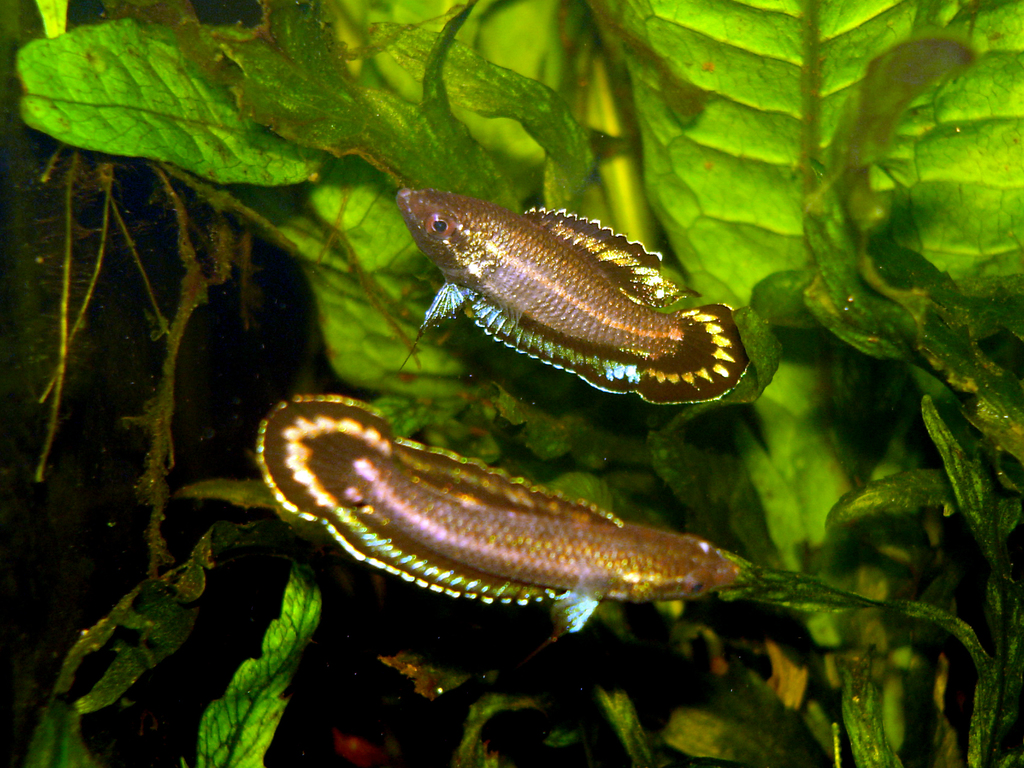
Harvey's Licorice Gourami
Parosphromenus harveyi
Parosphromenus harveyi is a species of gourami endemic to Malaysia, where it is known from Selangor. The most extreme freshwater habitats in Peninsular Malaysia are the peat swamp forests that consist of dark-coloured, highly acidic waters. Parosphromenus harveyi, commonly referred to as a "licorice gourami" alongside its congeners, is a small labyrinth fish native to peat swamp forests in the Tanjong Malim area within the state of Perak, with populations of the species exhibiting a wide variety of morphological and behavioural traits. Species of the genus Parosphromenus, usually less than 3.0 cm (1.2 in) in standard length, are stenotypic inhabitants of peat swamp forests and associated blackwater streams with limited light penetration. The species was described by Barbara Brown in 1987, alongside its congener P. allani. Since the 1950s, additional species in the genus have been described on a sporadic basis and there are 23 recognised members at present.
From the article Parosphromenus harveyi on Wikipedia (CC BY-SA), quoted section by section
Range & habitat
Parosphromenus harveyi is a tropical, freshwater, pelagic, non-migratory fish and a known inhabitant of peat swamp forests and associated blackwater streams. It typically occurs at a depth of 0.3 to 1.6 m (1.0 to 5.2 ft), although this fluctuates based on rainfall.
Wikipedia: “Ecology and habitat”
What it does
Parosphromenus spp. have been grouped arbitrarily based on courtship behaviour in males which adopt a "head-down", "head-up", or "horizontal" position depending on species. The species normally spawns in small caves or among leaf litter, forming temporary pair bonds with the male solely responsible for egg and brood-care. P. harveyi belongs to the former, more speciose, assemblage, in which the male assumes a near-vertical position with the head lowered and fins splayed during nuptial displays. Sexually-active males form small territories, at the centre of which is a small cave normally formed from leaf litter in natural settings, with males then attempting to attract females in the vicinity to enter the cave via courtship displays. Eggs and milt are released in batches during a series of embraces in which the male wraps its body around that of the female. Some males construct a rudimentary bubble nest inside the cave while others do not, but both males and females attempt to attach the eggs to the ceiling after they are released. Subsequent spawning embraces may dislodge eggs from the roof of the cave, and inexperienced adults sometimes simply eat them, so a degree of patience may be required until the fish successfully reproduce in captivity. Following a successful spawn, the female leaves the cave and proceeds to defend the surrounding area while the male tends to the brood. …
Wikipedia: “Reproduction”
In human culture
The generic name is a compound of para meaning "near", "similar to" and Osphronemus, a name coined by Philibert Commerson meaning "olfactory", a reference to its labyrinth organ, which Commerson thought was an olfactory organ. The person honoured in the specific name is thought to be the German born aquarist Will Harvey (1916-2013) who settled in Scotland after World War II and whose obituary Brown wrote.
Wikipedia: “Etymology”
Where it lives
Recorded sightings
—
geo-referenced records in GBIF, from museums, herbaria and field observers.
Drag the globe to turn it. Dots are where records exist, not a range map; darker means more records.
In the stacks
Searching the stacks…
Every page naming Parosphromenus harveyi in the Biodiversity Heritage Library →
This page is assembled live from iNaturalist, GBIF, Wikipedia, the Source Library and the Internet Archive. It is not yet part of the hand-edited codex. iNaturalist taxon 108805.