- Animals
- ›Chordates
- ›Vertebrates
- ›Ray-finned Fishes
- ›Spiny-rayed fishes
- ›Jacks, Flounders, Barracudas, and Allies
- ›Moonfishes and Billfishes
- ›Moonfishes
- ›Mene
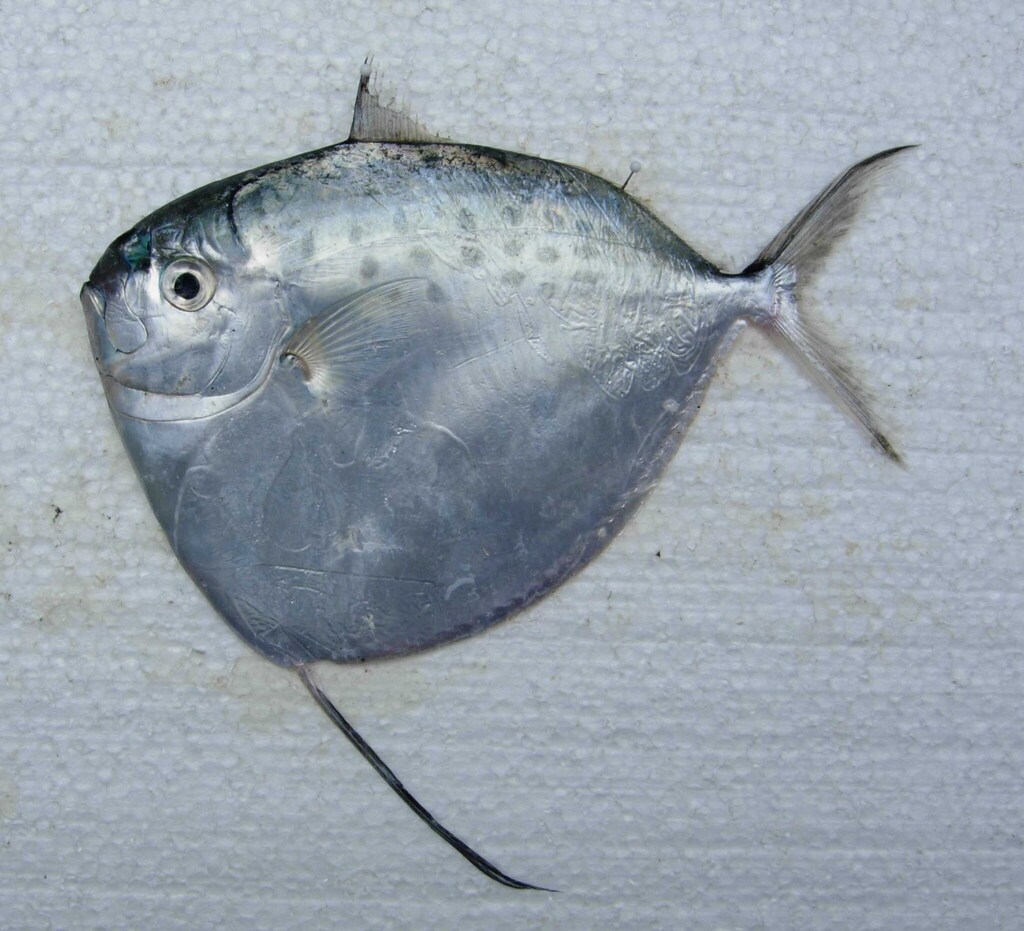
Razor Moonfish
Mene maculata
Mene maculata, the moonfish, is the only extant member of the genus Mene and of the family Menidae. The morphology of the moonfish is quite distinct as they have a compressiform (laterally compressed) that is disc-like shape that is almost triangular. They have a small protrusible superior mouth (a mouth that is orientated upwards) with teeth limited to villi-form bands in the jaws. Their maxilla are distinctively shaped and have long ascending processes of the premaxillae.
The dorsal fin of the moonfish has a short peak on the anterior side. Overall, it is long and low with thin and flexible rays. The anal fin starts where the pelvic fin is and is very long. The caudal fin is deeply forked. The pectoral fin is shorter than the length of the head, and the pelvic fins are slightly in front of the pectoral fins. The pelvic fin has 1 short spine followed by 5 soft rays. The first 2 soft rays are fused and greatly elongated in the adults, forming a prominent backward-pointing process on the underside of the fish. There is not much known about the hatchling and juvenile state. The lateral line curves upward toward the base of the last ray of the dorsal fin and ends above the midline of the caudal peduncle. Sometimes the lateral line continues to the base of the upper lobe of the caudal fin.
From the article Mene maculata on Wikipedia (CC BY-SA), quoted section by section
What it does
The moonfish live in marine to brackish waters and are known to inhabit midwater columns. They display weak to moderate swimming agility. These fish are bottom feeders, which is supported by the high percentage of mud and sand particles in their guts, along with other major food items. They are often found near the bottom of continental shelves and major island groups where they primarily feed on copepods, shrimp, and fish larvae. Because they eat such high-nutrient-filled prey, they play a crucial role in transferring energy to apex predators such as marlins, mahi-mahi, and tuna. Mene maculata are highly fragile with high mortality rates and increased vulnerability of their eggs and larvae to predation. The moonfish is also sensitive to strict environmental conditions. The exact maximum age of Mene maculata is not known, but based on a study, the maximum age is approximately 3 years of age. The relative size of the fish as an adult ranges from 21.8 to 33.4 cm, and the maximum weight of the moonfish is less than 500g.
Wikipedia: “Ecology”
At the table
While many major economically valuable species are declining, it is necessary to find an alternative species, such as the moonfish. However, there are not enough data to find out its biology and population. Mene maculata have a high percentage of protein in their tissue (23.16%), followed by lipids (2.62%), and carbohydrates (1.3%). The fish's tissue is a valuable food recipe for human consumption, due to its high-quality protein and well-balanced amino acids. The lipid content of the moonfish is found to be suitable for a healthy diet. This species also has the highest levels of calcium and other minerals. It has been said that the moonfish can be used as an alternative source of regular seafood that supplies rich nutrients for growing children, pregnant women, and people suffering from malnutrition. They are marketed fresh and dried.
Wikipedia: “Nutritional Value”
In human culture
Mene maculata, the moonfish, is the only extant member of the genus Mene and of the family Menidae. This family is morphologically distinct as they have a compressiform type of body (laterally compressed) that is disc-like and a small superior mouth (a mouth that is orientated upwards). Their maxilla are distinctively shaped and have long ascending processes of the premaxillae. This unique morphology characterizes the only extant member of Menidae, Mene maculata. It is also conserved over the known recent and numerous fossil species and history.
Figure of Family Menidae
Wikipedia: “History”
Where it lives
Recorded sightings
—
geo-referenced records in GBIF, from museums, herbaria and field observers.
Drag the globe to turn it. Dots are where records exist, not a range map; darker means more records.
In the stacks
Searching the stacks…
Every page naming Mene maculata in the Biodiversity Heritage Library →
This page is assembled live from iNaturalist, GBIF, Wikipedia, the Source Library and the Internet Archive. It is not yet part of the hand-edited codex. iNaturalist taxon 530351.