- Animals
- ›Chordates
- ›Vertebrates
- ›Ray-finned Fishes
- ›Spiny-rayed fishes
- ›Butterflyfishes, Angelfishes, and Allies
- ›Rovers
- ›Erythrocles
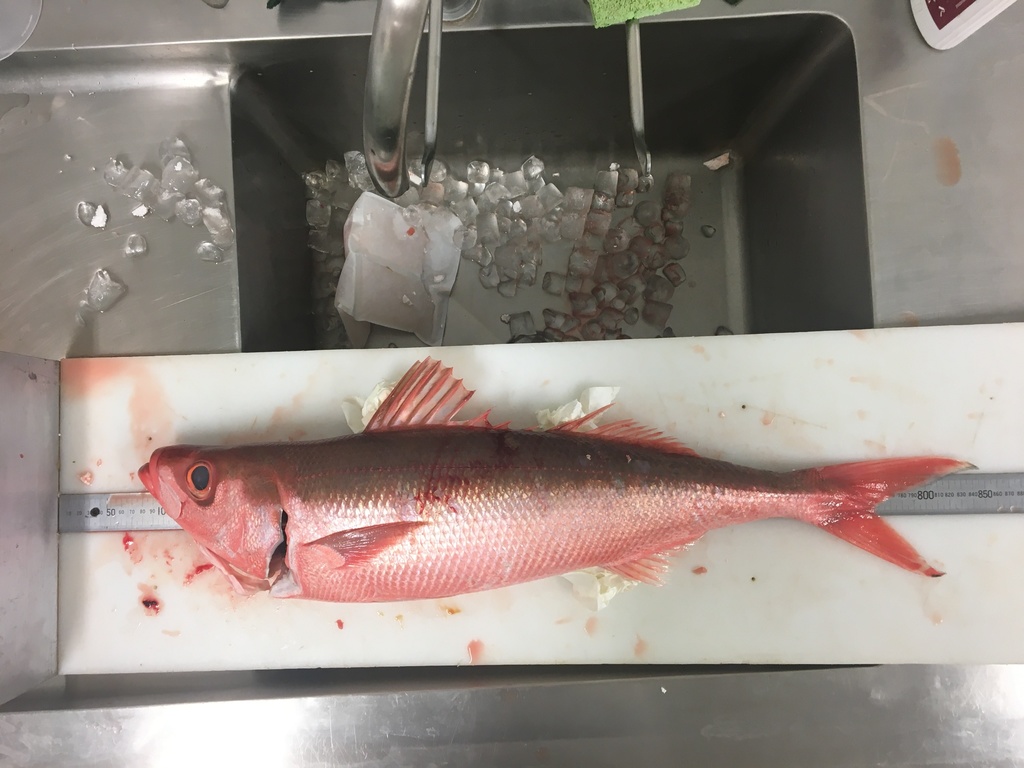
Japanese Rubyfish
Erythrocles schlegelii
The Japanese rubyfish (Erythrocles schlegelii) also known as the Pacific rover or dusky rover, is a species of marine ray-finned fish belonging to the family Emmelichthyidae, the rovers, bonnetmouths and rubyfishes. This fish is found in the Indian and western Pacific Oceans.
From the article Japanese rubyfish on Wikipedia (CC BY-SA), quoted section by section
Description
The Japanese rubyfish has an oblong body that has a depth of one-fifth to one-third of its standard length and which is less than the length of the head. The dorsal fin is incised to its base immediately before the last dorsal fin spine. The first dorsal fin contains 10 spines with the second dorsal fin having a single spine and between 10 and 12 soft rays. The anal fin has 3 spines and 9 or 10 soft rays. The caudal peduncle has a low, fleshy ridge on each side. The front of the lower jaw typically has a row of tiny teeth. They are bluish grey on the upper body, silvery white with pinkish hue ventrally with reddish orange caudal and pectoral fins. This species has reached a maximum published total length of 72 cm (28 in).
Range & habitat
The Japanese rubyfish has an Indo-West Pacific distribution. It is found in eastern Africa where it has been recorded from South Africa, Madagascar and Kenya east as far as Hawaii, north to southern Japan and south to Australia. In Australia it occurs from Rottnest Island in Western Australia around the northern tropical coast as far as Moreton Bay in Queensland and Lord Howe Island. This is a demersal fish found in deep waters at depths of 215 to 300 m (705 to 984 ft).
Wikipedia: “Distribution and habitat”
Where it lives
Recorded sightings
—
geo-referenced records in GBIF, from museums, herbaria and field observers.
Drag the globe to turn it. Dots are where records exist, not a range map; darker means more records.
In the stacks
Searching the stacks…
Every page naming Erythrocles schlegelii in the Biodiversity Heritage Library →
This page is assembled live from iNaturalist, GBIF, Wikipedia, the Source Library and the Internet Archive. It is not yet part of the hand-edited codex. iNaturalist taxon 529850.