- Animals
- ›Chordates
- ›Vertebrates
- ›Ray-finned Fishes
- ›Spiny-rayed fishes
- ›Perches, Scorpionfishes, Sticklebacks, and Allies
- ›Eelpouts and allies
- ›Quillfishes
- ›Ptilichthys
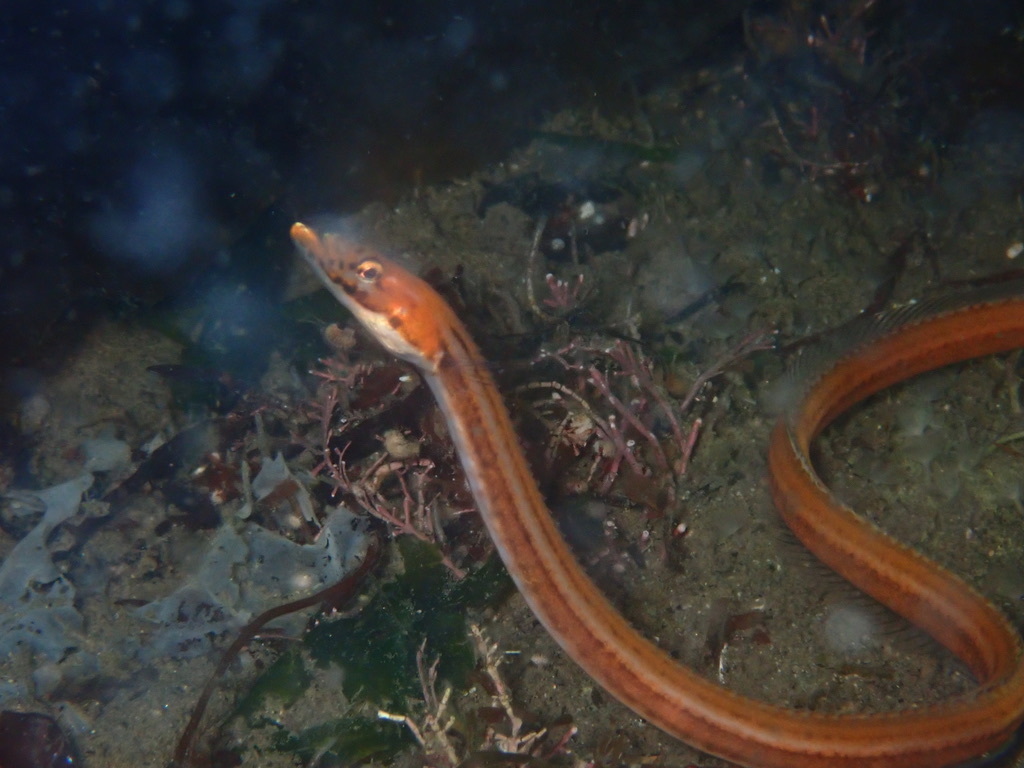
Quillfish
Ptilichthys goodei
The quillfish, Ptilichthys goodei, is a species of perciform fish, the only species in the genus Ptilichthys and family Ptilichthyidae. It is an elongated, eel-like fish that reaches 34 cm in length. It is native to the north Pacific Ocean, from the Bering Sea south to Oregon.
From the article Quillfish on Wikipedia (CC BY-SA), quoted section by section
Description
The Quillfish has an extremely elongate, slender body with lon-based tall dorsal and anal fins which make the fish similar in shape to the primary feather of a bird or a quill pen. The small head is only between 4 and 7% of the length of the body and there is a wide fleshy appendage at the front of the lower jaw. The dorsal fin has its origin on the nape and has between 79 and 90 low spines, free of the fin membrane, followed by between 130 and 157 soft rays. The anal fin has its origin at around a third of the body length, contains 166 to 196 soft rays. Both the dorsal fins are joined to the much reduced caudal fin. As the fish grows the caudal fin has a fleshy extension which extends and becomes more or less filamentous. It has rounded pectoral fins but no pelvic fins and lacks a pelvic girdle. There is a single pair of nostrils. The minute cycloid scales are scattered or may be absent. The sharp, conical teeth are present in the jaw, arranged in a dense single row, but there are no other teeth. There is no pyloric caeca or swim bladder. The overall colour may be yellow or orange to greenish gray, and the body is rather translucent. There is a dark streak along body with others on head in preserved specimens. Attains up to 39 cm length not including caudal filament. The species attains a maximum published total length of 40 cm (16 in).
Range & habitat
The quillfish occurs in the northern North Pacific Ocean from the Bering Sea in the north and south to Oregon in the eastern Pacific and to the Sea of Japan and Sea of Okhotsk in the western Pacific. They are demersal fish which arefound at depths between 0 and 360 m (0 and 1,181 ft).
Wikipedia: “Distribution and habitat”
In human culture
The generic name Ptilichthys is a combination of ptilon, which is Greek for "quill" with ichthys. meaning "fish", an allusion to the feather-like appearance of this fish, being extremely elongate, slender and with long dorsal and anal fins. The specific name honours the American ichthyologist George Brown Goode, who was a colleague and collaborator of Bean's.
Wikipedia: “Etymology”
Where it lives
Recorded sightings
—
geo-referenced records in GBIF, from museums, herbaria and field observers.
Drag the globe to turn it. Dots are where records exist, not a range map; darker means more records.
In the stacks
Searching the stacks…
Every page naming Ptilichthys goodei in the Biodiversity Heritage Library →
This page is assembled live from iNaturalist, GBIF, Wikipedia, the Source Library and the Internet Archive. It is not yet part of the hand-edited codex. iNaturalist taxon 229394.