- Animals
- ›Chordates
- ›Vertebrates
- ›Ray-finned Fishes
- ›Spiny-rayed fishes
- ›Blennies, Damselfishes and Allies
- ›Surfperches
- ›Rhacochilus
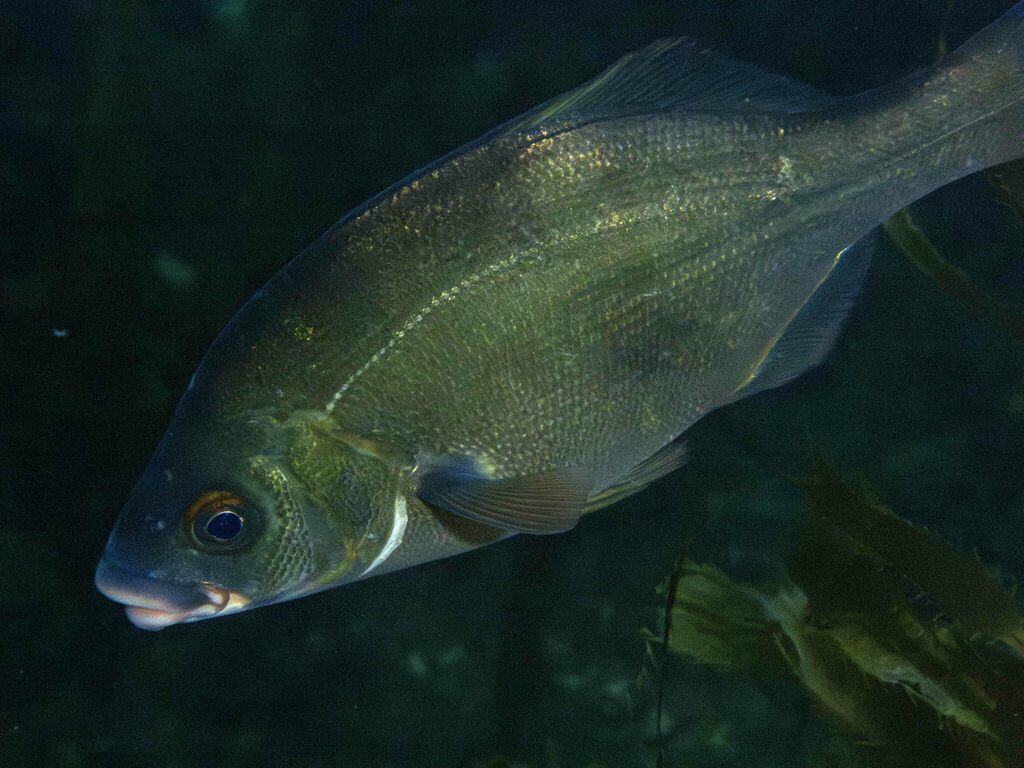
Rubberlip Surfperch
Rhacochilus toxotes
Rhacochilus toxotes, the rubberlip surfperch, is a species of surfperch found in the Eastern Pacific Ocean. They are the largest species of surfperch by weight, and second largest in length.
They are also commonly known as buttermouth perch, liverlip, rubberlip seaperch, as well as porgee and sprat in Mexico.
From the article Rhacochilus toxotes on Wikipedia (CC BY-SA), quoted section by section
Description
Like other surfperch of the family Embiotocidae, it has a laterally compressed profile, and is deep bodied. As the name suggests, rubberlip surfperch are notable for having distinct, large fleshy lips that are either white or pink in color. They can also be identified by a unique black or darkened band on each side of the body that can extend from the dorsal fin to the anal fin (although not all rubberlips possess this). The general coloration of the fish is a brown-brassy color, but can also be closer to white or chrome, and even a green-grey. Juveniles may be more a more pinkish-tan. They have a prominent lateral line and the body is covered with large scales. The pectoral fins are usually the same color as the body, but can also be yellow or grey, and the lower operculum and jaw is white. To distinguish them from the closely related pile surfperch (Rhacochilus vacca), which also possesses the black band, the first rays of the soft dorsal fin of the pile surfperch are much higher and the lips are less profound. …
Range & habitat
Rubberlip surfperch are found from Cabo Thurloe at the tip of the Baja California Sur to Medocino County in Northern California, and can also been seen around Guadalupe Island off Baja California. They are less common north of Monterey Bay. It is commonly seen near rocky reefs, kelp forests and beds, exposed and protected rocky shores, as well as in bays, tidepools, and near man-made structures like piers. They range from depths of the surf zone to 50 m (160 ft), but have also been seen as deep as 80 m (260 ft), preferring to inhabit rocky areas with abundant aquatic vegetation and prey. They occasionally are observed schooling with other surfperch like the pile surfperch and striped surfperch (Embiotoca lateralis). Rubberlip are known to feed primarily at night on thin-shelled invertebrates and crustaceans, using their large lips to help sense food while digging through sediment.
Wikipedia: “Habitat and ecology”
What it does
Rubberlip surfperch primarily eat small invertebrates, such as gammarid amphipods, small crabs, and mollusks (bivalves such as mussels, and tiny marine snails). Juveniles also eat marine worms, including polychaetes, while adults can eat larger prey like octopus, shrimp, and larger crabs.
Wikipedia: “Diet”
In human culture
The species was first described in 1854 by Louis Agassiz, a Swiss-American naturalist. The genus name Rhacochilus was derived from the Latin word "Rhakos", meaning "big tear", and the Greek word "Cheilos" meaning "lip." Toxotes was coined due to its resemblance to the archerfish family. They are one of two species in the genus Rhacochilus.
Wikipedia: “Taxonomy and etymology”
Where it lives
Recorded sightings
—
geo-referenced records in GBIF, from museums, herbaria and field observers.
Drag the globe to turn it. Dots are where records exist, not a range map; darker means more records.
In the stacks
Searching the stacks…
Every page naming Rhacochilus toxotes in the Biodiversity Heritage Library →
This page is assembled live from iNaturalist, GBIF, Wikipedia, the Source Library and the Internet Archive. It is not yet part of the hand-edited codex. iNaturalist taxon 117562.