- Animals
- ›Chordates
- ›Vertebrates
- ›Ray-finned Fishes
- ›Spiny-rayed fishes
- ›Blennies, Damselfishes and Allies
- ›Surfperches
- ›Amphistichus
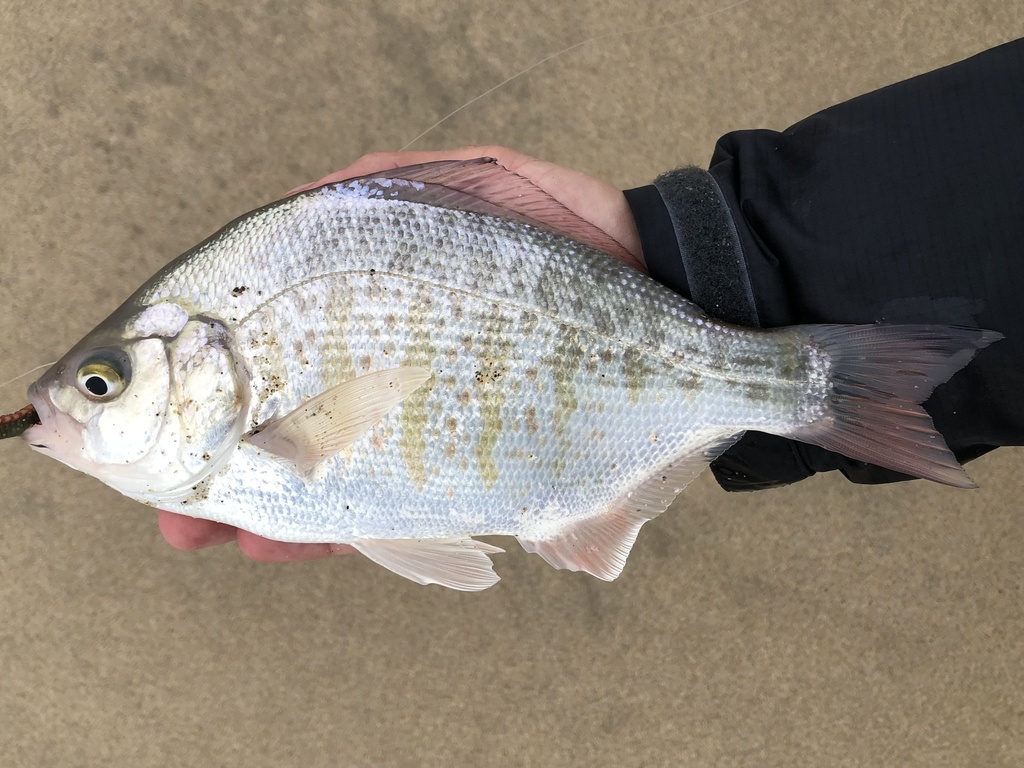
Redtail Surfperch
Amphistichus rhodoterus
The redtail surfperch (Amphistichus rhodoterus) is a species of surfperch (Embiotocidae) that inhabits the near-shore and estuarine waters of North American Pacific coasts.
Redtail surfperch are one of three species in the genus Amphistichus (i.e. redtail, barred and calico surfperch), and one of six species in the subfamily (i.e. genera Amphistichus and Hyperprosopon).
From the article Redtail surfperch on Wikipedia (CC BY-SA), quoted section by section
Description
Redtail surfperch are a deep bodied fish, (i.e. oval in sideview), that are compressed (i.e. slender) from side to side, most often observed in the 8 to 11 inch lengths. The body is light colored, white to silver, with vertical marks or bars and red or pink fins (e. g. dorsal, anal and tail). The vertical marks begin as bars when young and become less distinct olive-red-brown markings as the fish grows. Fins of the redtail surfperch have both spines and fin rays, and the tail is moderately forked. The longest dorsal spines of the redtail surfperch are longer than dorsal fin rays, which helps distinguish the redtail surfperch from the barred surfperch (Amphistichus argenteus) and calico surfperch (Amphistichus koelzi.) The redtail surfperch body is about twice as long as it is high, not including the mildly forked tail. The tail is about ¼ of the fish's length and is as wide as it is long. The first quarter of the redtail surfperch's length includes a small upturned mouth, eye, and gill cover. The second quarter of the fish includes an upward sloping back, the dorsal fin spines along the highest part of the back, a pectoral fin at the leading edge of the lowest part on the belly, and a moderately sized pectoral fin two-thirds of the way down the body just behind the gill cover. …
Range & habitat
Redtail surfperch are common along sandy ocean beaches and jetties year-round; these fish are found up-bay in estuaries seasonally, commonly during spring. Redtail surfperch are distributed from Avila Beach, California to Hope Island, B.C., and are the only New World marine surfperch that does not inhabit Southern and Baja California waters.
Wikipedia: “Range and habitat”
What it does
Redtail surfperch, like other surfperch, are viviparous, a species that gives birth to live young. Amphistichus rhodoterus are iteroparous (i.e. reproducing multiple times during their life) with females giving birth annually after reaching sexual maturity at 3 or 4 years of age. Females along the central Oregon coast contain fertilized eggs near the first of the year, gestate for 8 months, and give birth in August and September. Northern California populations of redtail surfperch have a similar reproductive schedule, except that parturition (live birth) starts in July. Redtail surfperch normally give birth to between three and forty young; there is a strong correlation between female size and number of young. In the laboratory some young may not develop fully inside the female and can be reabsorbed or born dead. Wild caught fish rarely contain abnormal embryos. Water temperature affects growth of embryos, time of birth, and size at birth, and may be related to the faster growth of females.
Male redtail surfperch develop a distinctive permanent shortening of some anal fins rays as they mature; the shortened anal fin rays appear as a notch in profile and can be used to externally determine mature males from females and juvenile fish.
Wikipedia: “Reproduction”
Where it lives
Recorded sightings
—
geo-referenced records in GBIF, from museums, herbaria and field observers.
Drag the globe to turn it. Dots are where records exist, not a range map; darker means more records.
In the stacks
Searching the stacks…
Every page naming Amphistichus rhodoterus in the Biodiversity Heritage Library →
This page is assembled live from iNaturalist, GBIF, Wikipedia, the Source Library and the Internet Archive. It is not yet part of the hand-edited codex. iNaturalist taxon 117552.