- Animals
- ›Chordates
- ›Vertebrates
- ›Ray-finned Fishes
- ›Spiny-rayed fishes
- ›Perches, Scorpionfishes, Sticklebacks, and Allies
- ›Perches, groupers and allies
- ›Sea Basses
- ›Hypoplectrus
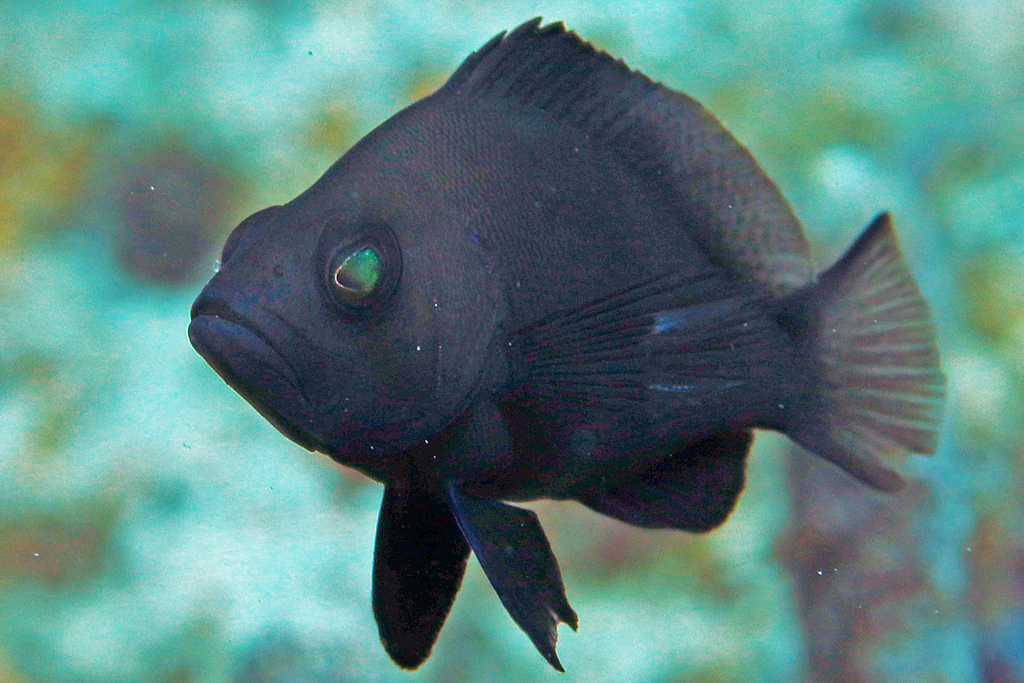
Black Hamlet
Hypoplectrus nigricans
Hypoplectrus nigricans, the black hamlet, is a species of marine ray-finned fish, a sea bass from the subfamily Serraninae which is part of the family Serranidae, which also includes the groupers and anthias. It is native to shallow parts of the central Western Atlantic Ocean and Caribbean Sea. It grows to about 15 cm (6 in) in total length. It is a simultaneous hermaphrodite, with a breeding strategy known as egg trading. One fish acts as a female and lays a batch of eggs which the other fertilises. The following night, the roles are reversed.
From the article Hypoplectrus nigricans on Wikipedia (CC BY-SA), quoted section by section
Description
Hypoplectrus nigricans is a small fish growing to a total length of 85 to 150 mm (3.3 to 5.9 in). The morphology and colouring of the fish varies across its range. Fish from Puerto Rico have greyish bodies, translucent pectoral fins, pointed pelvic fins and a caudal fin shaped like a crescent moon. Fish from Mexico and Belize are slightly smaller and have a darker body colour with dark pectoral fins, blunt pelvic fins and a short, square-cut caudal fin.
Range & habitat
The species is native to the central West Atlantic Ocean. Its range extends from southeastern Florida and the Bahamas, through the Caribbean Sea and the Gulf of Mexico to Santa Marta in Colombia and to the islands off the coast of Venezuela. It is a reef fish, inhabiting reefs with both stony corals and soft corals.
Wikipedia: “Distribution and habitat”
What it does
As a simultaneous hermaphrodite, H. nigricans has an unusual reproductive strategy known as egg trading. The fish is usually solitary, but at breeding time two fish come together at night. Courtship is initiated by one fish which temporarily takes a female role. The other fish acts as the male and fertilises a batch of eggs produced by the first fish. The following night their roles are reversed, and the second fish lays eggs and the first fish fertilises them. The two fish continue alternating roles in this way over the course of several nights. The pair usually stay together for the series of transfers, but sometimes each finds a different partner.
Wikipedia: “Ecology”
Where it lives
Recorded sightings
—
geo-referenced records in GBIF, from museums, herbaria and field observers.
Drag the globe to turn it. Dots are where records exist, not a range map; darker means more records.
In the stacks
Searching the stacks…
Every page naming Hypoplectrus nigricans in the Biodiversity Heritage Library →
This page is assembled live from iNaturalist, GBIF, Wikipedia, the Source Library and the Internet Archive. It is not yet part of the hand-edited codex. iNaturalist taxon 131475.