- Animals
- ›Chordates
- ›Vertebrates
- ›Ray-finned Fishes
- ›Spiny-rayed fishes
- ›Perches, Scorpionfishes, Sticklebacks, and Allies
- ›Perches, groupers and allies
- ›Anthiases
- ›Pseudanthias
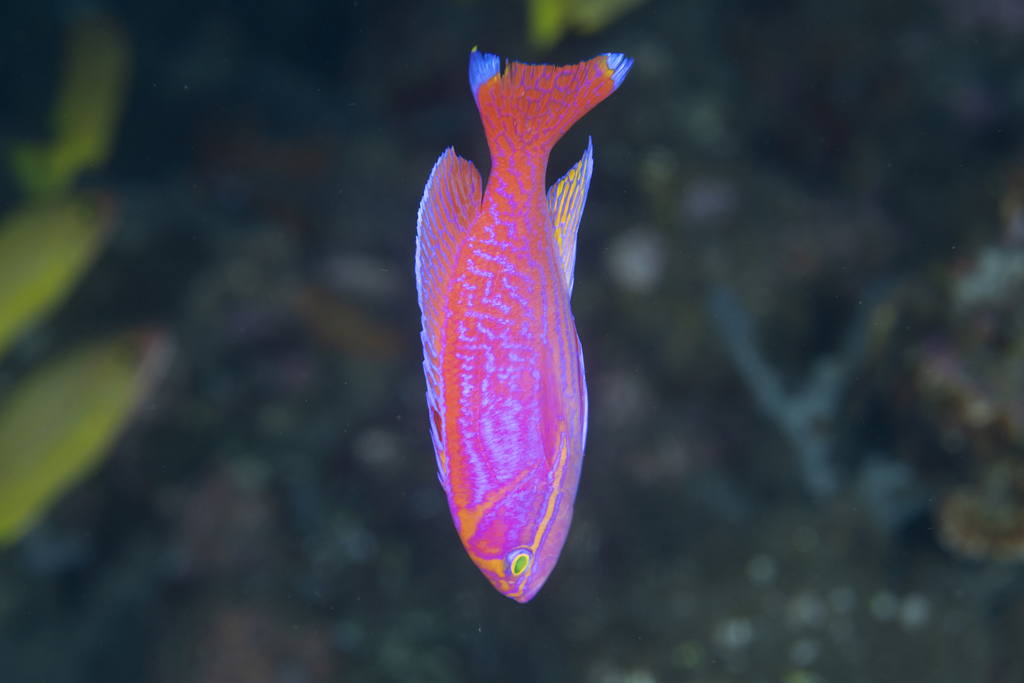
Two-spot Basslet
Pseudanthias bimaculatus
Pseudanthias bimaculatus, two-spot basslet, twospot anthias, twinspot anthias and bimac anthias, is a species of marine ray-finned fish from the subfamily Anthiinae of the family Serranidae, the groupers and sea basses. It is an Indo-Pacific species of reefs.
From the article Pseudanthias bimaculatus on Wikipedia (CC BY-SA), quoted section by section
Description
They are a medium-sized anthias reaching a maximum of 5in/12 cm at adulthood. This species is sexually dimorphic, meaning the males and females have differing physical characteristics. Pseudanthias bimaculatus males are primarily red with jagged pink lines along the body. Males will have a red tail with clear to white tips. Males will typically have yellow highlights on the tail, anal fins, and head area. Males also have one or two spots on their dorsal fin, hence the scientific name 'bimaculatus', meaning two spots. Females will be primarily pink with yellow fins and tail. Females will typically have a yellow line stretching across the head through their eyes.
Wikipedia: “Appearance”
Range & habitat
It is found in various reefs of ranging in the Indo-West Pacific from East Africa, Maldives, and Indonesia. It is a deep water species typically found in coastal drop-offs.
Wikipedia: “Range”
What it does
Pseudanthias bimaculatus are primarily carnivorous. The diet composing mainly of zooplankton and floating filamentous algae in the wild. In the aquarium, a varied diet of mysis shrimp, vitamin-enriched brine shrimp, frozen preparations and other meaty items for zooplankton feeders. Multiple small feedings throughout the day are recommended for this species.
Wikipedia: “Diet”
Where it lives
Recorded sightings
—
geo-referenced records in GBIF, from museums, herbaria and field observers.
Drag the globe to turn it. Dots are where records exist, not a range map; darker means more records.
In the stacks
Searching the stacks…
Every page naming Pseudanthias bimaculatus in the Biodiversity Heritage Library →
This page is assembled live from iNaturalist, GBIF, Wikipedia, the Source Library and the Internet Archive. It is not yet part of the hand-edited codex. iNaturalist taxon 620673.