- Animals
- ›Chordates
- ›Vertebrates
- ›Ray-finned Fishes
- ›Spiny-rayed fishes
- ›Wrasses and allies
- ›False scorpionfishes, wrasses, and parrotfishes
- ›Wrasses and Parrotfishes
- ›Rainbow Wrasses and Allies
- ›Thalassoma
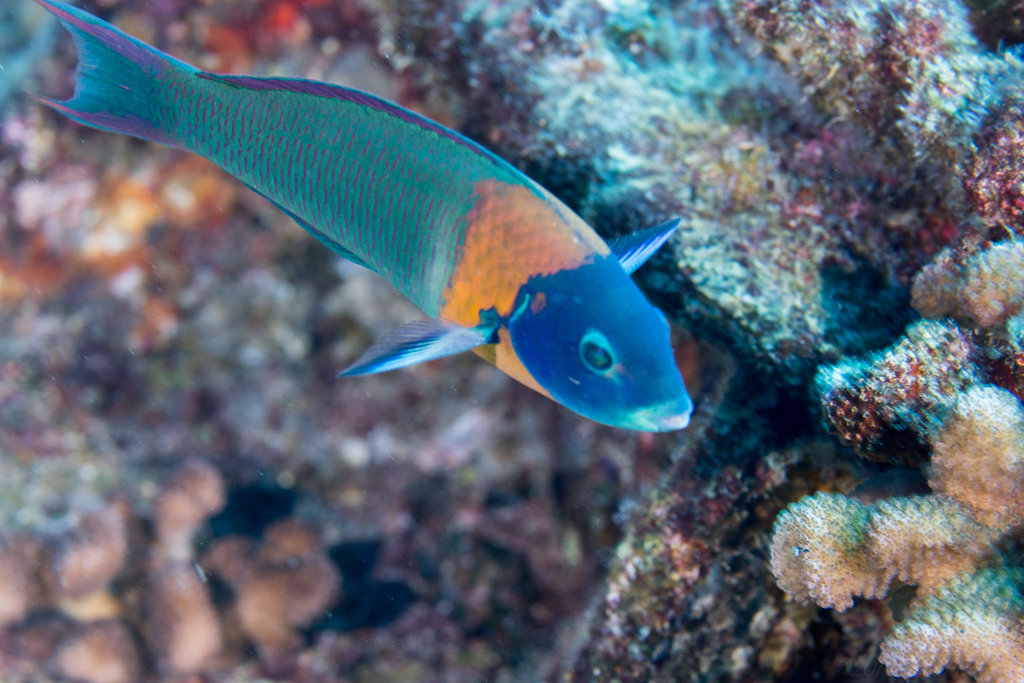
Saddle Wrasse
Thalassoma duperrey
The saddle wrasse (Thalassoma duperrey), also known as Hīnālea Lauwili in Hawaiʻi, is a species of wrasse native to the waters around the Hawaiian Islands and Johnston Island. They are found on reefs at depths from 5 to 25 m (16 to 82 ft). This species can reach 28 cm (11 in) in total length. This species can also be found in the aquarium trade.
From the article Saddle wrasse on Wikipedia (CC BY-SA), quoted section by section
Description
Adults of the saddle wrasse have a dark blue-green head followed by a dull orange band that will intensify during the spawning seasons, as for the rest of the body it is blue-green with numerous magenta arrows running down the sides. Terminal males typically have a white bar around the orange band that is able to be turned on or off, as well as a crescent-shaped tail fin. Juveniles tend to be more whitish with a dark stripe that runs from the top of the head to the tail. Smaller adults are able to revert to the juvenile coloration to avoid harassment from larger fish. Saddle wrasses can grow up to 11.5 inches (29.21 cm) in length.
Range & habitat
Saddle wrasses are endemic to Hawaii as well as Johnston Atoll, where they are very common. Saddle wrasses can be found in intertidal and shallow habitats down to about 70 ft (21.34 m) of depth. They are found in areas with a lot of corals, rocks, nooks, and crannies to have a quiet get-away and hiding place from potential threats. These fish sleep hidden in holes or burrows in sandy areas.
Wikipedia: “Distribution and habitat”
What it does
Saddle wrasses are carnivores and opportunistic feeders, consuming anything that will become available to them. As juveniles, they will tend to be considered "cleaners'': such as picking parasites from larger fish or animals, but as they mature they will start to scavenge for worms, shells, mollusks, shrimps, and other crustaceans. They have canine teeth and pharyngeal bones near their gills in order to help crush the shells.
Wikipedia: “Diet”
In human culture
Hīnālea were integral to society and fishing communities in Hawaii as a staple food and regular item in the Hawaiian diet. They were also regularly used in ceremonies and offerings to Hawaiian gods and goddesses. Specific fishing practices include melomelo, where club-like sticks were charred and anointed in oil to attract hīnālea when submerged underwater. Fishermen, or lawai'a, wove baskets, called hīnaʻi hoʻoluʻuluʻu, out of vines of the endemic 'āwikiwiki plant, which then were weighted and dropped into the ocean to trap hīnālea.
== References ==
Wikipedia: “Human use and cultural significance”
Where it lives
Recorded sightings
—
geo-referenced records in GBIF, from museums, herbaria and field observers.
Drag the globe to turn it. Dots are where records exist, not a range map; darker means more records.
In the stacks
Searching the stacks…
Every page naming Thalassoma duperrey in the Biodiversity Heritage Library →
This page is assembled live from iNaturalist, GBIF, Wikipedia, the Source Library and the Internet Archive. It is not yet part of the hand-edited codex. iNaturalist taxon 113973.