- Animals
- ›Chordates
- ›Vertebrates
- ›Ray-finned Fishes
- ›Spiny-rayed fishes
- ›Wrasses and allies
- ›False scorpionfishes, wrasses, and parrotfishes
- ›Wrasses and Parrotfishes
- ›Razorfishes and Allies
- ›Cymolutes
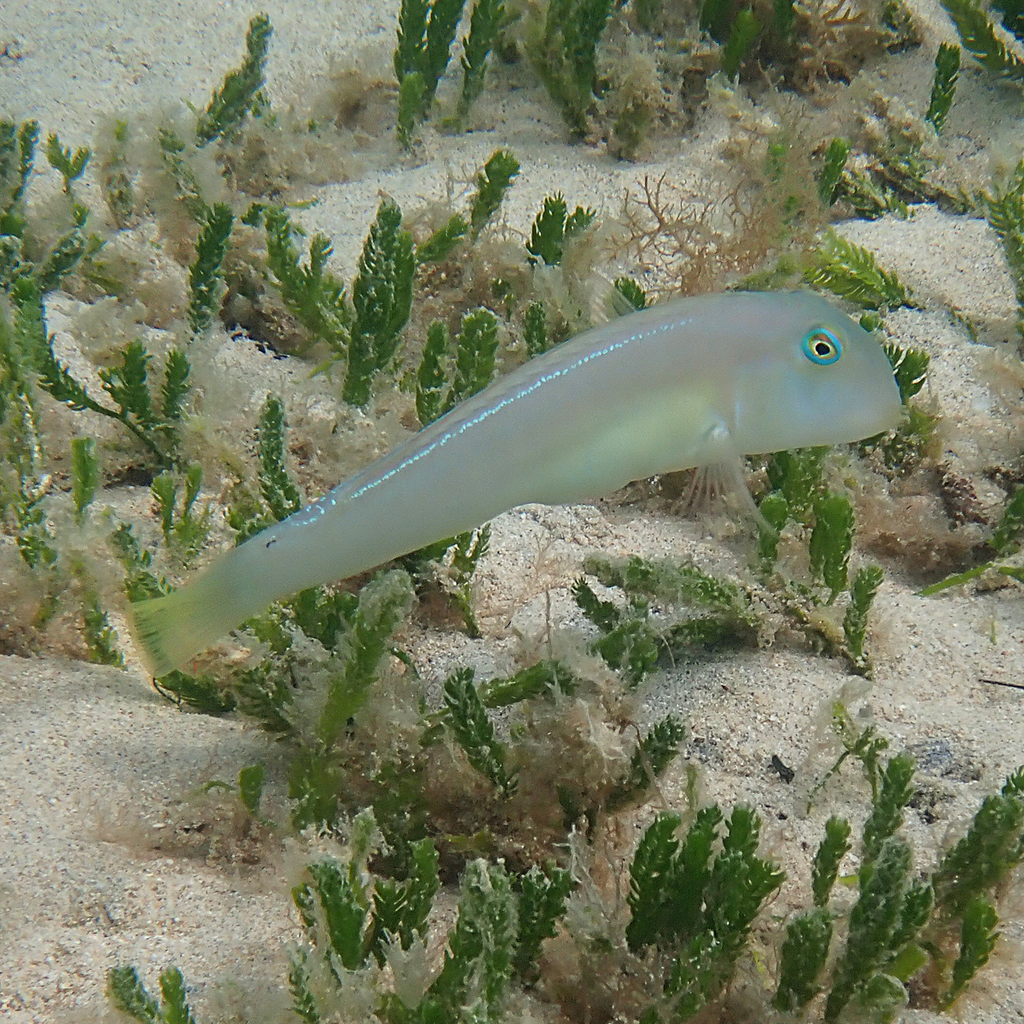
Knife Wrasse
Cymolutes praetextatus
Cymolutes praetextatus, the knife razorfish or knife wrasse, is a species of ray-finned fish from the family Labridae, the wrasses. It occurs in the Indo-Pacific where it occurs over reef flats and in shallow lagoons.
From the article Cymolutes praetextatus on Wikipedia (CC BY-SA), quoted section by section
Description
Cymolutes praetextatus is a pale coloured wrasse which has steep profile to its head. The flanks are marked with indistinct whitish bars and there is a white stripe along its back which sits above a wide, yellowish or darker coloured stripe, although this may not be present. This species has 9-10 spines in its dorsal fin which also has 12-13 soft rays while the anal fin has 2-3 spines and 11-12 soft rays. The largest males grow to a standard length of 20 centimetres (7.9 in).
Range & habitat
Cymolutes praetextatus is an Indo-Pacific species which is found from the eastern coast of Africa through the Indian Ocean and into the Pacific Ocean as far as the Society Islands, the Line Islands and Hawaii. In Australian waters it occurs at Ningaloo Reef, Rowley Shoals and Scott Reef in Western Australia, Ashmore Reef in the Timor Sea, and the Great Barrier Reef in Queensland, it also occurs around Norfolk Island in the Tasman Sea and the Cocos (Keeling) Islands.
Wikipedia: “Distribution”
At the table
This species is rarely caught by fisheries and does not appear often in the aquarium trade.
Wikipedia: “Human uses”
Where it lives
Recorded sightings
—
geo-referenced records in GBIF, from museums, herbaria and field observers.
Drag the globe to turn it. Dots are where records exist, not a range map; darker means more records.
In the stacks
Searching the stacks…
Every page naming Cymolutes praetextatus in the Biodiversity Heritage Library →
This page is assembled live from iNaturalist, GBIF, Wikipedia, the Source Library and the Internet Archive. It is not yet part of the hand-edited codex. iNaturalist taxon 98857.