- Animals
- ›Chordates
- ›Vertebrates
- ›Ray-finned Fishes
- ›Spiny-rayed fishes
- ›Wrasses and allies
- ›False scorpionfishes, wrasses, and parrotfishes
- ›Wrasses and Parrotfishes
- ›Rainbow Wrasses and Allies
- ›Halichoeres
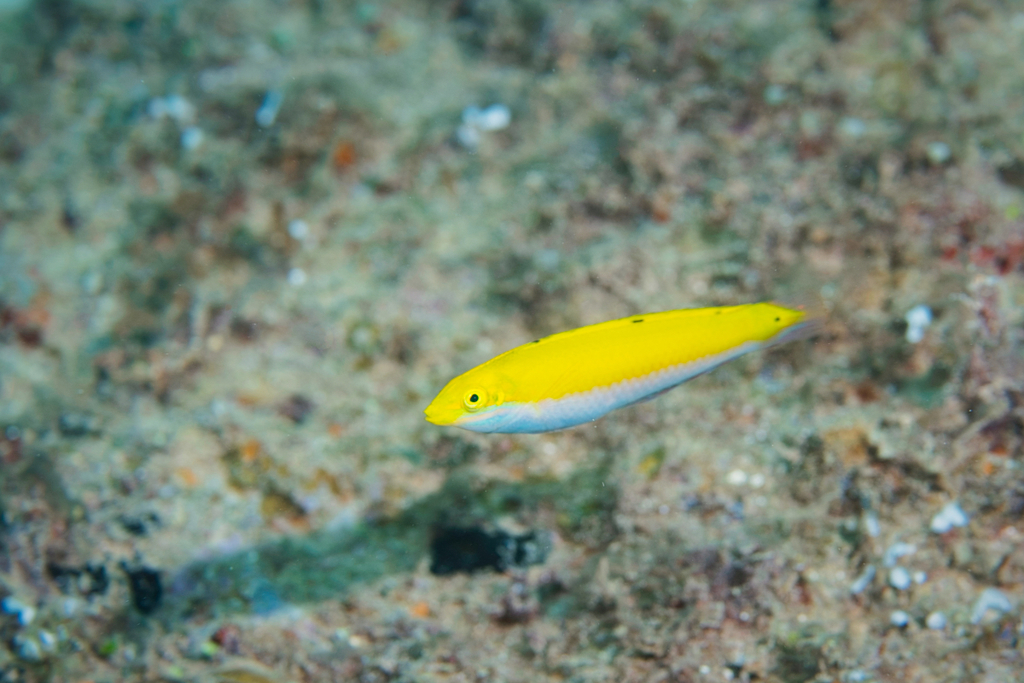
Canarytop Wrasse
Halichoeres leucoxanthus
Halichoeres leucoxanthus, commonly called the canarytop wrasse, whitebelly wrasse, or lemon meringue wrasse, is a fish species in the wrasse family endemic to the Indian Ocean.
From the article Halichoeres leucoxanthus on Wikipedia (CC BY-SA), quoted section by section
Description
The canarytop wrasse is a small fish that can reach a maximum length of 12 cm (4.7 in). It has a thin, elongate body with a terminal mouth. Body coloration is bright yellow and white with a few variations according to age. During the juvenile phase, the young wrasse is completely bright yellow with two black ocellus on the dorsal fin and one on the caudal peduncle. When reaching the initial phase, the body has two colors: white on belly and bright yellow on the back with the same ocellus, plus one more on the first spines of the dorsal fin. At the terminal phase, only a few changes occur, such as the head becoming a mix of yellowish and greenish with pinkish lines and with age the ocellus tending to blur.
Range & habitat
The canaritop wrasse is widespread throughout the tropical and subtropical waters of the Indian Ocean, from the Laccadive, Maledives, and Chagos archipelagos to the island of Java in Indonesia, including the Andaman Sea. This wrasse occurs in rubble and sandy areas close to coral reefs, from depths of 10 to 50 meters (33 to 164 ft).
Wikipedia: “Distribution and habitat”
Where it lives
Recorded sightings
—
geo-referenced records in GBIF, from museums, herbaria and field observers.
Drag the globe to turn it. Dots are where records exist, not a range map; darker means more records.
In the stacks
Searching the stacks…
Every page naming Halichoeres leucoxanthus in the Biodiversity Heritage Library →
This page is assembled live from iNaturalist, GBIF, Wikipedia, the Source Library and the Internet Archive. It is not yet part of the hand-edited codex. iNaturalist taxon 102051.