- Animals
- ›Chordates
- ›Vertebrates
- ›Ray-finned Fishes
- ›Spiny-rayed fishes
- ›Wrasses and allies
- ›False scorpionfishes, wrasses, and parrotfishes
- ›Wrasses and Parrotfishes
- ›Rainbow Wrasses and Allies
- ›Hemigymnus
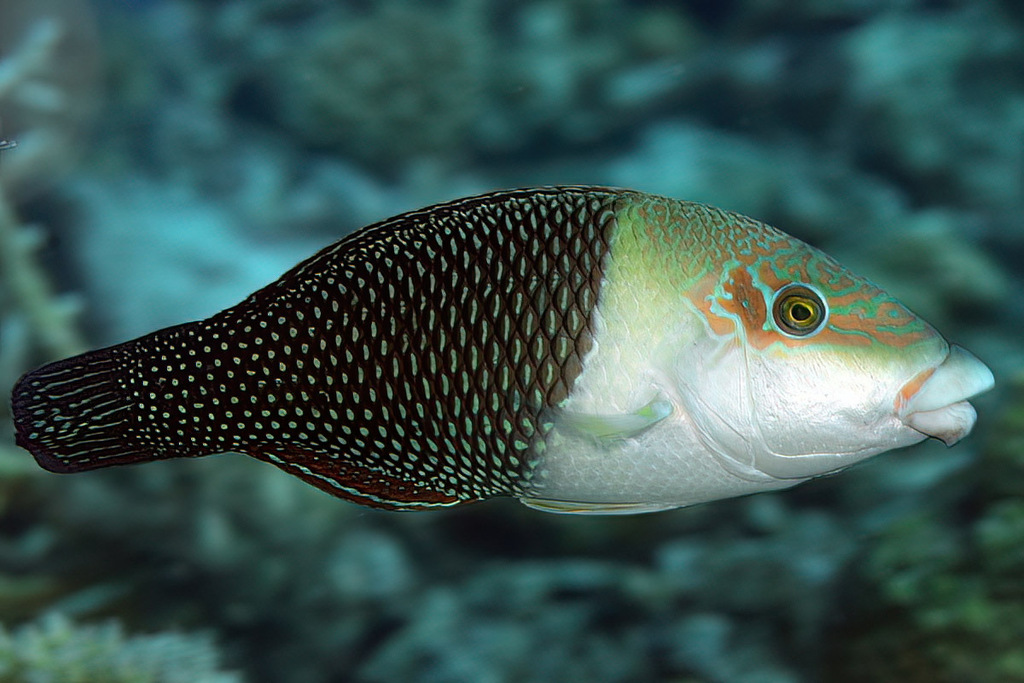
Blackeye Thicklip
Hemigymnus melapterus
The Blackeye thicklip wrasse or Half-and-half wrasse (Hemigymnus melapterus) is a species of fish belonging to the wrasse family. It is native to the Indo-Pacific.
From the article Hemigymnus melapterus on Wikipedia (CC BY-SA), quoted section by section
Description
The half-and-half wrasse is a medium-sized fish that can reach a maximum length of 50 cm. Its body is high, relatively flattened, its head is large and its terminal mouth has thick lips. Its body coloration varies according to age. Juvenile wrasse have a greenish yellow background color with yellow vertical lines, a broad white diagonal band just behind the operculum, an orange caudal fin and a greenish gray front. Mature females are green behind the oblique line, with black-rimmed scales. A complex tangle of pink lines underlined with turquoise crosses from the top of the snout to the head. Mature males (terminal phase - see below) also have an emerald green stripe behind each scale and a blue rim around the eye; the top of the snout and head are green with pink patterns highlighted in turquoise.
Range & habitat
The species is widespread throughout the tropical and subtropical waters of the Indo-Pacific, from the eastern coast of Africa including the Red Sea to Polynesia, and from New Caledonia to southern Japan. It prefers areas of coral, coral rubble and sand, outer reef slopes and drop-offs, to depths of at least 40 m. Juveniles are more secretive and always keep hidden in branching corals.
Wikipedia: “Distribution & habitat”
Where it lives
Recorded sightings
—
geo-referenced records in GBIF, from museums, herbaria and field observers.
Drag the globe to turn it. Dots are where records exist, not a range map; darker means more records.
In the stacks
Searching the stacks…
Every page naming Hemigymnus melapterus in the Biodiversity Heritage Library →
This page is assembled live from iNaturalist, GBIF, Wikipedia, the Source Library and the Internet Archive. It is not yet part of the hand-edited codex. iNaturalist taxon 102580.