- Animals
- ›Chordates
- ›Vertebrates
- ›Ray-finned Fishes
- ›Spiny-rayed fishes
- ›Wrasses and allies
- ›False scorpionfishes, wrasses, and parrotfishes
- ›Wrasses and Parrotfishes
- ›Rainbow Wrasses and Allies
- ›Gomphosus
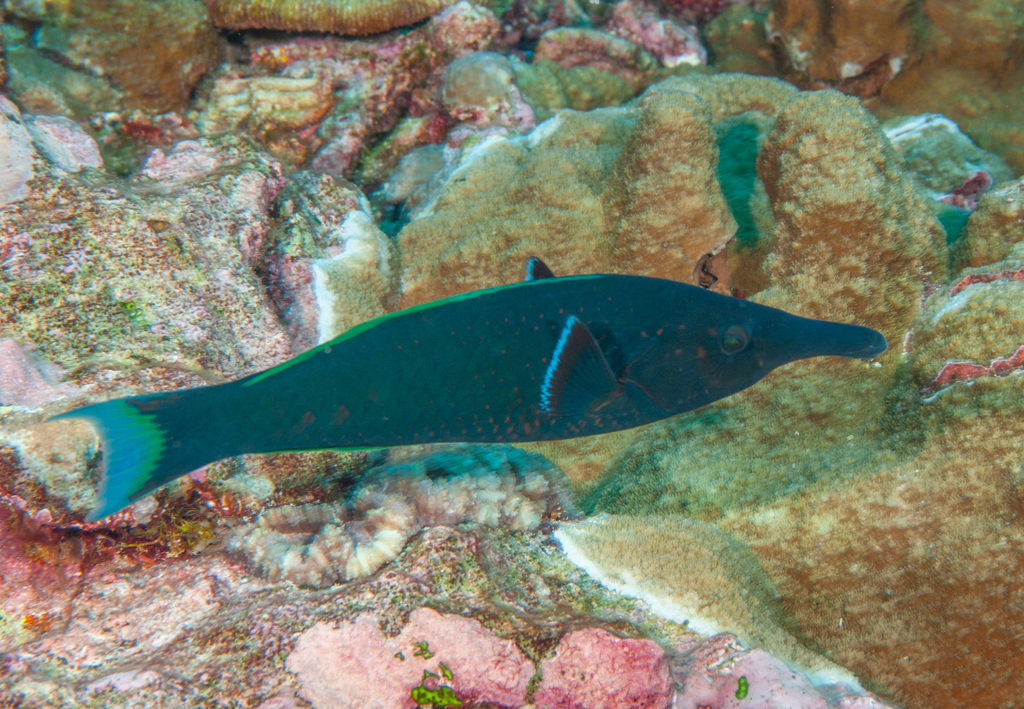
Green Bird Wrasse
Gomphosus caeruleus
Gomphosus caeruleus, the green birdmouth wrasse, is a species of wrasse belonging to the family Labridae. It can be found in the aquarium trade.
From the article Gomphosus caeruleus on Wikipedia (CC BY-SA), quoted section by section
Description
Gomphosus caeruleus can reach a length of about 32 centimetres (13 in), with a distinctive 'beak-like' snout. It is sexually dimorphic; the males are dark blue overall, with a light blue edge running along their pectoral fins and lime green dorsal and anal fins. Females, on the other hand, have a dark strip through the eye and yellow anal and caudal fins. Juveniles are pale, with a dusky streak from their snout through the eye and onto the body. This species can be told apart from the similar birdnose wrasse Gomphosus varius by their different distributions and by the fact that in the later species, males have a bright green stripe along the flanks, females do not have a yellow tail and juveniles have a green back. There are 8 spines and 13 soft rays in the dorsal fin while the anal fin has 3 spines and 11 soft rays.
Range & habitat
This tropical species of wrasse is native to the Indian Ocean, from East Africa south to Natal, South Africa, and east to the Andaman Sea. It occurs on rocky reefs and coral, especially in coral-rich areas of lagoon and seaward reefs, between depths of 1–35 metres (3.3–114.8 ft).
Wikipedia: “Distribution and habitat”
Where it lives
Recorded sightings
—
geo-referenced records in GBIF, from museums, herbaria and field observers.
Drag the globe to turn it. Dots are where records exist, not a range map; darker means more records.
In the stacks
Searching the stacks…
Every page naming Gomphosus caeruleus in the Biodiversity Heritage Library →
This page is assembled live from iNaturalist, GBIF, Wikipedia, the Source Library and the Internet Archive. It is not yet part of the hand-edited codex. iNaturalist taxon 52509.